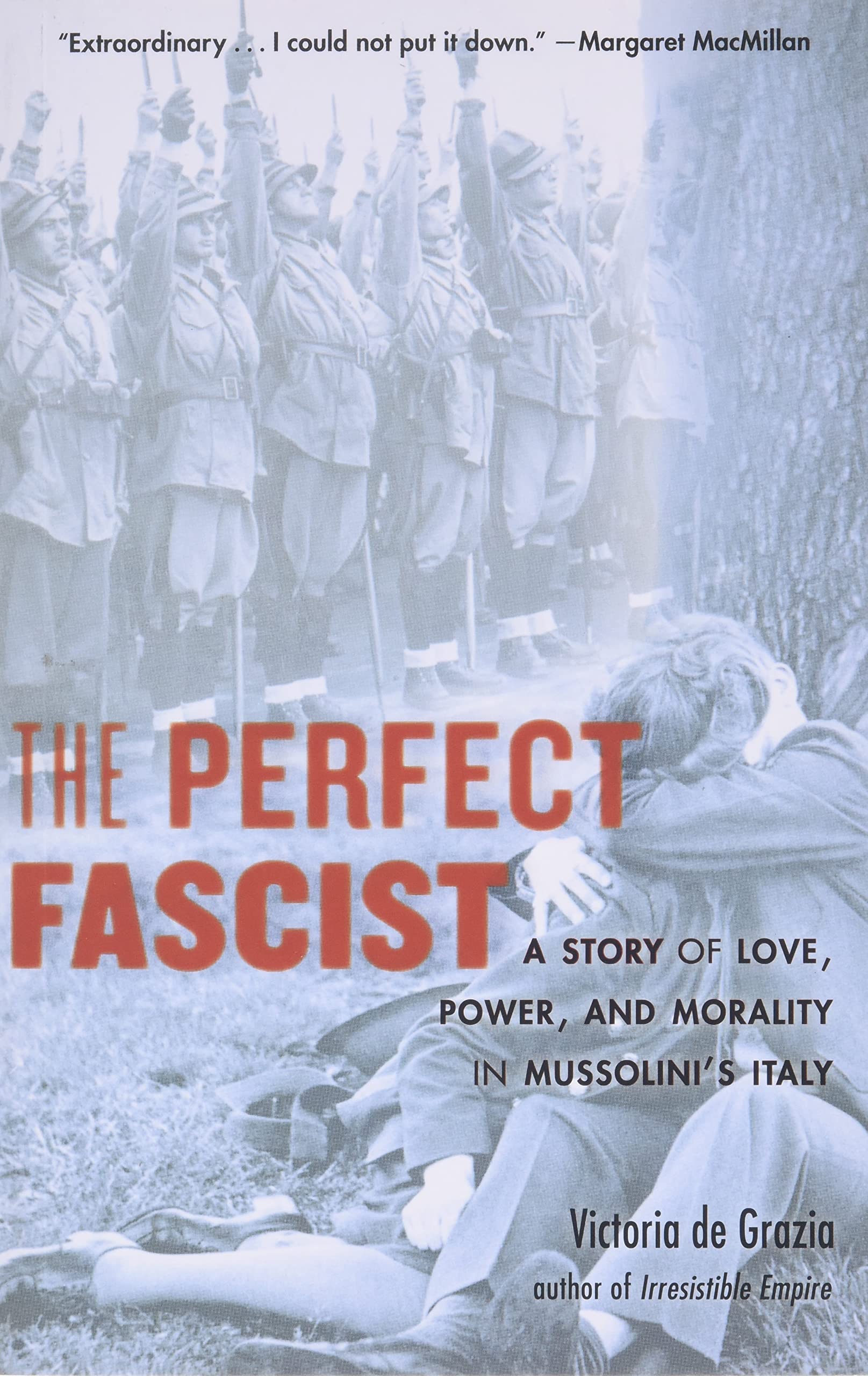
The Perfect Fascist: A Story of Love, Power, and Morality in Mussolini’s Italy
$20.37
by Victoria De Grazia



A New Statesman Book of the Year Winner of the Helen and Howard R. Marraro Prize Winner of the Aldo and Jeanne Scaglione Prize for Italian Studies “Extraordinary…I could not put it down.” ―Margaret MacMillan “Reveals how ideology corrupts the truth, how untrammeled ambition destroys the soul, and how the vanity of white male supremacy distorts emotion, making even love a matter of state.” ―Sonia Purnell, author of A Woman of No Importance When Attilio Teruzzi, a decorated military officer and early convert to the Fascist cause, married a rising American opera star, his good fortune seemed settled. The wedding was blessed by Mussolini himself. Yet only three years later, Teruzzi, now commander of the Black Shirts, renounced his wife. Lilliana was Jewish, and fascist Italy would soon introduce its first race laws. The Perfect Fascist pivots from the intimate story of a tempestuous courtship and inconvenient marriage to the operatic spectacle of Mussolini’s rise and fall. It invites us to see in the vain, unscrupulous, fanatically loyal Attilio Teruzzi an exemplar of fascism’s New Man. Victoria De Grazia’s landmark history shows how the personal was always political in the fascist quest for manhood and power. In his self-serving pieties and intimate betrayals, his violence and opportunism, Teruzzi is a forefather of the illiberal politicians of today. “The brilliance of de Grazia’s book lies in the way that she has made a page-turner of Teruzzi’s chaotic life, while providing a scholarly and engrossing portrait of the two decades of Fascist rule.” ―Caroline Moorhead, Wall Street Journal “Original and important…A probing analysis of the fascist ‘strong man.’ De Grazia’s attention to Teruzzi’s private life, his behavior as suitor and husband, deepens and enriches our understanding of the nature of leadership in Mussolini’s regime and of masculinity, virility, and honor in Italian fascist culture.” ―Robert O. Paxton, author of The Anatomy of Fascism “This is a perfect book!…Its two entwined narratives―one political and public, the other personal and private―help us understand why the personal is political for those who insist on reshaping people and society.” ―Azar Nafisi, author of Reading Lolita in Tehran “[A] fascinating book on the Fascist years, and particularly its social mores…Teruzzi was indeed the perfect Fascist: disciplined, unscrupulous, brutish, fanatically loyal to Mussolini… The brilliance of de Grazia’s book lies in the way that she has made a page-turner of Teruzzi’s chaotic life, while providing a scholarly and engrossing portrait of the two decades of Fascist rule.” ― Caroline Moorhead , Wall Street Journal “[A] captivating investigation into the trials and tribulations of Attilio Teruzzi―one of Benito Mussolini’s most trusted high-ranking officials…A work of serious historical research by one of the great historians of Italian history…Not unlike the popular thrillers on Netflix in its suspense and surprises, but this story is told with a scholar’s eye in reading, analyzing, and interpreting archival documents, and a historian’s experience in placing it all within the context of Mussolini’s Italy.” ― Aliza Wong , Los Angeles Review of Books “On the question of contemporary fascism, and the debate between those who see in Trump & Co its resurgence and those who do not, few writers have matched Victoria de Grazia for coolness of observation and depth of insight…A singular work that chronicles the life of Attilio Teruzzi, an army officer who became commander of the Blackshirts under Il Duce. Through the story of Teruzzi’s marriage to Lilliana Weinman, an American-Jewish opera singer, de Grazia has produced a masterwork on the nature of fascist politics and culture.” ― Gavin Jacobson , New Statesman “The book’s appeal goes well beyond its diligent scrutiny of life under Fascism…There is the perverse pleasure of checking off its foreshadowing of our own recent moment: the sleaze, the incompetence, the militias, the cynical embrace of religion, the gilded son-in-law…And there is the elemental satisfaction of the story itself, which progresses like a classic war novel, private passions unfolding against a backdrop of steadily escalating public strife, in settings ranging from New York to Addis Ababa, boudoirs to battlefields, silk-lined music rooms to colonial churches palisaded by shards of exploded poison gas canisters.” ― James Lasdun , London Review of Books “Explore[s] toxic masculinity and the contradictory relationship between the public roles and private lives of Fascist elites.” ― Gigliola Sulis , Times Literary Supplement “[A] pioneering work… It examines the hypocrisies of totalitarian leaders and the contradictions inherent in the regimes they build…One of the lessons of De Grazia’s epic microhistory is that to truly understand dictatorships, we need to understand the aspirations, behaviors, and vanities of those just beneath the leaders in the hierarchy a