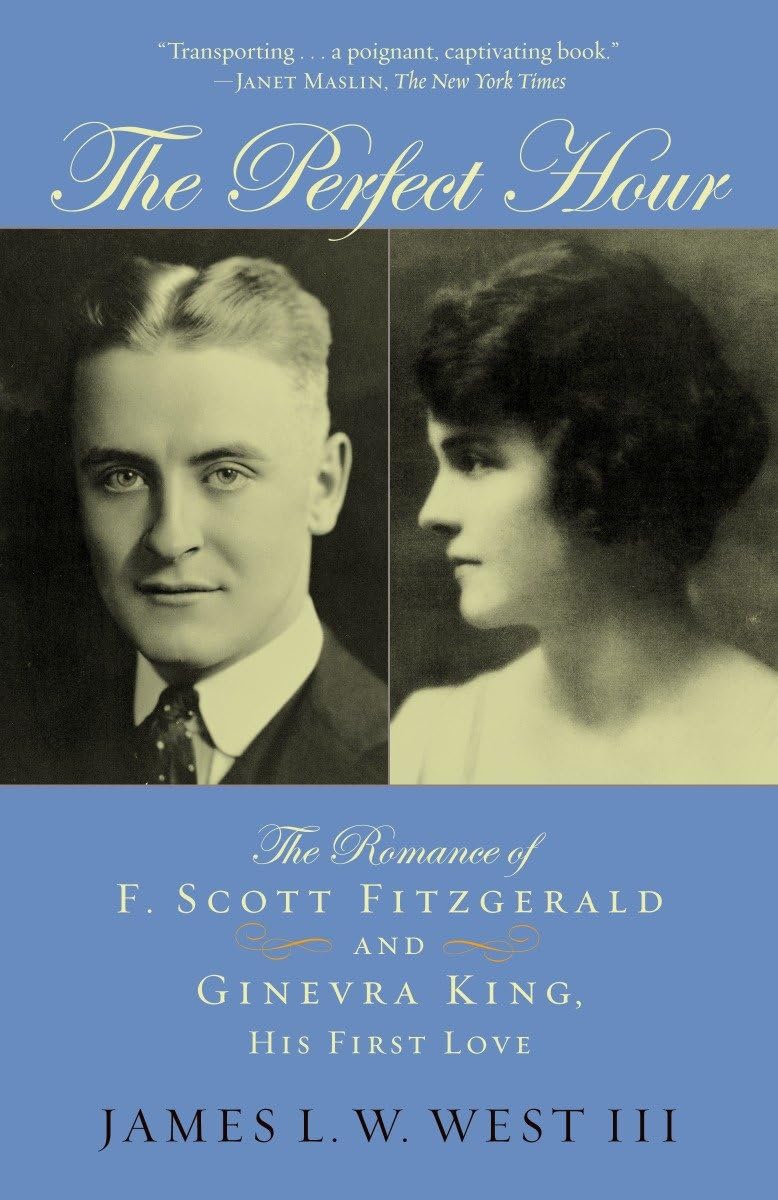
The Perfect Hour: The Romance of F. Scott Fitzgerald and Ginevra King, His First Love
$14.95
by James L. W. West III



In The Perfect Hour, biographer James L. W. West III reveals the never-before told story of the romance between F. Scott Fitzgerald and his first love, Ginevra King. They met in January 1915, when Scott was nineteen, a Princeton student, and sixteen-year-old Ginevra, socially poised and confident, was a sophomore at Westover School. Their romance flourished in heartfelt letters and quickly ran its course–but Scott never forgot it. Ginevra became the inspiration for Isabelle Borgé in This Side of Paradise and the model for Daisy Buchanan in The Great Gatsby. Scott also wrote short stories inspired by her–including “Babes in the Woods” and “Winter Dreams,” which, along with Ginevra’s own story featuring Scott are reprinted in this volume. With access to Ginevra’s personal diary, love letters, photographs, and Scott’s own scrapbook, West tells the beguiling story of youthful passion that shaped Scott Fitzgerald’s life as a writer. For Scott and Ginevra, “the perfect hour” was private code for a fleeting time they almost shared and then yearned after for the rest of their lives. Now West brings that perfect hour back to life in all its freshness, delicacy, and poignant brevity. “Transporting . . . a poignant, captivating book.” –Janet Maslin, The New York Times “A fascinating portrait not only of a first love, but of how a writer used the unspoiled memories of youthful idealism and bittersweet emotion to fuel his career.” –Entertainment Weekly “What is remarkable, as West conveys superbly, are the varied literary forms in which King would surface in Fitzgerald’s fiction.” –Chicago Tribune “[A] charming account . . . a must-read for Fitzgerald aficionados and literature lovers.” –Booklist F. Scott Fitzgerald was a handsome, ambitious sophomore at Princeton when he fell in love for the first time. Ginevra King, though only sixteen, was beautiful, socially poised, and blessed with the confidence that considerable wealth can bring. Their romance began instantly, flourished in heartfelt letters, and quickly ran its course-but Scott never forgot it. Now, for the first time, scholar and biographer James L. W. West III tells the story of the youthful passion that shaped Scott Fitzgerald's life as a writer. When Scott and Ginevra met in January 1915, the rest of the world was at war, but America remained a haven for young people who could afford to have a good time. Privileged and mildly rebellious, the two were swept together in a whirl of dances, parties, campus weekends, and chaperoned visits to New York. "For heaven's sake "don't idealize me!" Ginevra warned in one of the many letters she sent to Scott, but of course that's just what he did-for the next two decades. Though he fell in love with Zelda Sayre soon after learning of Ginevra's engagement to a well-to-do midwesterner, Scott drew on memories of Ginevra for his most unforgettable female characters-Isabelle Borge and Rosalind Connage in "This Side of Paradise, Judy Jones in "Winter Dreams," and above all Daisy Buchanan in "The Great Gatsby. Transformed by Scott's art, Ginevra became a new American heroine who inspired an entire generation. "From the Hardcover edition. JAMES L.W. WEST III is Sparks Professor of English at Pennsylvania State University. He has held fellowships from the Guggenheim Foundation, the National Humanities Center, and the National Endowment for the Humanities, and has been a Fulbright scholar to England and Belgium. He is the author of William Styron: A Life and is general editor of the Cambridge Edition of the Works of F. Scott Fitzgerald. Chapter 1 Ginevra and Scott Ginevra King was the eldest of the three daughters of Charles Garfield King, a wealthy Chicago stockbroker, and Ginevra Fuller King, his wife. There was money on both sides of the family, earned by Ginevra’s grandfathers, both of whom were self-made men. Her paternal grandfather, Charles Bohan King, had come to Chicago from upstate New York in 1863. At first he worked as a wholesale grocer, then as a jobber in hats, caps, and furs. He eventually moved into banking and prospered, retiring in 1885 as president of the Commercial Safe Deposit Co. He was a Republican and a Presbyterian; he sent his older son, Rockwell King, to Harvard and his younger son (Ginevra’s father) to Yale. Ginevra’s maternal grandfather, William Alden Fuller, was a native of Massachusetts. He began his working life in 1852 as a station agent for the Worcester & Nashua Railroad; in 1854 he came to Chicago and entered the lumber trade as a bookkeeper. Twelve years later, with backing from Potter Palmer, the dry goods magnate, he struck out as a dealer in building materials. He formed the corporation of Palmer, Fuller & Co.; the business was a success, and he became wealthy during the commercial boom that followed the Civil War. He belonged to the Episcopal Church and the Union League. Ginevra, as a teenager, knew him as a widower who lived in a large house at 2913 Michigan Avenue. Ginevra’