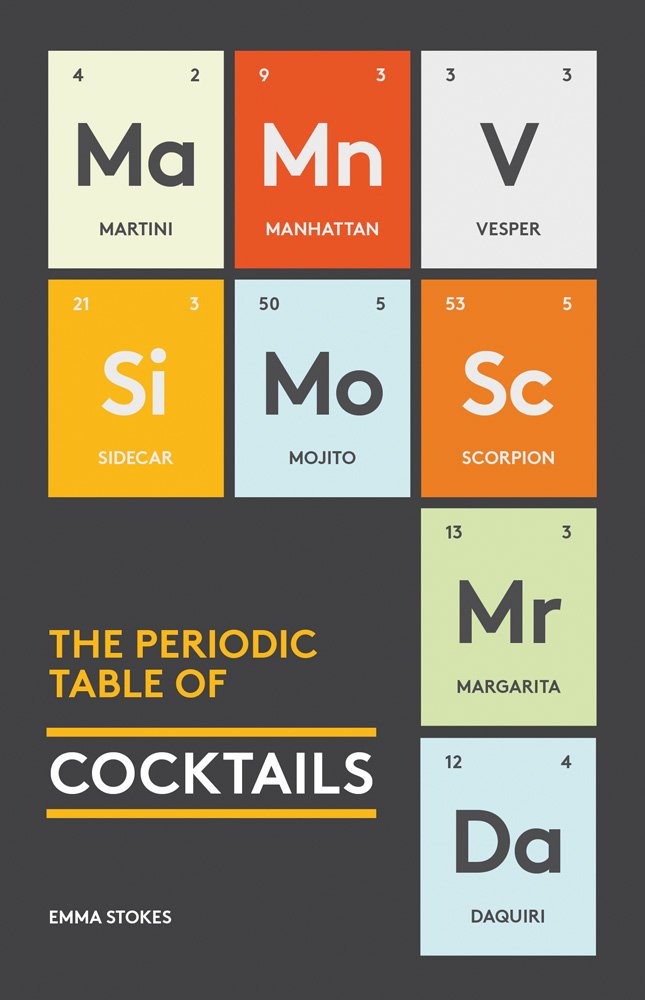



From the creator of Gin Monkey, an impartial and independent online guide to good cocktails, Emma Stokes’s The Periodic Table of Cocktails is a fun, concise, and appealingly geeky new concept to cocktail appreciation. The foundation of this book is a periodic table organized by cocktail styles (Martinis and Up, Fruity/Tropical, Highballs/Muddles, Collinses/Fizzes, etc.) and by predominant base alcohols across the chart’s rows (vodka, gin, tequila, etc.). If you like one cocktail in the table, you should enjoy all the cocktails that surround it. The Periodic Table of Cocktails also offers the background history and make-it-yourself recipe for each of the more than 100 “elements” or cocktails. Also available: The Periodic Table of Wine Emma Stokes created Gin Monkey, an impartial and independent online guide to good cocktails. She cofounded the London Cocktail Society and runs World Gin Day. She also presents the Gin Lab sessions at the City of London Distillery and has a day job working for the Wellcome Trust, a charity organization. The Periodic Table of Cocktails By Emma Stokes, David Cashion Abrams Books Copyright © 2015 Ebury Press All rights reserved. ISBN: 978-1-4197-2407-7 Contents The Periodic Table of Cocktails, viii, Introduction, 1, Martinis and Up, 5, Daisies, Sours, and Citrus Fresh, 21, Fruity and tropical, 53, Highballs, Swizzles, and Muddled!, 63, Collinses, Spritzes, and Fizzes, 79, Snappers, 93, Coconut, Cream, and Egg, 103, Absinthe, 115, Beer, 125, Overproof, 135, Bartender's Kit, 141, Glossary, 142, Further Reading, 144, Acknowledgments, 145, Index, 146, CHAPTER 1 Martinis and Up The cocktails in the first column of the table that are contained within this chapter can all be classified as martinis or cocktails that are served straight up (i.e., with no ice). They're pretty serious in terms of their booze-heavy makeup, so you won't find any mixers or citrus here (with the exception of the Harvard, which has a dash of soda in it). As they're mostly classic cocktails from bygone eras, drinking these drinks is akin to leafing through the pages of cocktail history, imbibing its past as you go and following a similar formula: a spirit, sweetener (vermouth, liqueur, or syrup), and a bitter or herbal element, often in the form of cocktail bitters. The cocktails in this chapter are therefore almost exclusively stirred, the exception being the classic Martini, which can be made "Bond style" and shaken if you like, although traditionally would only have been made stirred. The key to all of them is to use a good-quality base spirit, as this often makes up the majority of the drink. You also need to make sure that they're well chilled and properly diluted to make the alcohol "sing" — and make them palatably sippable. They say a classic Martini should be consumed in three or four sips. I can see why: You don't want the drink to sit for too long and warm up to room temperature. However, as I mentioned, these are seriously boozy drinks, which most people (myself included) are likely to take more time over. There's a trick I've picked up from bars along the way, which is handy for drinks like this. Place a small vessel — a mini wine carafe looks the part, but may be difficult to get hold of, so a small bottle will also do — in a glass of crushed ice to keep it cool. Pour half of your cocktail into it and the other half into the glass you're serving the drink in. This has the benefit of keeping half of the drink properly chilled without further diluting it, leaving you all the time in the world to savor your Martini, topping your glass up with the other half when you're done. Clever, eh? Column 1 Hp HANKY PANKY The Hanky Panky was created by Ada Coleman at The Savoy Hotel in London. Ada, or "Coley" as she was affectionately known, was the first female head bartender of the American Bar in The Savoy in the early 1900s, at a time when women weren't allowed to drink in the bar. A bit of a rock star of her time, both for the cocktails she created and for leading the way as a woman in a male-dominated industry, it is the Hanky Panky for which she is best known. Consisting of gin, sweet vermouth, and the Italian amaro Fernet Branca (a bitter aromatic spirit), the Hanky Panky is stirred down over ice, then strained and served straight up. Created especially for Savoy patron Sir Charles Hawtrey, an English actor, director, producer, and manager, Coley recalled the story behind the cocktail to the newspaper the People in 1925: The late Charles Hawtrey ... was one of the best judges of cocktails that I knew. Some years ago, when he was overworking, he used to come into the bar and say, "Coley, I am tired. Give me something with a bit of punch in it." It was for him that I spent hours experimenting until I had invented a new cocktail. The next time he came in, told him I had a new drink for him. He sipped it, and, draining the glass, he said