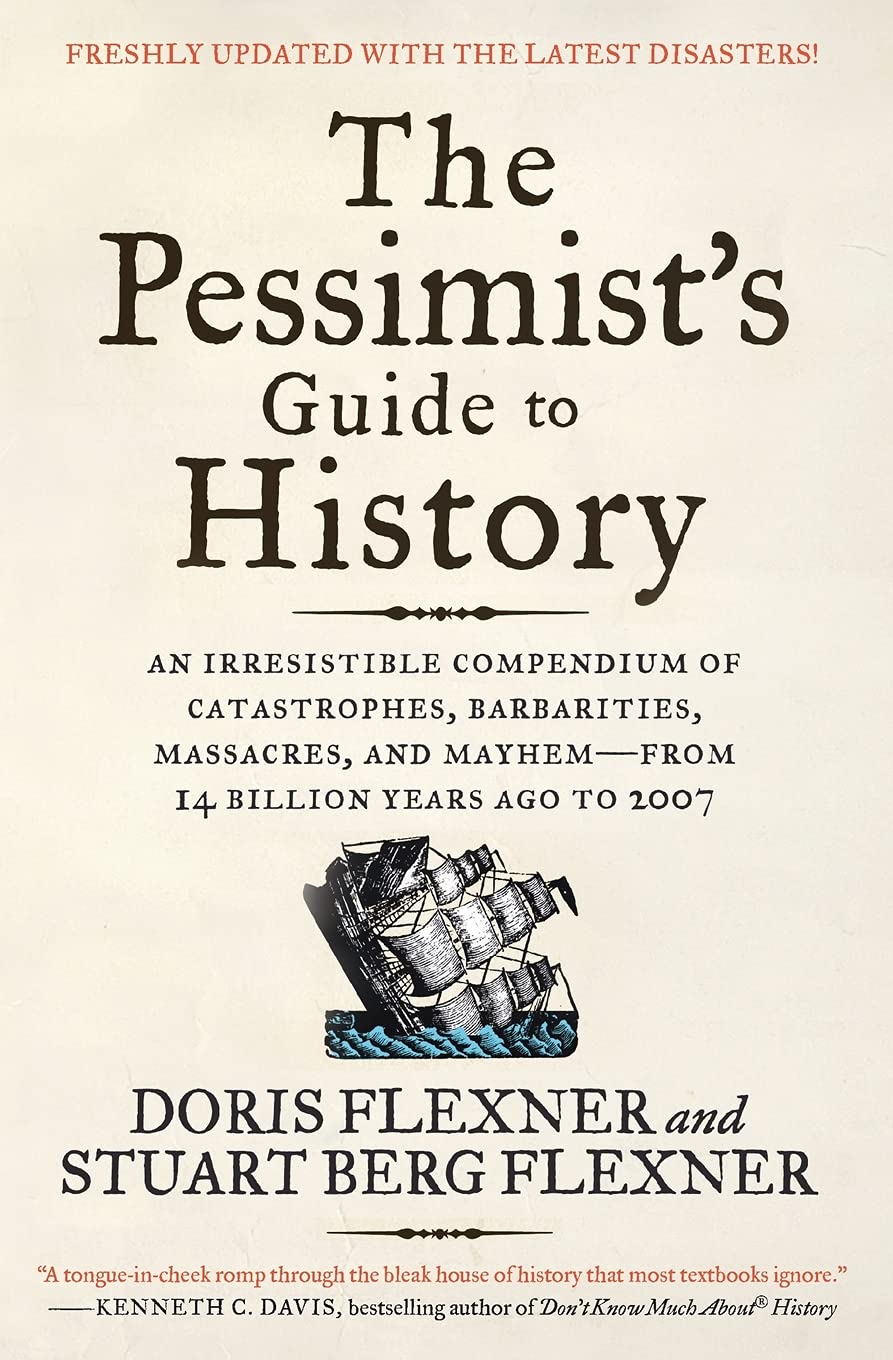
The Pessimist's Guide to History 3e: An Irresistible Compendium of Catastrophes, Barbarities, Massacres, and Mayhem―from 14 Billion Years Ago to 2007
$11.42
by Doris Flexner



The classic irreverent look at the past—now updated with even more appalling facts! Fourteen billion or so years ago, the Big Bang exploded—and it's been downhill from there. For every spectacular discovery throughout history, there have been hundreds of devastating epidemics; for every benevolent despot, a thousand like Vlad the Impaler; for every cup half-full, a larger cup half-empty. This enthralling, enlightening, and devilishly entertaining chronicle of disasters and dastardly deeds brings to light the darkest events in history and the most abysmal calamities to strike the planet . . . so far. 88 BC: Mithridates VI Eupator provides an early example of genocide by massacring 100,000 Romans. 1347: Saint Vitus' Dance Epidemic shimmies across Europe like a deadly disco fever, leaving its victims twitching, uncontrollably leaping, and foaming at the mouth. 1888: Jack the Ripper stalks through the dark alleys of Whitechapel, England, turning the world's oldest profession into the world's most dangerous one. 1939: A Swiss chemist wins a Nobel Prize for developing DDT—and the environment gets another nail in the coffin. 2005: Hurricane Katrina devastates the Gulf Coast. In a classic double whammy, the government response also devastates the Gulf Coast. And much, much more! “A tongue-in-cheek romp through the bleak house of history that most textbooks ignore.” - Kenneth C. Davis, bestselling author of Don't Know Much About ® History The classic irreverent look at the past—now updated with even more appalling facts! Fourteen billion or so years ago, the Big Bang exploded—and it's been downhill from there. For every spectacular discovery throughout history, there have been hundreds of devastating epidemics; for every benevolent despot, a thousand like Vlad the Impaler; for every cup half-full, a larger cup half-empty. This enthralling, enlightening, and devilishly entertaining chronicle of disasters and dastardly deeds brings to light the darkest events in history and the most abysmal calamities to strike the planet . . . so far. 88 BC: Mithridates VI Eupator provides an early example of genocide by massacring 100,000 Romans. 1347: Saint Vitus' Dance Epidemic shimmies across Europe like a deadly disco fever, leaving its victims twitching, uncontrollably leaping, and foaming at the mouth. 1888: Jack the Ripper stalks through the dark alleys of Whitechapel, England, turning the world's oldest profession into the world's most dangerous one. 1939: A Swiss chemist wins a Nobel Prize for developing DDT—and the environment gets another nail in the coffin. 2005: Hurricane Katrina devastates the Gulf Coast. In a classic double whammy, the government response also devastates the Gulf Coast. And much, much more! Stuart Flexner and Doris Flexner are popular reference historians. Doris Flexner, who did all the updates on this book, is also the author of The Optimist's Guide to History. She lives in Chapel Hill, NC. The Pessimist's Guide to History 3e An Irresistible Compendium of Catastrophes, Barbarities, Massacres, and Mayhem?from 14 Billion Years Ago to 2007 By Doris Flexner HarperCollins Publishers, Inc. Copyright © 2008 Doris Flexner All right reserved. ISBN: 9780061431012 Description of Events 18 Billion Years Ago: The Big Bang. The first and greatest natural catastrophe imaginable was the Big Bang, the cataclysmic event that scientists believe created virtually the entire universe we know today. The true pessimists among us might find it a less than desirable event, as the calamities that follow would never have occurred had it not been for the Big Bang. While no one knows what really took place, scientists today believe the universe before the Big Bang was a single, supercooled energy field no bigger than a speck that floated in a dark, limitless vacuum. Then, for some unknown reason, the energy field was disturbed by a random fluctuation. Suddenly the field started expanding rapidly; then gravity, fight, and subatomic particles formed from the original energy field. In a fraction of a second, the Big Bang blasted matter and energy outward at incredible speeds, and even today, billions of years later, the universe continues expanding outward. During the eons following the Big Bang, great clouds of gases and dust formed and gradually condensed into the galaxies, stars, planets, and everything else we see around us today. 65 Million Years Ago: Extinction of the Dinosaurs. For 160 million years dinosaurs roamed the earth, evolving into a multitude of species that could be found on land, in the sea, and in the air. They survived the massive upheavals of primeval continents breaking up and shifting about the face of the earth, all the while thriving in a climate that was much like a continuous temperate summer. Suddenly, sixty-five million years ago, they disappeared. The mystery of their abrupt extinction has left scientists baffled. There are numerous theories, of course, some of them postulatin