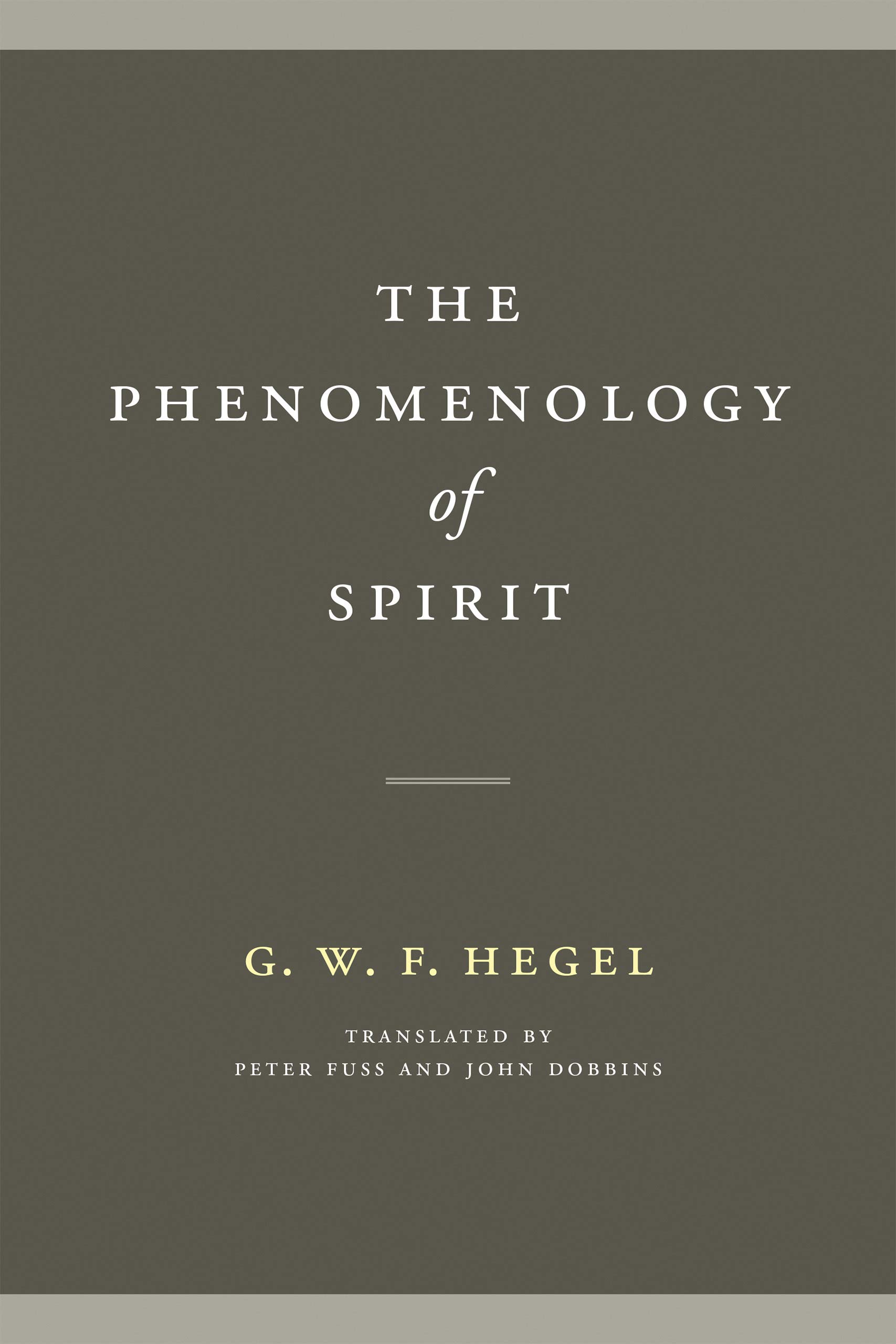



The Phenomenology of Spirit , first published in 1807, is G. W. F. Hegel’s remarkable philosophical text that examines the dynamics of human experience from its simplest beginnings in consciousness through its development into ever more complex and self-conscious forms. The work explores the inner discovery of reason and its progressive expansion into spirit, a world of intercommunicating and interacting minds reconceiving and re-creating themselves and their reality. The Phenomenology of Spirit is a notoriously challenging and arduous text that students and scholars have been studying ever since its publication. In this long-awaited translation, Peter Fuss and John Dobbins provide a succinct, highly informative, and readily comprehensible introduction to several key concepts in Hegel's thinking. This edition includes an extensive conceptual index, which offers easy reference to specific discussions in the text and elucidates the more subtle nuances of Hegel's concepts and word usage. This modern American English translation employs natural idioms that accurately convey what Hegel means. Throughout the book, the translators adhered to the maxim: if you want to understand Hegel, read him in the English. This book is intended for intellectuals with a vested interest in modern philosophy and history, as well as students of all levels, seeking to access or further engage with this seminal text. "An entrenched failing of Anglo-American philosophy is its neglect of Hegel. We have yet to reckon with how Hegel overcomes the dichotomies that confine modernity. Through decades of collaborative research, Peter Fuss and John Dobbins deliver with precision and grace a readable and teachable The Phenomenology of Spirit . Readers will awaken to a worldly Hegel who penetrates the drama and conceptual dynamism of human experience." ―Patrick Murray and Jeanne Schuler, Creighton University "The translators succeed masterfully in this effort and the result makes a considerable contribution to understanding this formidable text. . . . As I read their introduction, I had the impression that Hegel was suddenly―wonder of wonders―speaking English! Perhaps for the first time, he was saying clearly what he wanted to say to native speakers of American English like myself." ―Daniel O. Dahlstrom, John R. Silber Professor of Philosophy, Boston University G. W. F. Hegel (1770–1831) is one of the most significant thinkers in the history of philosophy. He is the author of several influential works, including The Science of Logic . Peter Fuss is professor emeritus of philosophy at University of Missouri–St. Louis. He is co-translator with John Dobbins of G. W. F. Hegel's Three Essays, 1793–1795 (University of Notre Dame Press, 1984). John Dobbins is a former research assistant at University of Missouri–St. Louis. It is natural to suppose that in philosophy, before getting on with one’s main concern, that of actually knowing what in truth is, one first has to understand the intellect, this being commonly regarded as an instrument with which to get hold of the absolute truth or as a medium through which one beholds it. There seems good reason for concern whether there might be various kinds of knowledge, one perhaps better suited to this end than another, so that by choosing the wrong one―or, assuming the intellect to be a faculty finite in kind and scope, by failing to determine with precision its nature and limits―one might embrace clouds of error instead of the clear skies of truth. Such concerns are bound to lead to the conviction that the whole idea of undertaking to secure for consciousness what things are in themselves by means of the intellect is absurd, and that between the intellect and absolute truth there lies a barrier that quite simply separates them. For, supposing that the intellect is an instrument for apprehending what absolutely is, it readily occurs to us that when we apply an instrument to an object we aren’t letting it be what it is in its own right but are undertaking to alter it or change its form. Supposing, on the other hand, that the intellect isn’t a tool we actively employ but a more or less passive medium through which the light of truth reaches us, then once again what we receive isn’t the truth as it is in itself but only as it is in and through this medium. Either way we’re employing a means that brings about the direct opposite of its purpose―which is to say that the absurdity lies instead in our making use of a means at all. –It might of course seem that we could find a way out of this predicament by figuring out exactly how this “instrument” works, since that would enable us to take the representation of absolute truth that we obtained by means of it, subtracting the portion of the end-product that’s due to it and thus leaving us with what’s clearly true. Yet a remedy such as this would in fact only bring us back to where we were before. For were we to subtract from anything whose form has bee