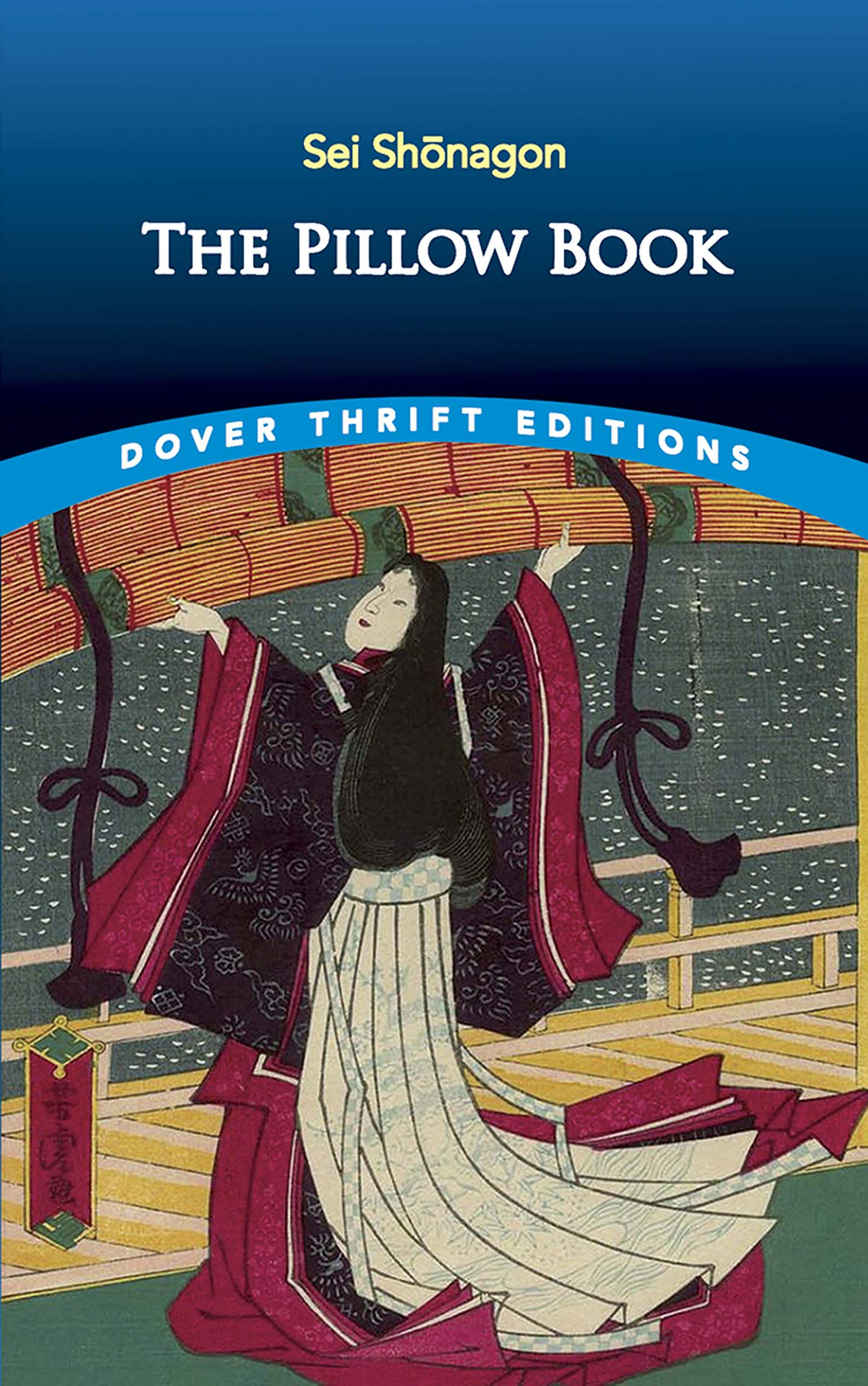



In the tenth century, Japan was both physically and culturally isolated from the rest of the world. The Pillow Book recaptures this lost world with the diary of a young court lady. Sei Shōnagon was a contemporary of Murasaki Shikibu, who wrote the well-known novel The Tale of Genji. Unlike the latter's fictionalized view of the Heian-era court, Shōnagon's journal provides a lively miscellany of anecdotes, observations, and gossip, intended to be read in juicy bits and pieces. This unique volume was first rendered into English in 1889. In 1928, Arthur Waley, a seminal figure in the Western studies of Japanese culture, undertook a translation. The distinguished scholar devised this abridged version of the text, re-creating in English the stylistic beauty of its prose and the vitality of its narrative. Waley's interpretation offers a fascinating glimpse of the artistic pursuits of the royal court and its constant round of rituals, festivals, and ceremonies. The Pillow Book By Sei Shonagon, Arthur Waley Dover Publications, Inc. Copyright © 2019 Dover Publications, Inc. All rights reserved. ISBN: 978-0-486-83443-6 CHAPTER 1 JAPAN IN THE TENTH CENTURY When the first volume of The Tale of Genji appeared in English, the prevailing comment of critics was that the book revealed a subtle and highly developed civilization, the very existence of which had hitherto remained unsuspected. It was guessed that so curious a state of society, with its rampant aestheticism and sophisticated unmorality, its dread of the explicit, the emphatic, must have behind it a protracted history of undisturbed development, or (as others put it) must be the climax of an age-long decadence. And it is indeed true that the unique civilization portrayed in The Tale of Genji and The Pillow Book of Sei Shonagon corresponds to a unique record of isolation and tranquility. The position of Japan, lying on the edge of the Oriental world, has been compared to that of England always in full communion with Europe, yet exempt from the worst perils of contiguity — in fact, ideally "semidetached." But the comparison has little force. Japan is eight times farther from the mainland than we from France. One cannot swim across the Straits of Tsushima. Yet phase after phase of civilization — agriculture, tools, domestic animals at an age long before history, then later, the Chinese ideograms, Indian religion, Persian textiles — managed to filter across the Straits; while invasion, save for an occasional raid of pirates from China, not merely during those early years, but until the abortive Mongol descent in the thirteenth century, was almost unknown. In Europe and on the continent of Asia no single strip of land has ever enjoyed a like immunity. Across France, Hungary, Poland, Turkestan, how many armies marched during the long centuries of Japan's absolute security! Thus arose a culture that, among other peculiarities, had that of not being cosmopolitan. Rome, Byzantium, Ctesiphon, even Ch'ang-an were international cities. In the streets of Kyoto a stray Korean or Chinaman was, as specimens of the exotic, the best that could be hoped for. The world, to a Japanese of the tenth century, meant Japan and China. India was semi-mythical, and Persia uncertainly poised somewhere between China and Japan. Thus, since the establishment of the capital at Heian in 794, had grown up a highly specialized, intense and uniform civilization, dominated by one family, the Fujiwara; a state of society in which the stock of knowledge, the experience, the prejudices of all individuals were so similar that the grosser forms of communication seemed no longer necessary. A phrase, a clouded hint, an allusion half-expressed, a gesture imperceptible to common eyes, moved this courtly herd with a facility as magic as those silent messages that in the prairie ripple from beast to beast. It was a purely aesthetic and, above all, a literary civilization. Never, among people of exquisite cultivation and lively intelligence, have purely intellectual pursuits played so small a part. What strikes us most is that the past was almost a blank; not least so the history of Japan, extending even in mythological theory only to the seventh century B.C. and remaining fabulous for fifteen hundred years. It is indeed our intense curiosity about the past that most sharply distinguishes us from the ancient Japanese. Here every educated person is interested in some form or another of history. The busiest merchant is an authority upon snuff-boxes, Tudor London, or Chinese jade. The remotest country clergyman reads papers on eoliths; his daughters revive forgotten folk-dances. But to the Japanese of the tenth century, "old" meant fusty, uncouth, disagreeable. To be "worth looking at" a thing must be imamekashi, "nowish," up-to-date. By Shonagon and Murasaki the great collection of early poetry (the Manyoshu), on the rare occasions when they quote it, is always referred to in an ap