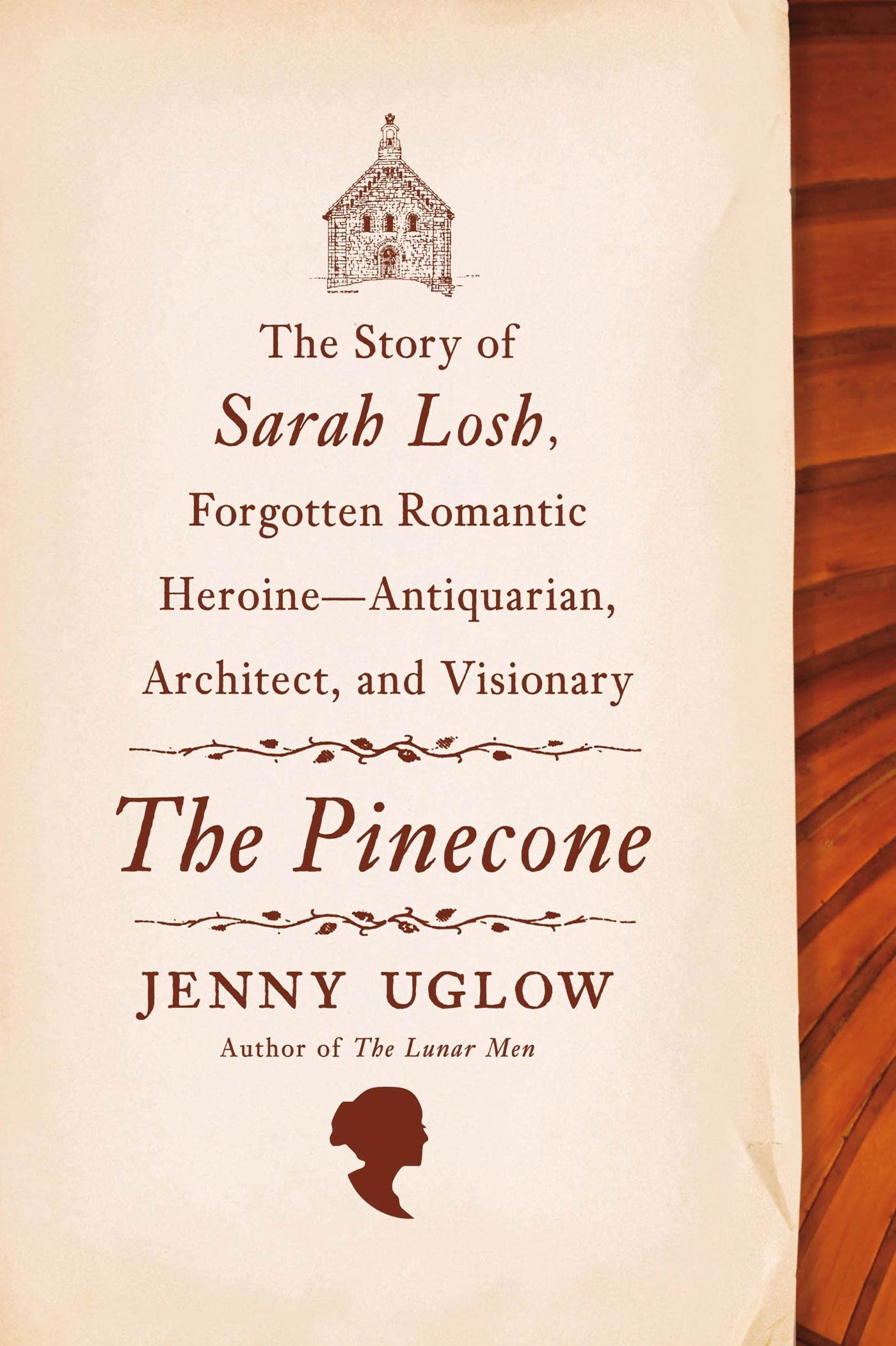
The Pinecone: The Story of Sarah Losh, Forgotten Romantic Heroine--Antiquarian, Architect, and Visionary
$26.99
by Jenny Uglow



In the village of Wreay, near Carlisle, stands the strangest and most magical Victorian church in England. This vivid, original book tells the story of its builder, Sarah Losh, strong-willed, passionate, and unusual in every way. Sarah Losh is a lost Romantic genius―an antiquarian, an architect, and a visionary. Born into an old Cumbrian family, heiress to an industrial fortune, Losh combined a zest for progress with a love of the past. In the church, her masterpiece, she let her imagination flower―there are carvings of ammonites, scarabs, and poppies; an arrow pierces the wall as if shot from a bow; a tortoise-gargoyle launches itself into the air. And everywhere there are pinecones in stone. The church is a dramatic rendering of the power of myth and the great natural cycles of life, death, and rebirth. Losh's story is also that of her radical family, friends of Wordsworth and Coleridge; of the love between sisters and the life of a village; of the struggles of the weavers, the coming of the railways, the findings of geology, and the fate of a young northern soldier in the First Afghan War. Above all, it is about the joy of making and the skill of unsung local craftsmen. Intimate, engrossing, and moving, The Pinecone , by Jenny Uglow, the Prize-winning author of The Lunar Men , brings to life an extraordinary woman, a region, and an age. *Starred Review* Uglow takes such delight in her work that every page shimmers and whirls. On a mission to rescue neglected, radical English artists, such as Thomas Bewick (Nature’s Engraver, 2007), she now richly and inquisitively portrays brainy and independent Sarah Losh (1786–1853). Uglow grew up in Cumbria, Losh’s home territory, and knows well the wildly unconventional church Losh designed and built in the village of Wreay, a house of worship brimming with imagery drawn from Greek, Roman, Egyptian, Hindu, and Buddhist traditions, all shaped by Losh’s passion for fossils and science. Losh even helped craft the carved stone and wood vines, lotus flowers, dragon, butterflies, raven, bat, eagle, stork, and her favorite, the pinecone, an “ancient symbol of regeneration, fertility, and inner enlightenment.” What sort of Victorian Englishwoman would construct a pantheistic temple? Bright, willful, and soon motherless, young Losh was supported in her quest for education by her wealthy industrialist father (Uglow’s history of the family fortune is fascinating) and progressive uncle. Losh deflected her suitors to live a liberated life with her beloved sister, whose death precipitated Losh’s phenomenal surge of creativity. Uglow expertly sets Losh’s singular story within a historical context as intricately detailed and vital as Losh’s church as she shares her profound appreciation for this visionary and her “defiant celebration of life and art.” --Donna Seaman “[Uglow] quickly revealed herself to be one of the most resourceful and innovative writers in the genre . . . as in the best biographies, the question becomes not what the subject will do, but how and why she will do it.” ― Megan Marshall, The New York Times Book Review “This mesmerizing account reveals the uniqueness of Losh's achievement while retaining its mystery.” ― The New Yorker “[An] entrancing book . . . Always impeccable in her choice of the vivid anecdote and the memorable image with which to conjure life into the northern hillscape that she evidently loves so well, Uglow has produced a quiet masterpiece: a book to savour and treasure.” ― Miranda Seymour, The Sunday Times (London) “In its intimate tone, its lavishly detailed depictions of Losh's creations, and its seamless interweaving of the local and immediate with the global and the timeless, [ The Pinecone ] is an exuberant match for the beautiful, ornate and movingly personal nature of Losh's extraordinary church.” ― Rachel Hewitt , The Guardian “Uglow pieces together an absorbing portrait . . . Like her subject, Uglow triumphs with quiet urgency.” ― Laura Battle, Financial Times “[An] engaging historical study . . . With her precise sense of history's intellectual and political movements, Uglow is good at explaining [the] artistic background . . . [and] illuminating subjects as diverse as the use of alkalis in industry . . . and Italian politics in the wake of the Napoleonic wars . . . Uglow's telling of [Losh's story] is clearly focused, wonderfully stimulating and surprisingly colourful.” ― Andrew Lycet, The Telegraph “[In The Pinecone ] Jenny Uglow not only proves the importance of Sarah Losh but shows what biography at its very best can do.” ― Frances Wilson, Literary Review “A riveting story, and Jenny Uglow makes the most of it, exploring the intellectual and social background to Losh's unusual masterpiece . . . She fully explains the impetus for one of the most startling small masterpieces of nineteenth-century architecture in Britain, as well as bringing to life the admirable Miss Losh of Wreay.” ― John Martin Robinson, The Spe