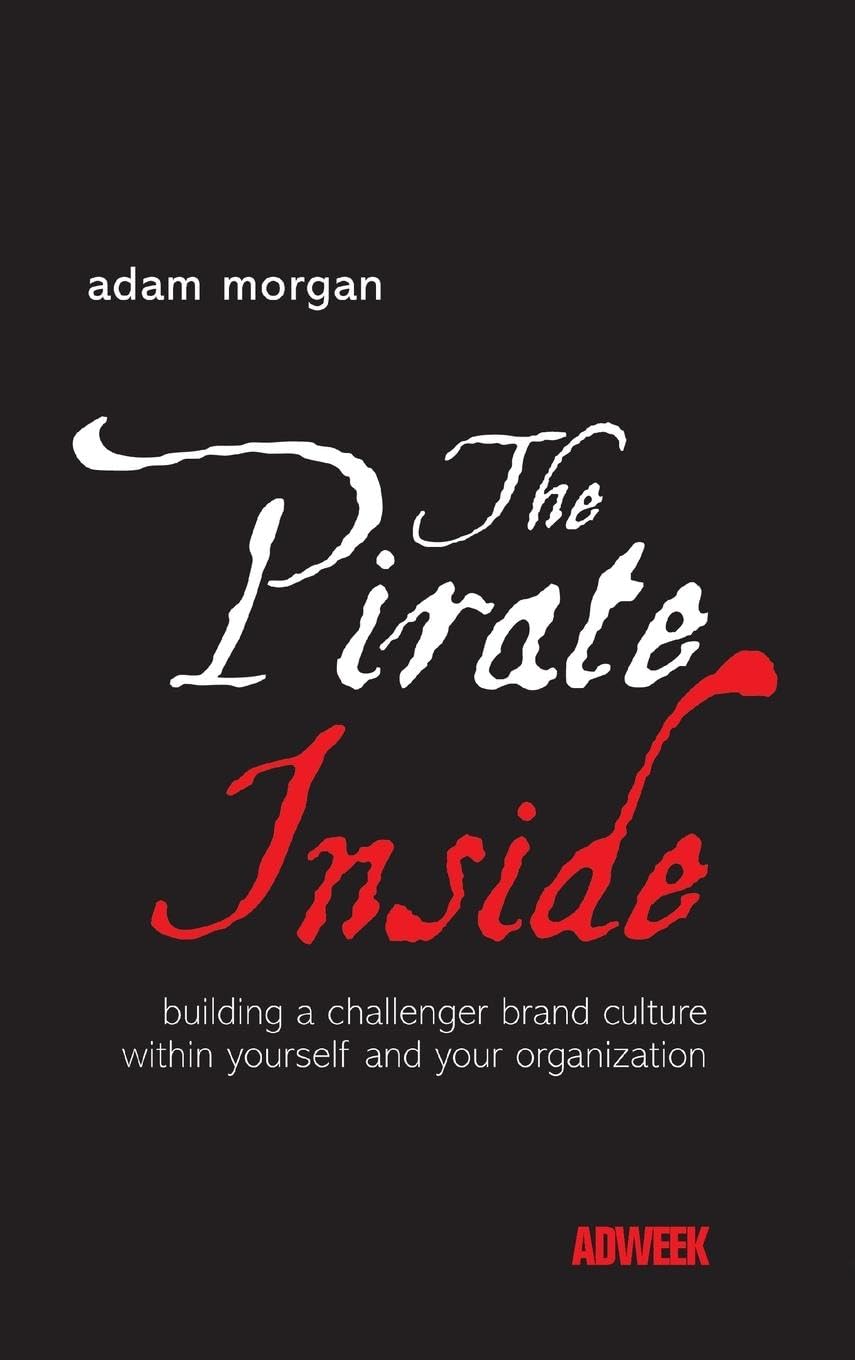
The Pirate Inside: Building a Challenger Brand Culture Within Yourself and Your Organization
$10.28
by Adam Morgan



Most marketing and branding books fall into one of two camps: either they are about leaders or they assume that brands can be managed by process alone. The Pirate Inside is different. It forwards the idea that brands are about people, and Challenger Brands are driven by a certain kind of person in a certain kind of way. Challenger Brands don't rely on CEOs or founders, but on the people within the organization whose personal qualities and approach to what they do make the difference between whether the brand turns to gold or falls to dust. In line with this thinking, The Pirate Inside forwards two key questions: what does it take to be the driver or guardian of a successful Challenger Brand, and what are the demands made by this on character and corporate culture? Building on his answers, Adam Morgan then explores the critical issue of whether big, multi-brand companies can create Challenger micro-climates within their companies, and the benefits that they might achieve by doing so. Brand maven Adam Morgan, author of Eating the Big Fish , wants you to free your inner pirate and sail under the flag of the brand rather than the company. Morgan frames his brand-building advice by comparing time in the Navy (becoming a "corporate drone") with the life of a marketing pirate ("who does what is important, regardless of wisdom offered around us.") Pirates, who challenge dominant brands, have a code. But it does not include the virtues of respecting the parent company, people's space, or the ways things have always been. Morgan draws upon 50 interviews with pirates from brand challenging companies including Diesel, Tommy Bahama, and Southwest airlines. His pirates dazzle with daring do: Apple's Steve Jobs, who shows what Morgan calls "emotional insertion" when he says, "Today we put the romance into computers" or Ingvar Kamprad, Founder of IKEA, who, in a Chinese chicken market, models "insights of opportunity" as he wonders how he can use the extra feathers. For those of us without sea legs, Morgan offers four crisp sets of behavior to become a brand pirate and five personality traits to foster a challenger culture. Morgan is a wonderfully engaging writer, but sometimes his nautical analogies can get diluted by other metaphors. His ideas for helping challenger brands take on the big fish bristle with energy, originality--and above all--practicality. --Barbara Mackoff “… will appeal to anyone who bought Morgan’s last book, Eating the Big Fish, and is a natural follow-up…” (Publishing News, 19th March 2004) “An excellent read” (Marketer, September 2004) “…divides neatly into two sections…many examples and insights…” (Brand Strategy, November 2004) “…uses the analogy of being a pirate to demonstrate how challenger brands can be shaped by the people behind them…” (Campaign, 10th December 2004) "...fascinating book..." (Marketer, June 2006) "... individuals who know a little about marketing would do well to learn how to use Morgan’s branding insights...." ( Chicago Tribune, June 2006) This is a book for Necessary Pirates. People who have to leave 'the Navy' the way their category and perhaps even their company has historically done things in order to succeed. In writing it, Adam Morgan has deliberately set out to research not just the legendary founders associated with iconic Challenger brands such as Diesel, but also the previously 'invisible' people that have been responsible for step-changing Challengers within larger, multi-brand corporations. By isolating common qualities and behaviour across the interviewees, he has harnessed for the first time insights into those aspects of ourselves we must encourage to achieve breakthrough as Challengers. Drawing on these findings, The Pirate Inside argues that being a Pirate is not being an anarchist: it has its own disciplines. Real-life pirates had a code of conduct called The Articles: a different set of rules from those of the Navy, but a binding one all the same. And in the same way, Morgan offers advice on what the new behaviours for Marketing Pirates are: where they look for opportunity, for example; how they think about small budgets and limited distribution; how they productively push back against their superiors. And how they manage That Difficult First Year when they have committed to a new direction, but the results have yet to prove them right. The first part of The Pirate Inside sets out these behaviours, and shows how to apply them in the most productive way to become a Marketing Pirate and create step-change for your brand. Part Two moves on to explore 'Pirates within the Navy' brand-centred subcultures within larger organizations without a founder and explores how these Challenger micro-climates are best created and nurtured. Along the way Morgan examines and dismantles the 'Six Excuses for the Navy': the reasons we commonly give for not being the Pirate our brand needs us to be, such as: "But I don't have a founder", "But I don'