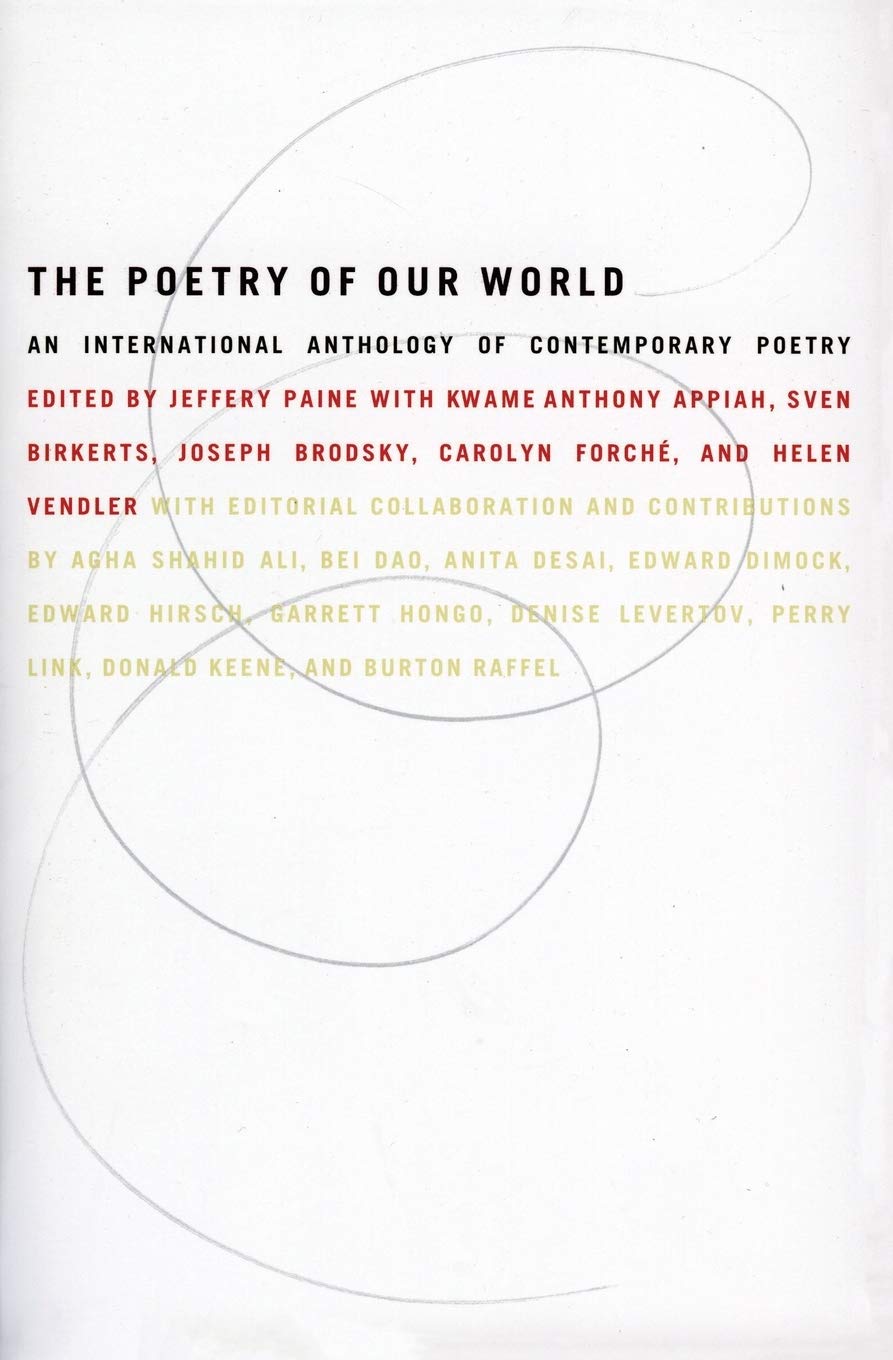
The Poetry of Our World: An International Anthology of Contemporary Poetry – An Eclectic Guide with Essays by Eminent Scholars
$10.54
by Ed J. Paine



Here is a capacious and sparkling gathering of poems, an anthology that extends its reach from the English-speaking world to Asia, Africa, Europe, and Latin America. This unique volume includes such well-known figures as Pablo Neruda, Anna Akhmatova, Paul Celan, Seamus Heaney, Wole Soyinka, and Elizabeth Bishop but also offers the less familiar but equally welcome voices of Ugandan Okot p'Bitek, Indian A.K. Ramanujan, and the Japanese poet Shuntaro Tanikawa. With insightful essays by such eminent scholars and poets as Helen Vendler, Kwame Anthony Appiah, Sven Birkerts, Carolyn Forché, and Bei Dao placing the selections from each region in their cultural, political, and literary contexts, The Poetry of Our World guides readers through the richest and most eclectic selection of world poetry available today. Here is a capacious and sparkling gathering of poems, an anthology that extends its reach from the English-speaking world to Asia, Africa, Europe, and Latin America. This unique volume includes such well-known figures as Pablo Neruda, Anna Akhmatova, Paul Celan, Seamus Heaney, Wole Soyinka, and Elizabeth Bishop but also offers the less familiar but equally welcome voices of Ugandan Okot p'Bitek, Indian A.K. Ramanujan, and the Japanese poet Shuntaro Tanikawa. With insightful essays by such eminent scholars and poets as Helen Vendler, Kwame Anthony Appiah, Sven Birkerts, Carolyn Forché, and Bei Dao placing the selections from each region in their cultural, political, and literary contexts, The Poetry of Our World guides readers through the richest and most eclectic selection of world poetry available today. Jeffery Paine is the author of Father India: Westerners Under the Spell of an Ancient Culture . He is contributing editor, and was for many years literary editor, of the Wilson Quarterly. Jeffery Paine lives in Washington, D.C. The Poetry of Our World An International Anthology of Contemporary Poetry By Paine, Jeffery Perennial Copyright © 2004 Ed J. Paine All right reserved. ISBN: 0060951931 Chapter One The English-Speaking World Greatest Things From Least Suggestions Helen Vendler Two books confirmed me in my love of poetry. The first was a book written for young people, Poetry for You, by the poet Cecil Day-Lewis. It showed me, for the first time, manuscript drafts of a poem-one of DayLewis's own-and made me realize that a poem might begin as an inchoate image, or a stray line, or a fugitive rhythm; it revealed to me that the poet (as Wordsworth said) builds up "greatest things from least suggestions." I found this thrilling, and for several years afterward hunted down evidence of manuscript development, as though by tracking a poem through its multiple stages I could understand what made it into the haunting thing it was. To turn over Dylan Thomas's thirty drafts of "Fern Hill" made me feel that I had been admitted to the heart of creation, and I've never entirely lost that response. To see what has been added, to see what has been canceled, to see what has been accepted but revised-there is no truer way to investigate the aims that a poet is, even unconsciously, pursuing. Day-Lewis disclosed why he had written a given line, why he had omitted another, what he was avoiding, what he was hoping to find: And through those scribbled-in additions and corrections I saw the poem evolve from chaos to order. Later, when I came across the facsimile edition of The Waste Land drafts, it seemed entirely natural that such a complex poem should have had a "long foreground"--the phrase is Emerson's, voicing his (correct) speculation that Whitman had been writing for a long time before he burst on the American scene with "Song of Myself." Though I had no manuscript evidence for most of the poems I read, I now saw them less as products than as the result of a process--a process that had halted at a particular order of words, but that had begun, earlier, from an undisclosed nucleus. I thought I could often see that nucleus surviving in the final poem-not only when the poet revealed it (as when Keats mentioned the "stubble plains" as the source of his autumn ode), but also when I had nothing to go on but conjecture. The unfolding of a whole from a part still seems to me the most marvelous aspect of poetic composition. After Day-Lewis's Poetry for You, the second book that meant a great deal to me was the first volume I ever bought with my own money: Oscar Williams's Little Treasury of Modern Poetry. It introduced me to the great modernist poets, the ones I had not found at home (since my mother's knowledge of poetry stopped with Tennyson and Swinburne). Some of the poets I found irritating (especially Wallace Stevens, who was later to become my favorite among the moderns), but others I was drawn to instantly, not least Robert Lowell, who was writing (in "Where the Rainbow Ends") about my own city of Boston, where The Pepperpot, ironic rainbow, spans Charles River and its scales of sc