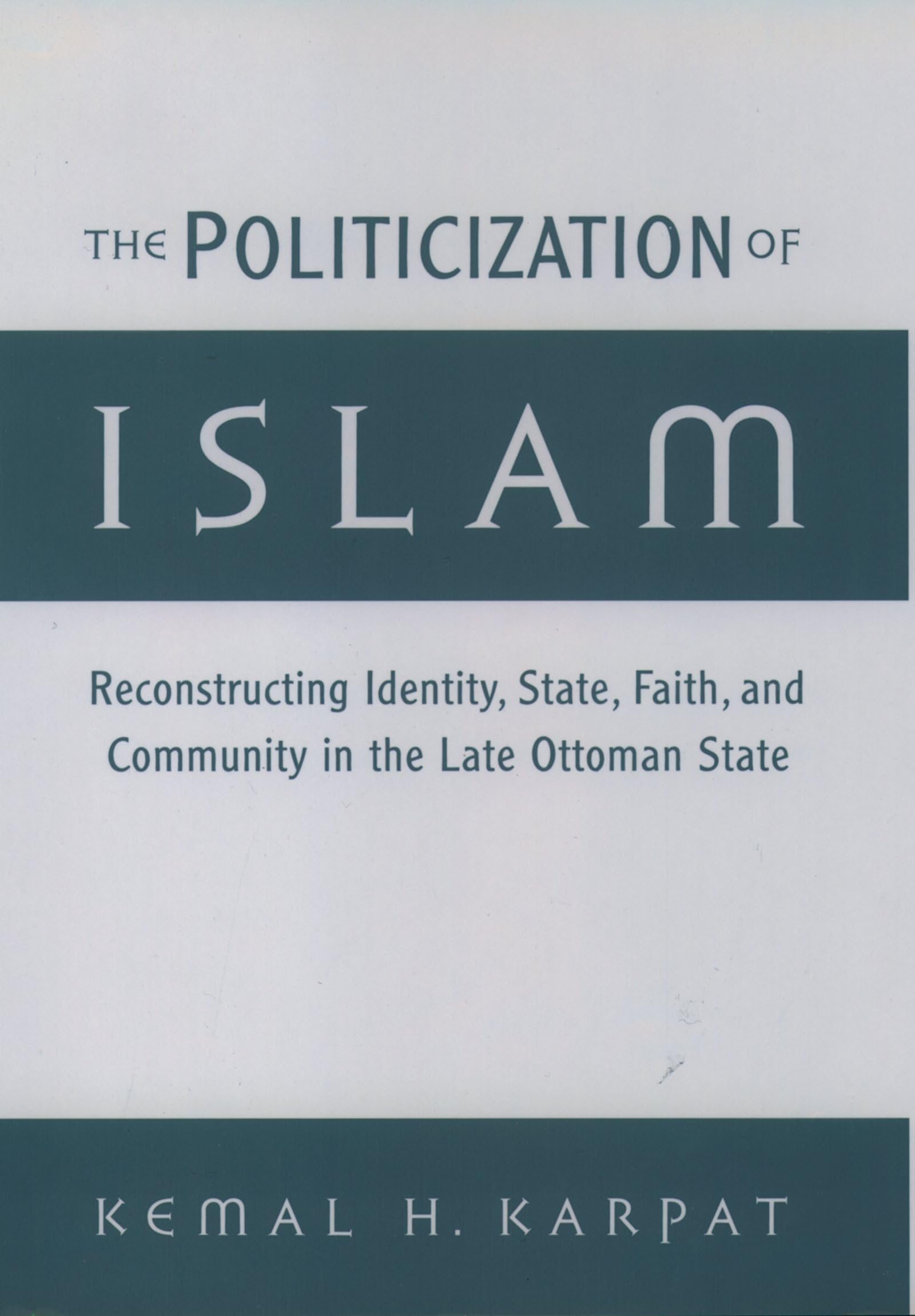
The Politicization of Islam: Reconstructing Identity, State, Faith, and Community in the Late Ottoman State (Studies in Middle Eastern History)
$171.54
by Kemal H. Karpat



Combining international and domestic perspectives, this book analyzes the transformation of the Ottoman Empire over the nineteenth and twentieth centuries. It views privatization of state lands and the increase of domestic and foreign trade as key factors in the rise of a Muslim middle class, which, increasingly aware of its economic interests and communal roots, then attempted to reshape the government to reflect its ideals. "His works of reference are the classical sociologists Karl Marx, Max Weber, Emile Durkheim and Joseph Schumpeter. The author is well versed in this tradition of analytical history and offers penetrating explanations drawn from general sociological categories without compromising the historical details of his empirical material."-- middle East Journal "A monumental work by one of the most respected scholars of the Ottoman Empire. A valuable effort and contribution in understanding the process of politicization of Islam."-- Central Eurasian Studies Review "The book is an extended essay recording the author's ruminations on Ottoman history, Turkish politics, and their interconnections."-- American Historical Review "This may be Karpat's magnum opus...The result is a book that is destined to become a classic."-- CHOICE "A thoroughly innovative, ambitious, and entirely successful new foray into Ottoman history."-- History: Reviews of New Books "Professor Karpat's The Politicization of Islam is a landmark study. It does not simply refute an outdated approach picturing the entire transformation of the Ottoman Empire as a deadly and everlasting struggle between Islam and modernity, but offers an insightful analysis of how this transformation materialized during the nineteenth and early twentieth centuries, and deftly analyzes the complex processes of state building, politicization of Islam, and invention of tradition."--M. Sükrü Hanioglu, Princeton University "This is a painstakingly researched and passionately written account of Ottoman politics, society, and ideology from the mid-nineteenth century to the nation-state period. Professor Karpat analyzes assertions of local power and ethnic identity in an Islamic notion. He posits Islamism as an ideology of reform responding to popular pressures and international factors, and thus provides a corrective to the entrenched notion that Islam (or pan-Islam) served as a repressive, retrogressive, and expansionist ideological instrument. Comprehensive and analytical, yet broad in scope and accessible to both the general reader and the scholar, this book is a significant contribution to Middle Eastern studies."--Hasan Kayali, University of California, San Diego "Undaunted by the entrenched, simplistic interpretations of Abdulhamid II's reign as Sultan of the Ottoman Empire (1876-1909), Professor Kemal Karpat, in a marvelous synthesis, brings fresh insight into the complex social, cultural, and political forces that influenced Ottoman modernization. He shows how the idea of Islamism (pan-Islam), far from being the backward ideology depicted by the Sultan's critics, was turned into a positive force in mobilizing the Empire's people to accept major changes in their traditional institutions. Professor Karpat brings provocative insight into his analysis of the relationship between ideology and institutional change. His work is of great interest, not only to Ottomanists and students of Middle Eastern history, but also to those interested in the factors that affect the very nature of modernization throughout the world."--Stanford J. Shaw, University of California, Los Angeles and Bilkent University, Ankara, Turkey "Arguably one of the most significant books to appear in the last thirty years on the transformation of the late Ottoman Empire. A first-rate intellectual history grounded in the society and economy of the period, in which he examines the impact of capitalism as the Ottoman Empire was incorporated in the world system during the nineteenth century."-- Journal of Islamic Studies Kemal H. Karpat is Distinguished Professor of History at the University of Wisconsin, Madison.