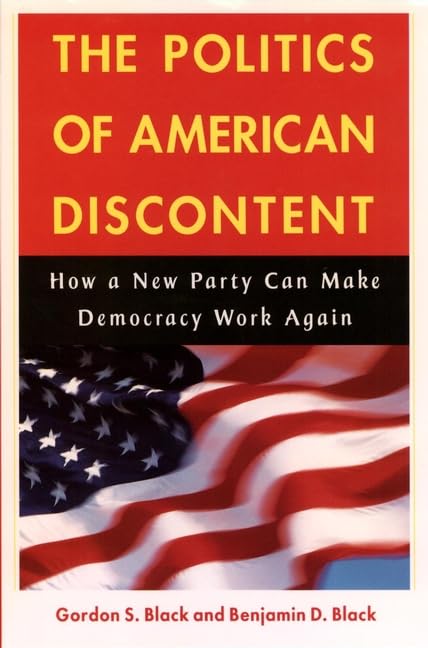
The Politics of American Discontent: How a New Party Can Make Democracy Work Again
$26.65
by Gordon S. Black



Advance praise for The Politics of American Discontent "This is a manifesto for a new American political system. Unlike most manifestos, it is backed by hard data and sound analysis, demonstrating impressively that a third party will work and can free America from the shackles of the outmoded two-party system. Gordon and Ben Black have written a book that I wish I had written." Theodore Lowi Professor of American Institutions, Cornell University and Past President of the American Political Science Association "The authors agenda for political reform should send a wake-up call to every concerned American. Like Thomas Paine in Common Sense, they identify root causes
the section on the pervasive corruption of our electoral process by special interests is both well-documented and thoroughly researched
a blueprint for political action to bring about genuine change." John Anderson Professor of Law, Nova University "A passionate plea for forming a third party of the radical middle, The Politics of American Discontent is the best analysis yet of the Perot voters who may provide its base
indispensable to understanding the present political scene." Joel Rogers Professor of Political Science, University of Wisconsin "Gordon and Ben Black define the political quandary of America with powerful statistics. But unlike other expert commentary, they neither leave us hanging or in despair, showing that the way out of gridlock is to break out of an irrelevant monopoly: the two party system." Lowell Weicker Governor of Connecticut "This is a richly documented and vigorously argued analysis of the contemporary American party system and the malaise that afflicts so many of our citizens as they long for political change
Americans concerned about their country and their own responsibilities as citizens should give this book careful attention." Robert Salisbury Professor of Political Science, Washington University The tide of public opinion has been rising against politics for a number of years, perhaps cresting with Ross Perot's candidacy. The authors, both professional pollsters (Gordon Black conducted polls for Perot), here contend that "the virtual elimination of electoral competition by incumbents is the single most important underlying cause of most of what troubles Americans today about politics." The authors cite common indicators of the decline of American democracy: the rise in the length of congressional tenure; the increase in the number of safe seats in Congress; the perks enjoyed by incumbents; and the declining number of voters participating in elections. They argue that only a new third party can remove the entrenched power structures and reform democracy. Unfortunately, their definition of democracy is extremely narrow and leads them to numerous flawed interpretations of the data they present. For a more balanced and insightful analysis, E.J. Dionne's Why Americans Hate Politics (LJ 4/15/91) is a much better choice. Thomas J. Baldino, Wilkes Univ., Wilkes-Barre, Pa. Copyright 1994 Reed Business Information, Inc. The Blacks, father and son, are two pollsters flummoxed by the inability of a third party to establish itself. Stymied by the electorate's palpable exasperation with the two main parties, they recap in reams of tables and graphs the familiar horror stories about the incumbents' self-protection scams, which build up their 90 percent reelection rates with 70 percent of the votes. Competition is dead, the Blacks are mad as hell, and they're not going to take it anymore. They here present a quasi platform for a Center party akin to the nationalistic party de Gaulle created, the Rassemblement du Peuple Fran{}cais. The American version's central plank would be vigilant fiscal conservatism that resists the phalanx of forces--such as subsidized industries and government employee unions--which yelp when higher spending is endangered. Ranking high on the Blacks' fix-it list is rejuvenating tools dormant since the progressive era, such as referenda for term limits, which they hope can rev up the discontented middle class. An emphasis on opinion polls and a suggested course of action distinguish this book from such popular diagnoses as Kevin Phillips' Boiling Point . Gilbert Taylor An incomplete, if sometimes stimulating, analysis of discontent in the electorate and the prospects for a new centrist political party. The authors, both political pollsters (one of Gordon Black's 1992 clients was independent presidential candidate H. Ross Perot), argue persuasively that growing frustration with democracy is rooted in declining political competition for seats in Congress and state legialatures as a result of our system's structuring to support incumbents. Among the examples the authors offer of such anticompetitive elements are gerrymandering, PAC funding, and incumbents' abuse of franking privileges. The authors go on to describe how legislators ignore the general good in favor of special interest groups. Unc