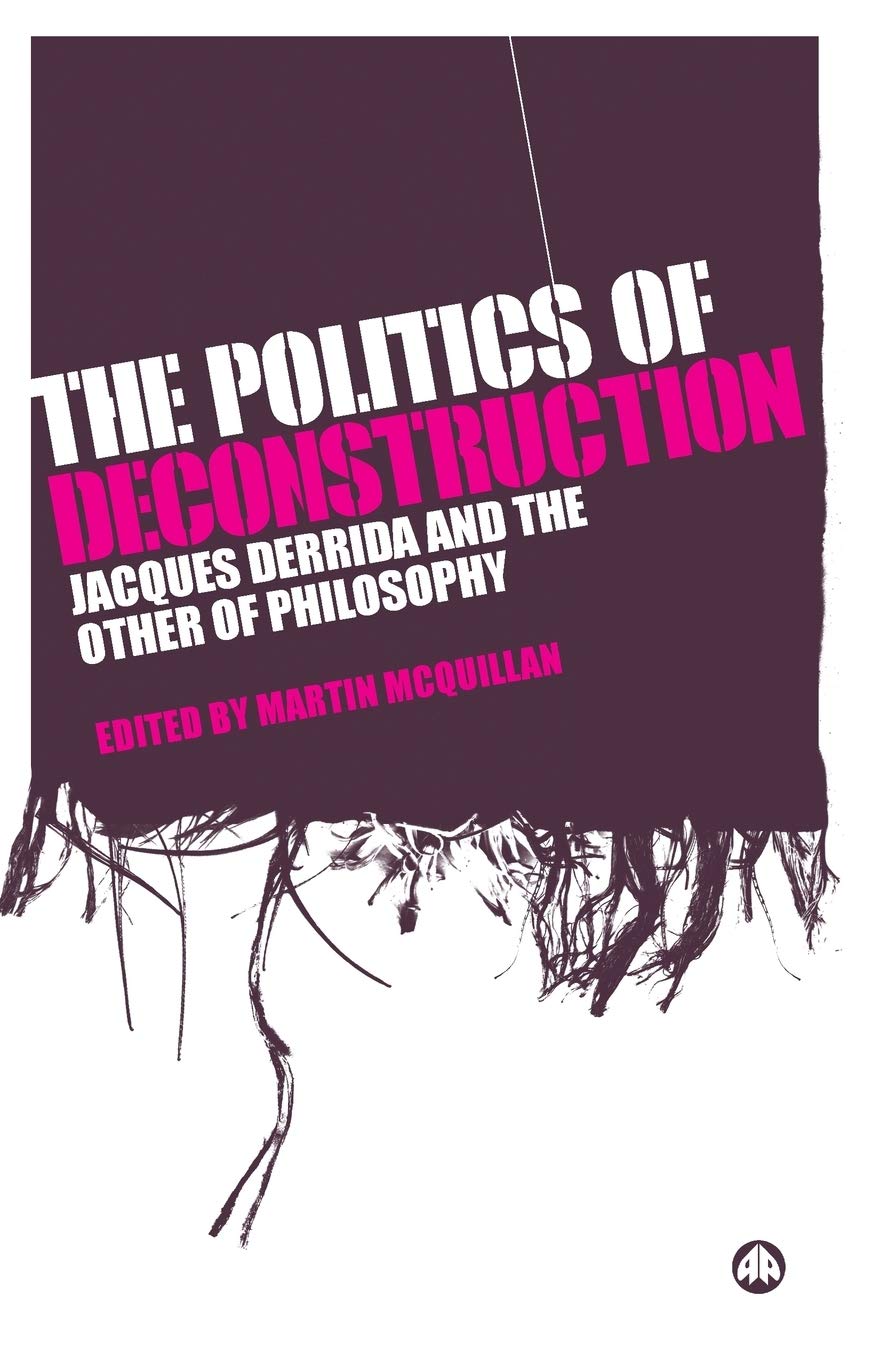
The Politics of Deconstruction: Jacques Derrida and the Other of Philosophy
$37.00
by Martin McQuillan



Jacques Derrida has had a huge influence on contemporary political theory and political philosophy. Derrida's thinking has inspired Slavoj Zizek, Richard Rorty, Ernesto Laclau, Judith Butler and many more contemporary theorists. This book brings together a first class line up of Derrida scholars to develop a deconstructive approach to politics. Deconstruction examines the internal logic of any given text or discourse. It helps us analyse the contradictions inherent in all schools of thought, and as such it has proved revolutionary in political analysis, particularly ideology critique. This book is ideal for all students of political theory, and anyone looking for an accessible guide to Derrida's thinking and how it can be used as a radical tool for political analysis. 'In this fine collection a group of distinguished scholars have produced the best book so far about Derrida's politics of the future.' --J. Hillis Miller, Distinguished Research Professor, University of California at Irvine Martin McQuillan is Pro-Dean of Research in the Faculty of Performance, Visual Arts and Communication at the University of Leeds. He is the author, along with Eleanor Byrne, of Deconstructing Disney (Pluto, 1999), Paul de Man (2000) and editor of Deconstruction: A Reader (2000), The Narrative Reader (2000), and Theorising Muriel Spark: Gender, Race, Deconstruction (2002) and co-editor of Post-Theory: New Directions in Criticism (1999). The Politics of Deconstruction Jacques Derrida and the Other of Philosophy By Martin McQuillan Pluto Press Copyright © 2007 Martin McQuillan All rights reserved. ISBN: 978-0-7453-2674-0 Contents Acknowledgements, vii, List of Abbreviations, viii, Introduction: The Day After Tomorrow ... or, The Deconstruction of the Future Martin McQuillan, 1, Part One: Philosophy of Politics, 1. Demo Geoffrey Bennington, 17, 2. On the Multiple Senses of Democracy Jean-Luc Nancy, 43, 3. The Art of the Impossible? Derek Attridge, 54, 4. Impossible Speech Acts Andrew Parker, 66, Part Two: Politics of Philosophy, 5. The Crisis of Critique and the Awakening of Politicisation in Levinas and Derrida Robert Bernasconi, 81, 6. The Popularity of Language: Rousseau and the Mother-Tongue Anne Berger, 98, 7. In Light of Light: on Jan Patocka's Notion of Europe Rodolphe Gasché, 116, 8. Phenomenology to Come: Derrida's Ellipses Joanna Hodge, 137, Part Three: Otherwise, 9. From (Within) Without: the Ends of Politics Marc Froment-Meurice, 157, 10. Thinking (Through) the Desert (la pensée du désert) With(in) Jacques Derrida Laurent Milesi, 173, 11. Graphematics, Politics and Irony Claire Colebrook, 192, 12. The Irony of Deconstruction and the Example of Marx Richard Beardsworth, 212, 13. Karl Marx and the Philosopher's Stone, or, On Theory and Practice Martin McQuillan, 235, Notes on Contributors, 255, Index, 257, CHAPTER 1 Demo Geoffrey Bennington '... no doubt more serious for what is called democracy, if at least we still understand by that the name of a regime, which, as is well known, will always have been problematical' (Derrida, Politiques de l'amitié, p. 12). DEMO 'Demo' here refers in the first instance to democracy, as a sort of possible nickname (like some people used to refer to postmodernism as 'pomo', post-colonial studies as 'poco', and even deconstruction as 'decon', I think) and I will indeed be talking essentially about democracy. But I use 'demo' here too in the sense of demonstration. This second sense hangs between the strong philosophical or logical sense in which a point might be demonstrated, that is, proven; the slightly weaker sense in which someone might provide a demonstration, an exemplary execution of some more or less difficult technique or trick that a reader or spectator might then want to try for themselves; the music-industry sense of a trial or sample recording designed to show off one's talent or potential, and the computer sense of a limited version of a program, designed to give a sense of its capacities and capabilities without providing what is called 'full functionality'. This is only a demo, lacking full functionality and, I fear, still full of bugs. The point of the demo (about 'demo', then) is to approach Derrida's slogan, in Politiques de l'amitié: 'no deconstruction without democracy, no democracy without deconstruction', but also the claim that what he calls the limit between the conditional and the unconditional inscribes an auto-deconstructive force in the very motif of democracy, the possibility and the duty for democracy to de-limit itself. Democracy is the autos of deconstructive auto-delimitation. A delimitation not only in the name of a regulative Idea and an indefinite perfectibility, but each time in the urgency of a here and now. And this demo about demo can then connect with a third sense of demonstration, as Derrida lays it out in Le monolinguisme de l'autre, playing a little uncertainly across Frenc