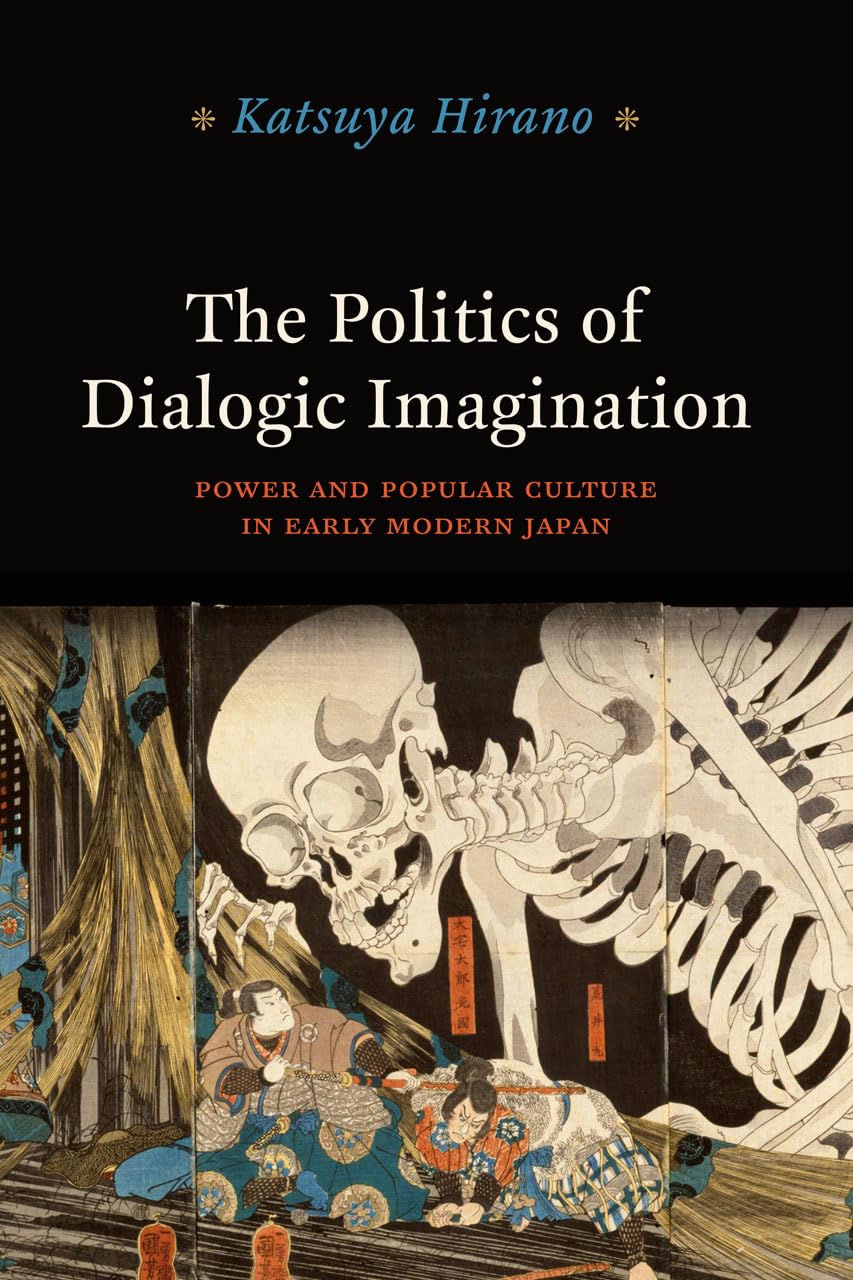
The Politics of Dialogic Imagination: Power and Popular Culture in Early Modern Japan (Chicago Studies in Practices of Meaning)
$31.00
by Katsuya Hirano



In The Politics of Dialogic Imagination , Katsuya Hirano seeks to understand why, with its seemingly unrivaled power, the Tokugawa shogunate of early modern Japan tried so hard to regulate the ostensibly unimportant popular culture of Edo (present-day Tokyo)—including fashion, leisure activities, prints, and theater. He does so by examining the works of writers and artists who depicted and celebrated the culture of play and pleasure associated with Edo’s street entertainers, vagrants, actors, and prostitutes, whom Tokugawa authorities condemned to be detrimental to public mores, social order, and political economy. Hirano uncovers a logic of politics within Edo’s cultural works that was extremely potent in exposing contradictions between the formal structure of the Tokugawa world and its rapidly changing realities. He goes on to look at the effects of this logic, examining policies enacted during the next era—the Meiji period—that mark a drastic reconfiguration of power and a new politics toward ordinary people under modernizing Japan. Deftly navigating Japan’s history and culture, The Politics of Dialogic Imagination provides a sophisticated account of a country in the process of radical transformation—and of the intensely creative culture that came out of it. “ The Politics of Dialogic Imagination is an extraordinarily sophisticated and brilliant look at the political effects of an emergent popular culture. The larger significance of Katsuya Hirano’s ‘local’ study is the way it demonstrates the actual politicality of cultural production in its aptitude for generating new forms of representation on a scale infinitely more numerous than politics itself.” -- Harry Harootunian, Weatherhead East Asian Institute, Columbia University “An astute analysis of the relationship between shogunal policies of social control and the subversions of Edo popular culture, The Politics of Dialogic Imagination lays bare the Tokugawa politics of culture as well as its later transformation into the mobilizing, modernizing power of the Meiji state. An important intervention in the field.” -- Carol Gluck, author of Words in Motion: Toward a Global Lexicon “Katsuya Hirano succeeds brilliantly, not only in accurately portraying important manifestations of early modern Japanese popular culture and interpreting them in original and persuasive ways, but in thoroughly explaining and justifying those interpretations in lucid theoretical prose. This book should be widely read across disciplines in the social sciences and humanities as a model of theoretically self-aware scholarship.” -- Julien Victor Koschmann, Cornell University “Hirano successfully traces the impact art had on a country that was undergoing rapid and radical transformation.” ― Japan Times “Hirano uses Kabuki, illustrated books, and woodblock prints to form the basis of his argument that ‘the Tokugawa government constructed its mechanisms of rule based on a fundamental distrust of the body,’ and he ‘probes the implications of social, economic, and ideological structures after 1868’ in the mind-body relationship. Literary theorists and art and cultural historians will appreciate this linkage to more universal intellectual trends and careful interpretation of specific texts and images.” ― Choice Katsuya Hirano is associate professor of history at the University of California, Los Angeles.