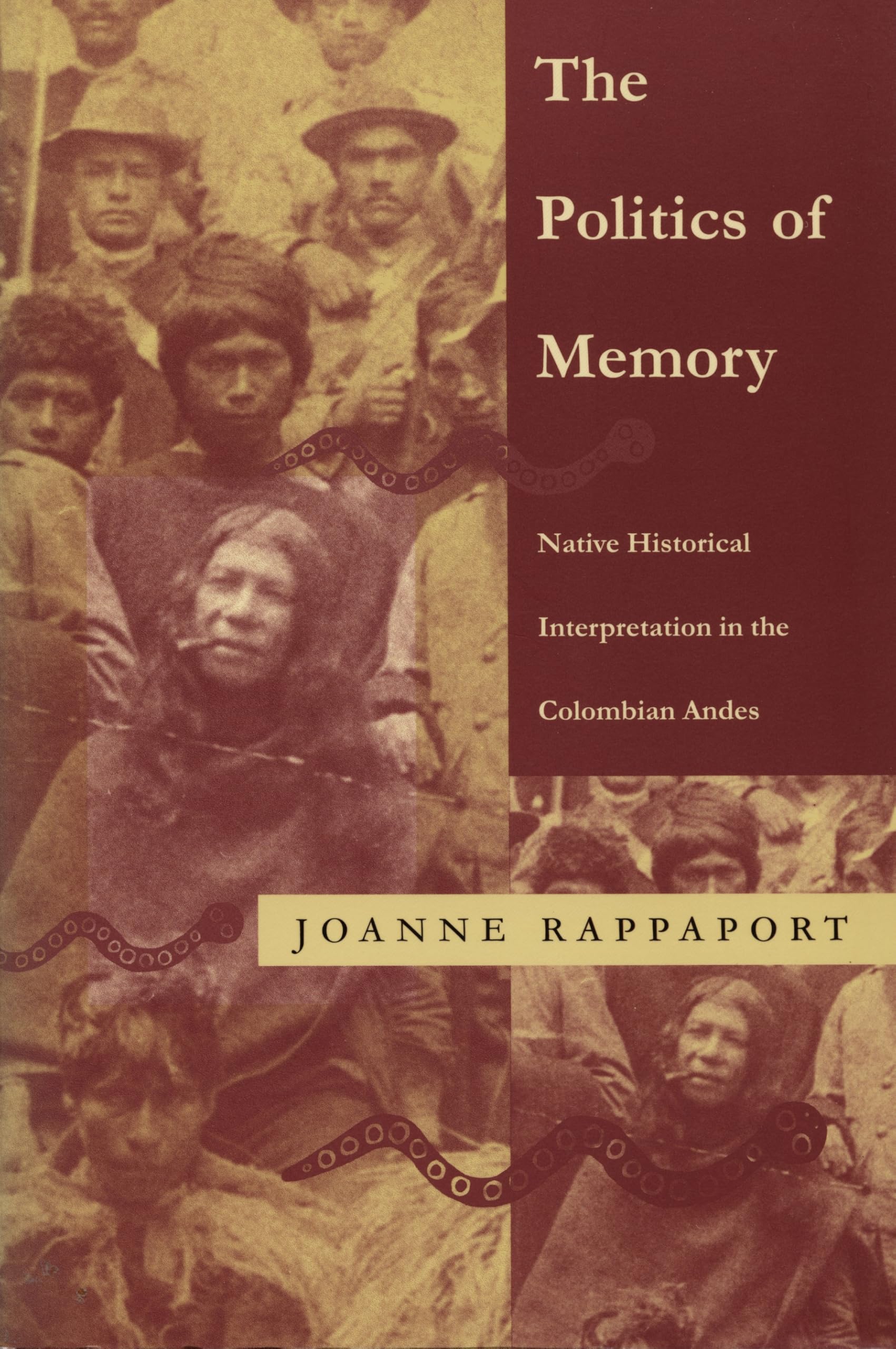
The Politics of Memory: Native Historical Interpretation in the Colombian Andes (Latin America Otherwise)
$29.00
by Joanne Rappaport



How does a culture in which writing is not a prominent feature create historical tradition? In The Politics of Memory , Joanne Rappaport answers this question by tracing the past three centuries of the intellectual history of the Nasa—a community in the Colombian Andes. Focusing on the Nasa historians of the eighteenth through twentieth centuries, Rappaport highlights the differences between "native" history and Eurocentric history and demonstrates how these histories must be examined in relation to the particular circumstances in which they were produced. Reconsidering the predominantly mythic status of non-Western historical narrative, Rappaport identifies the political realities that influenced the form and content of Andean history, revealing the distinct historical vision of these stories. Because of her examination of the influences of literacy in the creation of history, Rappaport’s analysis makes a special contribution to Latin American and Andean studies, solidly grounding subaltern texts in their sociopolitical contexts. "This is one of those historical texts in which the author not only revises our understanding of the past, but also shakes up our intellectual certainties in the present." --British Bulletin of Publications "Rappaport demonstrates how a long-oppressed people uses the available fragments of historical interpretation to create a highly politicized form of historical thought."--Jean E. Jackson, "Hispanic American Historical Review" Joanne Rappaport is Associate Professor of Spanish and Portuguese at Georgetown University. The Politics of Memory Native Historical Interpretation in the Colombian Andes By Joanne Rappaport Duke University Press Copyright © 1990 Cambridge University Press All rights reserved. ISBN: 978-0-8223-1972-6 Contents About the Series, Preface to the Duke Edition, Illustrations, Preface, CHAPTER 1 Introduction: Interpreting the Past, PART I The Creation of a Chiefly Ideology: Nasa Historical Thought under Spanish Rule, CHAPTER 2 The Rise of the Colonial Cacique, CHAPTER 3 The Birth of the Myth: Don Juan Tama y Calambás, PART II From Colony to Republic: Cacique and Caudillo, CHAPTER 4 The Chiefdom Transformed: The Nineteenth-Century Nasa, CHAPTER 5 From Sharecropper to Caudillo: Manuel Quintín Lame, PART III Contemporary Historical Voices, CHAPTER 6 The Cacique Reborn: The Twentieth-Century Nasa, CHAPTER 7 Julio Niquinás, a Contemporary Nasa Historian, CHAPTER 8 Conclusion: Narrative and Image in a Textual Community, Glossary, Notes, References, Index, CHAPTER 1 Introduction: Interpreting the Past In Losfunerales de la Mamá Grande, Gabriel Garcia Márquez declares that he must tell his story "before the historians have time to arrive." But in reality, the historians arrived long ago, and the novelist is righting the wrongs of Colombian historiography by giving life and breath to long-forgotten incidents which should have been at the center of the Colombian historical consciousness, but were omitted by historians. Throughout the Americas indigenous peoples are working toward these same ends, revalidating their own historical knowledge as an arm against their subordinate position in society. For them, history is a source of knowledge of how they were first subjugated and of information about their legal rights, the beginnings of a new definition of themselves as a people, a model upon which to base new national structures (Barre 1983). For them as for Garcia Márquez, Western historiography has severed the Indians from their past by neglecting to mention them except as exotic beings or as savages. Western historiography thus justifies the European invasion. Nevertheless, from the perspective of aboriginal peoples, the writings of historians are more legendary than accurate (Wankar 1981: 297-81). European myths of the Americas have served as tools for dominating Native Americans by denying them access to a knowledge of their own past so necessary for organizing in the present. In the words of one native writer: "The whites block our road toward the future by blocking our road to the past" (Wankar 1981: 279). This book will trace the process by which the Nasa of southern highland Colombia have revalidated their historical vision since the eighteenth century by defining, stating, reformulating and acting upon their own notion of their place in the historical process. I will examine their process of historical definition, highlighting selected periods in which native historians elaborated on their past in a form accessible to us, and tracing the continuities in narrative themes that link late-twentieth-century storytellers to their colonial counterparts. Although Nasa narrative exhibits a clear continuity from past to present, it is also the product of the historical conditions under which it was elaborated. The historical consciousness of the people of Tierradentro is most clearly understood when interpreted in conj