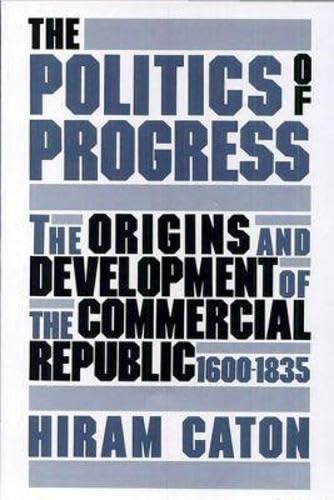
The Politics of Progress: The Origins and Development of the Commercial Republic, 1600-1835
$115.20
by Hiram Caton



Book by Caton, Hiram " a history constructed around a Baconian paradigm, and Caton has gone about constructing it with enormous learning, zest, and readability. Historians, philosophers, political theorist, and social scientists will all find the book speaking to them - though they won't all like what it says." -- J.G.A. Pocock, Johns Hopkins University "The author has set himself a monumental task, no less than clarifying and explicating the roots of modernity. He has produced a monumental work to match the task. There is a grandeur in the ambition and in the scope and sweep of the achievement. It is an intellectual and social tour of modern civilization in the West. "The author has more in mind than new research on a narrow topic. He wants to convey in all its many facets the shape of the progressive urge. He has succeeded beautifully. I can think of no comparable effort at synthesis, at least not one that is so aware of the latest controversies and findings of modern scholarship. "No small part of the book's appeal is its style, straightforward and highly readable. There is an excitement and a verve in the writing, and the reader is caught up in the telling of the tale. "The author is doing more than just entering the thicket of contemporary debate over the republican tradition. Many writers pursue particular themes in particular periods of writers. This book is much more ambitious, reminiscent of older efforts at grand synthesizing like Laski, Halevy, and of course its literal prototype, Bury. What Caton does is, in fact, make these classics somewhat obsolete. He has produced a book that should become a definitive source on liberal capitalist society and social thought." -- Isaac Kramnick, Cornell University "The erudition and breadth of knowledge displayed in this book are genuinely impressive. Few scholars could begin to marshal the 'data base' the author invokes here. In an age wherein too many are tempted to know more and more about less and less, Caton is willing to range broadly and think big." -- Thomas A. Spragens, Jr., Duke University "The erudition of the author is awe-inspiring, the treatment of Hobbes is brilliant." -- Joyce Appleby, University of California-Los Angeles The Editor Hiram Caton, D.Litt., is professor of politics and history at Griffith University, Brisbane, Australian. He is well qualified for his task. He holds the M.A. in Arabic and Islamic Civilization from the Oriental Institute of the University of Chicago and the doctorate in Philosophy from Yale University. He is familiar with the project to unite the social and biological sciences, having contributed to that effort as a historian, political psychologist, human ethnologist, and bibliographer. As a political scientist he is at home with cultural politics that lent passion to the controversy. His philosophical training and policy studies on applications of biomedical technology have equipped him to deal with the challenging problems of knowledge evaluation raised by the clash between the two images of Samoa. Among his current publications are The politics of Progress: The Origins and Development of the Commercial Republic 1600-1835, University of Florida Press, and Trends in Biomedical regulation (editor), butterworths, in press. Introduction THE PRESENT volume is a study of polytechnic rationality under the aspect of the political program with which it was most intimately identified, here called the politics of progress. I have undertaken to describe its origins and successive legitimations, its main transformations, and its notable achievements. I have also been attentive to its limitations, liabilities, and defeats. The commercial republic mentioned in the subtitle refers to the regime typically favored by exponents of progress. The term is drawn from the vocabulary of preindustrial politics. Writers of the last century were more comfortable with liberalism, democracy, and capitalism. I have settled on the older usage because it dominated until about 1800, when the influence of Adam Smith brought the liberal system into currency. The termination of this study in 1835, with an account of the polarization of labor and capital in Great Britain, is a temporary resting point. A more satisfactory periodization would carry the story forward to 1914. I intend to cover this period in another volume. Since the historiography of progress is a legacy of "Whig history," the orientation of my study may in some measure be characterized by reference to that tradition. Whig history is more aptly called liberal history. Its monuments are the Cambridge Modern History (1902-12), published under the editorship of Lord Acton, and the Histoire de France (1910), edited by Ernest Lavisse. The presiding concept of liberal historiography was the idea of universal, scientific history promoted by Leopold Ranke during his prolific career as scholar and teacher. Acton was among Ranke's many students, and we find him writing in th