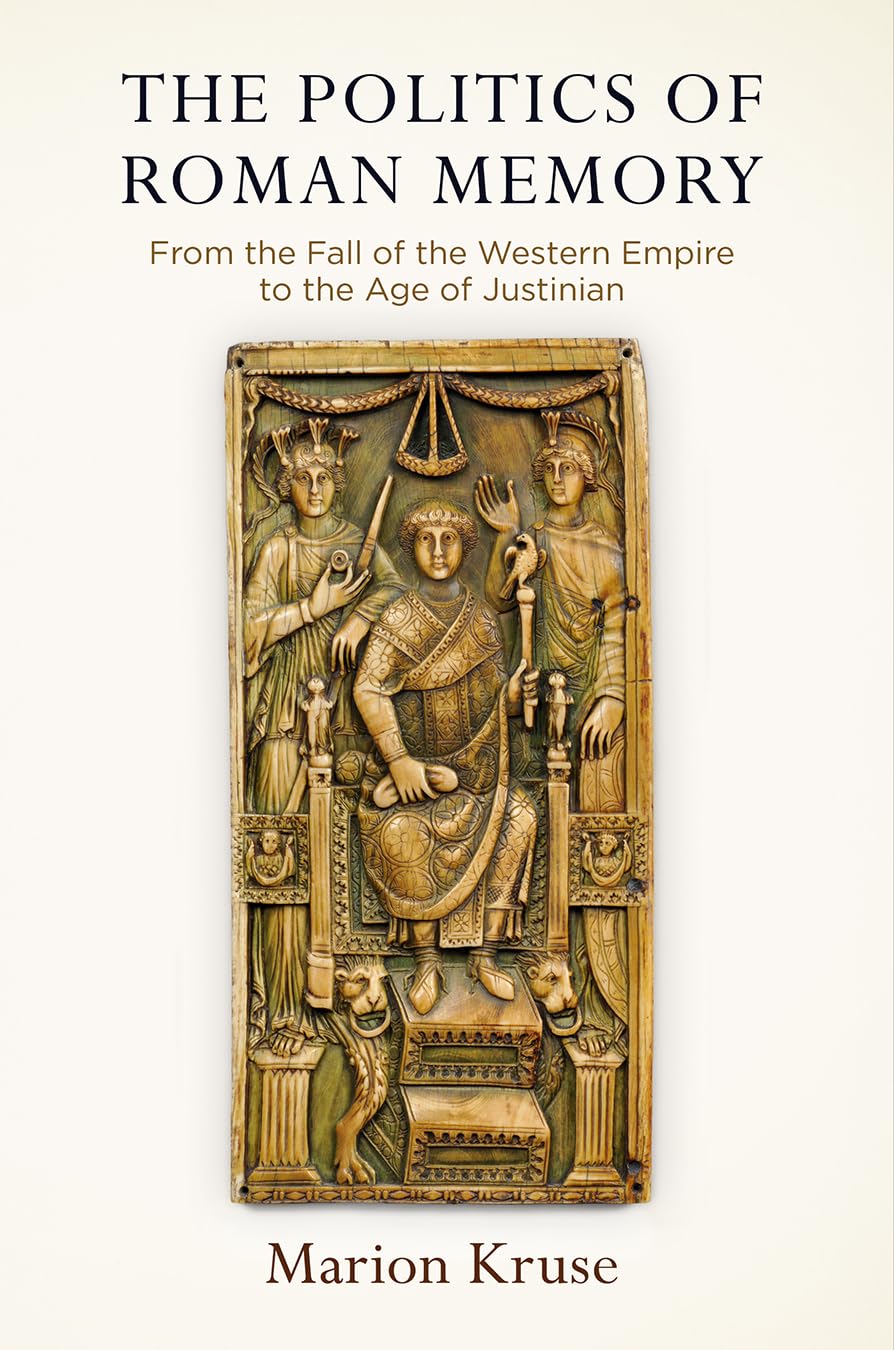
The Politics of Roman Memory: From the Fall of the Western Empire to the Age of Justinian (Empire and After)
$70.28
by Marion Kruse



What did it mean to be Roman after the fall of the western Roman empire in 476, and what were the implications of new formulations of Roman identity for the inhabitants of both east and west? How could an empire be Roman when it was, in fact, at war with Rome? How did these issues motivate and shape historical constructions of Constantinople as the New Rome? And how did the idea that a Roman empire could fall influence political rhetoric in Constantinople? In The Politics of Roman Memory , Marion Kruse visits and revisits these questions to explore the process by which the emperors, historians, jurists, antiquarians, and poets of the eastern Roman empire employed both history and mythologized versions of the same to reimagine themselves not merely as Romans but as the only Romans worthy of the name. The Politics of Roman Memory challenges conventional narratives of the transformation of the classical world, the supremacy of Christian identity in late antiquity, and the low literary merit of writers in this period. Kruse reconstructs a coherent intellectual movement in Constantinople that redefined Romanness in a Constantinopolitan idiom through the manipulation of Roman historical memory. Debates over the historical parameters of Romanness drew the attention of figures as diverse as Zosimos—long dismissed as a cranky pagan outlier, but here rehabilitated—and the emperor Justinian, as well as the major authors of Justinian's reign, such as Prokopios, Ioannes Lydos, and Jordanes. Finally, by examining the narratives embedded in Justinian's laws, Kruse demonstrates the importance of historical memory to the construction of imperial authority. " The Politics of Roman Memory is an exciting addition to the scholarship about the intellectual and literary directions of both Justinian's Constantinople and the wider sixth-century Mediterranean world." ― Edward Watts, University of California, San Diego "Highlighting an often overlooked group of authors and a time period often bypassed by memory studies, Marion Kruse persuasively articulates the ongoing but changing significance of the city of Rome for literate elites of early- to mid-sixth century Constantinople." ― Jacob Latham, University of Tennessee, Knoxville Marion Kruse teaches classics at the University of Cincinnati. Introduction Roman History After the Fall of RomeTherefore, most pious princeps , it befits your power and office that we should seek your concord, which we have done up until now out of friendship. For you are the most beautiful glory of all kingdoms, the helpful bulwark of the whole world, you whom other rulers look up to by law because they perceive that there is something exceptional in you. We, who with divine aid learned in your respublica how we are able to rule Romans equitably, do this most of all. Our kingdom is an imitation of yours, the image of your good intention, modeled on the one and only empire. Insofar as we follow you, we surpass all other peoples. —King Theoderic to Emperor Anastasius in Cassiodorus, Variae 1.1.2-3At some point near the middle of the reign of Anastasius (r. 491-518), likely during a tense period for east-west relations (505-8), Theoderic, king of the Goths and Italians, sent a letter to the emperor in Constantinople which had been drafted by his prefect, the Roman senator Cassiodorus. In this letter, part of which is quoted above, Theoderic claims to be a subordinate partner in the project of Roman government and describes his rule in Italy as an imitation of the one true respublica Romana , the Roman empire of the east. Theoderic occupied an unusual position in the Roman world of the sixth century. He had been educated, as his letter mentions, in Constantinople, where he grew up as a diplomatic hostage. After being released, Theoderic established himself as the leader of a confederation of Goths whom he eventually led into Italy, with the support of the emperor Zeno (r. 474-91), to depose Odoacer, the barbarian general who had himself deposed Romulus Augustulus in 476, an event that has been taken by many modern historians to mark the fall of the western Roman empire. Once in Italy, Theoderic established a Gothic kingdom in the heartland of the former Roman empire, one that was theoretically and rhetorically subject to the emperor in Constantinople, yet functionally independent. Theoderic's rhetoric in his letter to Anastasius may have been only diplomatically polite, but it underscores a fundamental dynamic of the sixth century: the former western Roman empire, including Rome herself, now sought to legitimize its Romanness and standing in the world by reference to the emperors of Constantinople. The Roman heartland had shifted from Italy to Thrace, its political center from Rome to New Rome. The inversion of the Roman world, in which Rome's former provincial territories came to usurp that city's traditional prerogatives as the mother of empire, can be observed independently of the fraught m