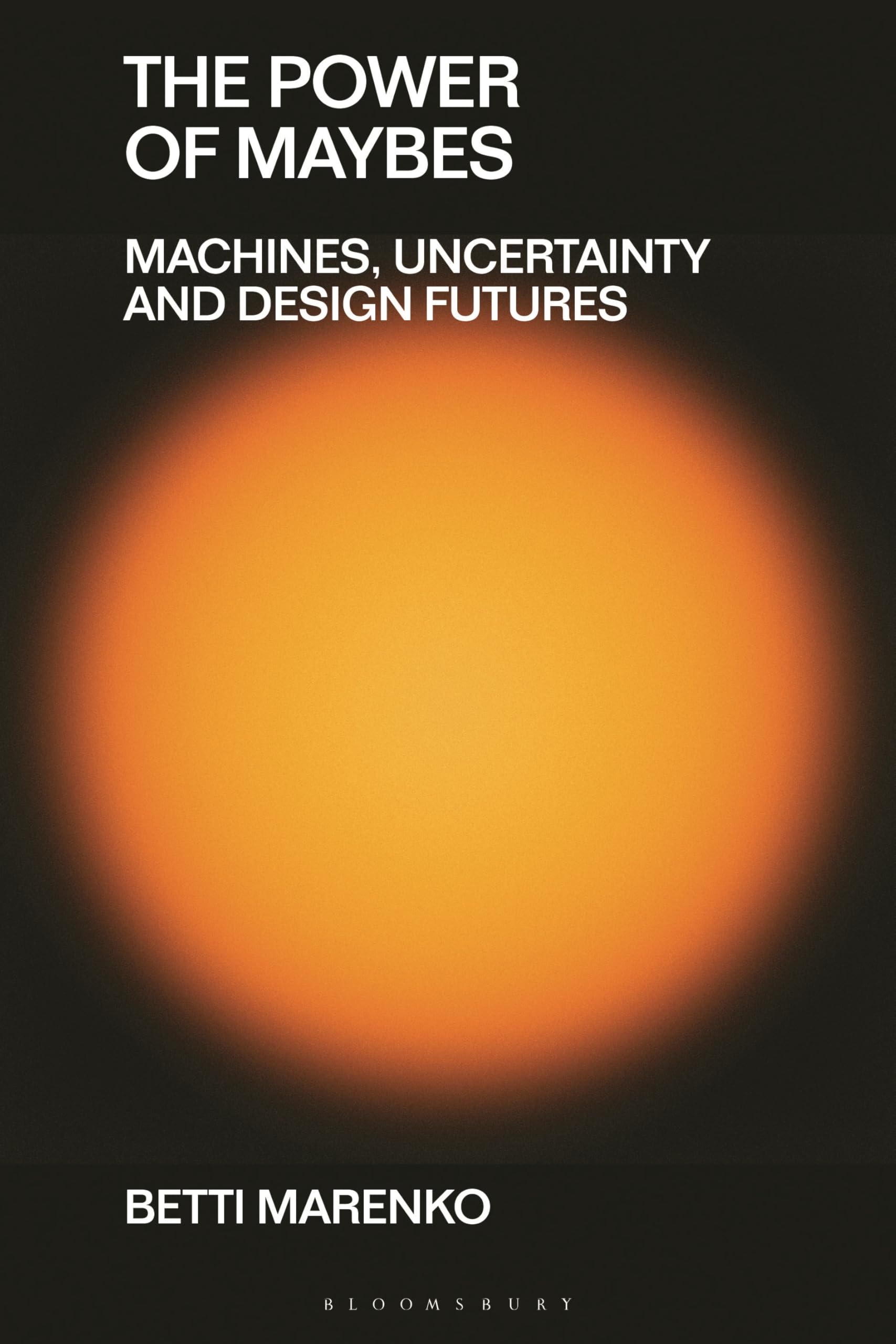
The Power of Maybes: Machines, Uncertainty and Design Futures (Beyond the Modern)
$24.95
by Betti Marenko



In a world of endless predictions and precision algorithms, The Power of Maybes offers a daring new way forward. What if uncertainty isn't a problem to solve, but a gift? This book reclaims hesitation, ambiguity and not-knowing as powerful tools to resist the rigid control of digital systems. Where machines seek to lock down knowledge, capture potential, dictate futures and foreclose possibilities, The Power of Maybes presents the radical idea that embracing uncertainty is essential in our age of planetary computation and offers ways of cultivating it as a form of resistance. By reframing the unknown as a powerful resource, Marenko offers a bold approach to living and thinking alongside machines without surrendering to their grip. Blending philosophy, design and critical tech studies, it challenges dystopian fears and utopian hopes about technology, and champions new ways of being-open, ungridded, unscaled. It's a call to cultivate the unknown and nurture potential. For those ready to reclaim their agency in an algorithmic age, The Power of Maybes is a guide to living with oceanic uncertainty-and finding power in it. “A brilliant and inspiring philosophical manifesto for an open and inventive approach to design and being alive.” ― Matthew Fuller, Professor of Cultural Studies, Goldsmiths, University of London, UK “A dazzling exploration of the themes of uncertainty, power, futures, and designs and their relation to the epistemic, epoch defining challenges of planetary computation and the automation of decision making . ” ― Tiziana Terranova, author of Network Culture (2004) and After the Internet (2022) “Betti Marenko has created a striking meditation on openness, indeterminacy and the call of an imminent future for theorizing, as well as making and unmaking forms of human invention.” ― Elizabeth Grosz, author of The Incorporeal: Ontology, Ethics and the Limits of Materialism (2017) Betti Marenko is Reader in Design and Techno-Digital Futures at Central Saint Martins, University of the Arts London, UK. She is a transdisciplinary theorist working at the intersection of process philosophies, design theory and critical technologies studies. She co-edited Deleuze and Design (2015) and Designing Smart Objects in Everyday Life (2021), and her work has been published in New Formations, Design and Culture, Design Studies, Digital Creativity, Leonardo and Technophany. Clive Dilnot is professor of Design Studies at Parsons The New School for Design, New York, USA. Recent publications include Ethics? Design? (2005) and the text for Chris Killip: Pirelli Work (2007). Eduardo Staszowski is Professor of Design Strategies at Parsons School of Design and Director of the Parsons DESIS Lab, USA. He is the co-editor of the Designing in Dark Times, Radical Thinkers in Design, and Beyond the Modern series, and Designing in Dark Times: An Arendtian Lexicon (Bloomsbury, 2020). Virginia Tassinari is Assistant Professor in the Human-Centered Design Department, Faculty of Industrial Design Engineering at TU Delft, the Netherlands, and a design researcher for the foresight and design studio Pantopicon, Belgium. She is the co-editor of the Beyond the Modern series and Designing in Dark Times: An Arendtian Lexicon (Bloomsbury, 2020).