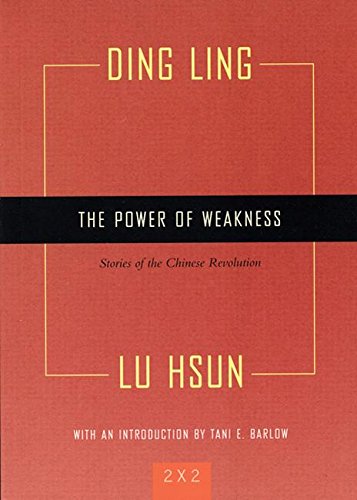



The Power of Weakness juxtaposes stories by Lu Hsun, revered as the most important figure in twentieth-century Chinese letters,” and Ding Ling, his successor in writing in a realistic style about life in modern China. Six works of astringent social commentary locate moments of conflict when tradition and notions of social conformity are in flux. In his speech What Happens After Nora Leaves Home?” (a reference to Ibsen) and his short stories New Year’s Sacrifice” and Regret for the Past,” Lu Hsun exposes how the anti-Confucian nationalist movement of the 1920s liberated women’s thoughts and expanded their expectations only to leave them stranded by outmoded customs and financial dependency. Ding Ling, reacting to the clash between the nationalist and communist movements dating from the late 1920s, moves on from Lu Hsun’s sentiments in her feminist speech Thoughts on March 8 (Women’s Day)” and in her more hopeful short stories New Faith” and When I Was in Xia Village.” Named the commander of China’s cultural revolution” by Mao Zedong, Lu Hsun (18811936) is one of the most influential writers of the twentieth century. Ding Ling (19041985) was one of modern China’s most famous writers and cultural revolutionaries. "Stories by two giants of literary realism in modern China answer 'How do you write about a revolution?'" Tani E. Barlow, author of The Question of Women in Chinese Feminism "A vital collection . . . from 1920s and 1930s China written at a moment of despair and hope. The stories, no less than the excellent Introduction, have much to say about writing the historical experience of revolution, and, by implication, about how we might write our current times. A must read for anyone interested in good world literature, feminism and/or politics." Rebecca E. Karl, author of Staging the World: Chinese Nationalism at the Turn of the Twentieth Century "Stories by two giants of literary realism in modern China answer 'How do you write about a revolution?'" ― Tani E. Barlow, author of The Question of Women in Chinese Feminism "A vital collection . . . from 1920s and 1930s China written at a moment of despair and hope. The stories, no less than the excellent Introduction, have much to say about writing the historical experience of revolution, and, by implication, about how we might write our current times. A must read for anyone interested in good world literature, feminism and/or politics." ― Rebecca E. Karl, author of Staging the World: Chinese Nationalism at the Turn of the Twentieth Century Ding Líng was the pseudonym of Jiang Bingzhi (October 12, 1904 - March 4, 1986), a contemporary Chinese author from Linli, Hunan province. She is most noted for Miss Sophie's Diary , published in 1927, and later her Communist literature, including The Sun Shines Over the Sanggan River , which won the Stalin Prize for literature in 1951. Hailed by Mao Zedong as the source of modern Chinese revolutionary literature, Lu Hsün or Lu Xun (September 25, 1881 - October 19, 1936), the pen name of Zhou Shuren, is considered one of the most influential Chinese writers of the 20th century. His literary works enriched every modern genre, except the novel, and influenced the rise of Chinese nationalism. Tani E. Barlow is the Director for the Project for Critical Asian Studies and Professor of History and Women's Studies at the University of Washington, Seattle. Her most recent book is The Question of Women in Chinese Feminism . She has also edited an anthology entitled I Myself Am Woman: Selected Writings of Ding Ling . Used Book in Good Condition