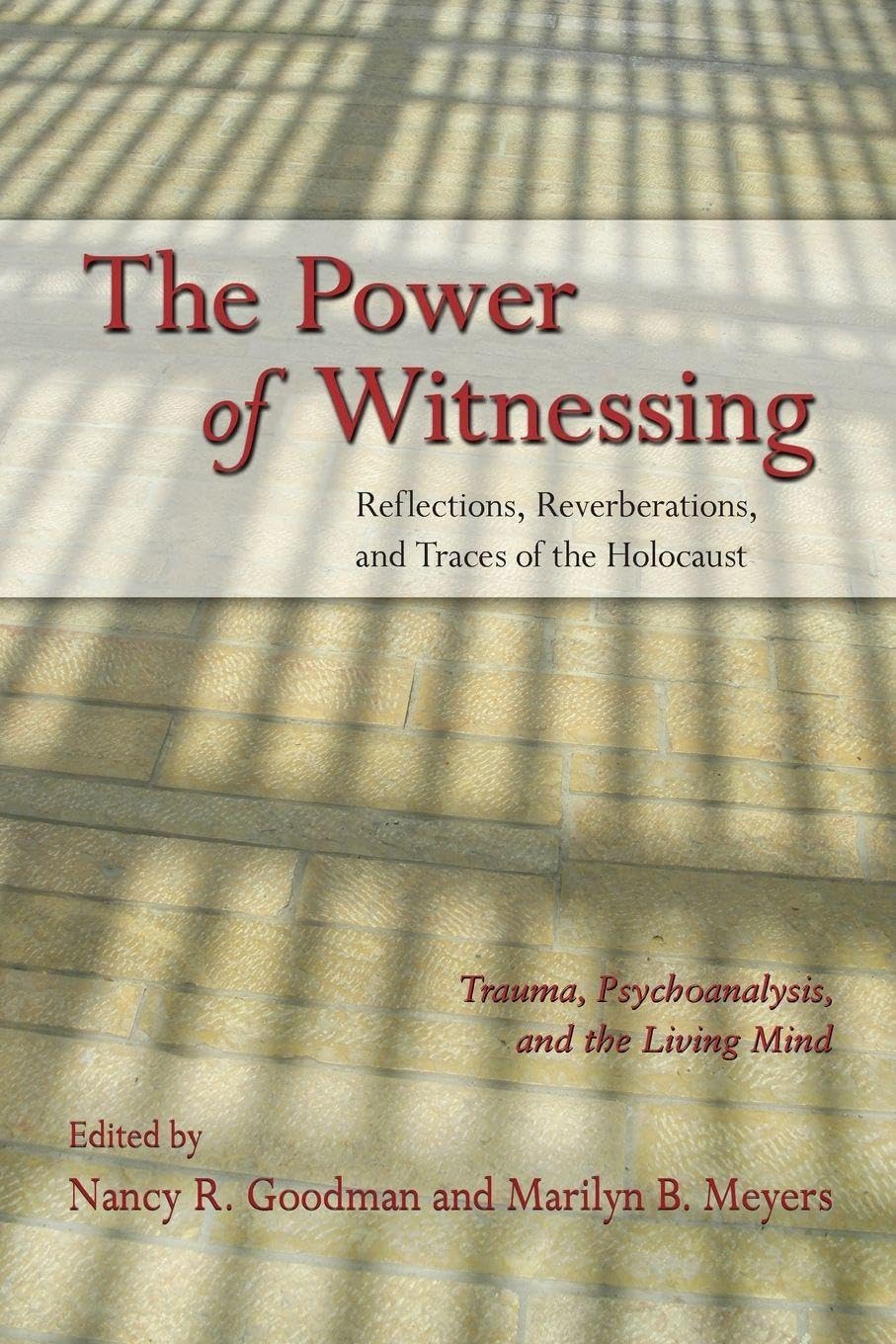
The Power of Witnessing: Reflections, Reverberations, and Traces of the Holocaust: Trauma, Psychoanalysis, and the Living Mind
$32.00
by Nancy R. Goodman



Witnessing comes in as many forms as the trauma that gives birth to it. The Holocaust, undeniably one of the greatest traumatic events in recent human history, still resonates into the twenty-first century. The echoes that haunt those who survived continue to reach their children and others who did not share the experience directly. In what ways is this massive trauma processed and understood, both for survivors and future generations? The answer, as deftly illustrated by Nancy Goodman and Marilyn Meyers, lies in the power of witnessing: the act of acknowledging that trauma took place, coupled with the desire to share that knowledge with others to build a space in which to reveal, confront, and symbolize it. As the contributors to this book demonstrate, testimonial writing and memoir, artwork, poetry, documentary, theater, and even the simple recollection of a memory are ways that honor and serve as forms of witnessing. Each chapter is a fusion of narrative and metaphor that exists as evidence of the living mind that emerges amid the dead spaces produced by mass trauma, creating a revelatory, transformational space for the terror of knowing and the possibility for affirmation of hope, courage, and endurance in the face of almost unspeakable evil. Additionally, the power of witnessing is extended from the Holocaust to contemporary instances of mass trauma and to psychoanalytic treatments, proving its efficacy in the dyadic relationship of everyday practice for both patient and analyst. The Holocaust is not an easy subject to approach, but the intimate and personal stories included here add up to an act of witnessing in and of itself, combining the past and the present and placing the trauma in the realm of knowing, sharing, and understanding. Contributors: Harriet Basseches, Elsa Blum, Bridget Conley-Zilkic, Paula Ellman, Susan Elmendorf, George Halasz, Geoffrey Hartman, Renee Hartman, Elaine Neumann Kulp-Shabad, Dori Laub, Clemens Loew, Gail Humphries Mardirosian, Margit Meissner, Henri Parens, Arlene Kramer Richards, Arnold Richards, Sophia Richman, Katalin Roth, Nina Shapiro-Perl, Myra Sklarew, Ervin Staub. "We can be grateful for the publication of this book. It serves not only as a reminder of a deplorable human conflagration that Pines and others have urged us not to forget, but also as a reminder that we psychoanalysts need to resist the pull to overlook or deny the impact of external reality upon our patients. The book represents a counterweight to the unfortunate tendency that has arisen within our profession to overvalorize the here-and-now interaction between patient and therapist, to the exclusion of appreciating what the patient has experienced en route to the analyst’s office. " The Psychoanalytic Quarterly, 2014 "Goodman and Meyers’s primarily experiential book stands testament to the power of witnessing. It allows readers to imagine what it might have been like to have experienced the unimaginable. The editors’ passion and dedication to their mission to keep the memory of the Holocaust experience alive in the minds of the living is impressive, scholarly, and creative. Their book will be of value to psychotherapists and psychoanalysts treating patients with traumatic experiences of varying degrees of severity." -Journal of the American Psychoanalytic Association "This book manages to include many different voices and perspectives on the large subject of witnessing. There is much to be learned from this collection. Readers of this book will be challenged in unexpected ways. Memories may be stirred, and genealogies may be questioned. The editors are to be applauded for their choices and for bringing together all of this material in one volume." –Division Review "Witnessing is indeed a process that involves experiencing the trauma. Goodman and Meyers' work with survivors and their children is an area that we need to continually observe. But it is not just the Holocaust that needs repeated witnessing―it is all areas of trauma. The Power of Witnessing focuses on the intimacy of the therapist with the survivor, which in turn helps widen the survivor's awareness of the residues and their continuing influences. This witnessing makes possible resilience." - Henry Krystal, M.D., author, Integration and Self-Healing (The Analytic Press, 1993) " Witnessing―most readily thought of in terms of the Holocaust―is actually a vital intersubjective phenomenon that is central to the way that the interpersonal process facilitates individual consolidation and growth. As does a clinical analysis, so does this piercingly wise study of witnessing engage the reader in the active emotional experience of learning, leading one to know from both inside and outside, to understand from new depths. The contributions within this work expose not only the impact of trauma but, importantly, how the very act of witnessing is itself essential to life, to change, and to growth. It was so for me and I believe will be so fo