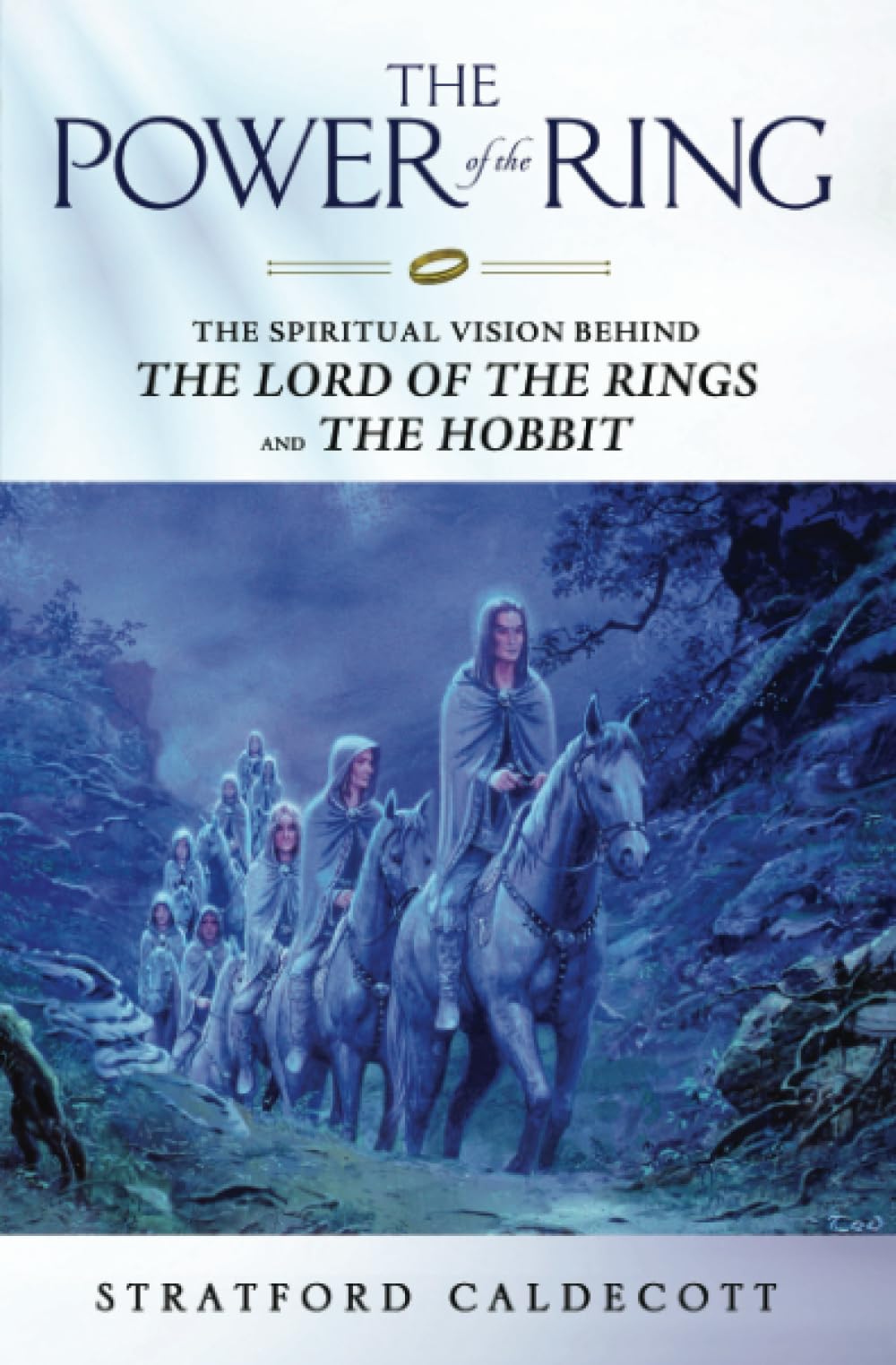
The Power of the Ring: The Spiritual Vision Behind the Lord of the Rings and The Hobbit
$17.62
by Stratford Caldecott



Digging deep into J. R. R. Tolkien’s spiritual biography—his religious scholarship and his love of both Christian and pagan myth—Stratford Caldecott offers a critical study of how the acclaimed author effectively created a vivid Middle Earth using the familiar rites and ceremonies of human history. And while readers and moviegoers alike may appreciate the fantasy world of The Hobbit and the Lord of the Rings trilogy, few know that in life, Tolkien was a devout Roman Catholic and that the characters, the events, and the general morality of each novel are informed by the dogmas of his faith. Revised and updated, this acclaimed study of Tolkien’s achievement—previously released as Secret Fire in the UK—includes commentary on Peter Jackson’s film adaptations and explores many of the fascinating stories and letters published after Tolkien’s death. "A superb book that blends academic rigor with a clear passion for the subject." — Christian Marketplace "Caldecott's work is a delight to read, with fascinating insights on nearly every page as he discusses the riches of Tolkien's work." — The Sower "This book will be welcomed by those interested in the deep theological underpinnings of Tolkien's works, and is recommended to academic libraries supporting upper level coursework on Tolkien or religion and literature." —Daniel Boice, Catholic Library World " [...] Caldecott examines and elucidates the underlying Christian aspect of Tolkien’s symbolism within his fantastical universe. A thoughtful reader with no religious background will learn much about the complexity of Tolkien’s fictitious universe [...] The trilogy is much more than a whimsical fairyland; behind it lies a profound knowledge of ancient mythopoeic tradition, baptized by a Catholic imagination." —Francis Phillips, The Catholic Herald Stratford Caldecott is the director of the Centre for Faith and Culture in Oxford, England, and the author of All Things Made New , Beauty for Truth’s Sake , and Beauty in the Word . The Power of the Ring The Spiritual Vision Behind The Hobbit and The Lord of the Rings By Stratford Caldecott The Crossroad Publishing Company Copyright © 2012 Stratford Caldecott All rights reserved. ISBN: 978-0-8245-4983-1 Contents Acknowledgments, Preface to the Revised Edition, Introduction, Part One THE SECRET FIRE, 1. The Tree of Tales, 2. The Hobbit: There and Back Again, 3. A Very Great Story, 4. A Hidden Presence: Tolkien's Catholicism, 5. Let These Things Be, 6. Behind the Stars, 7. Tolkien's Achievement, Part Two APPENDICES, 1. An Archetypal Journey: Tolkien and Jung, 2. Tolkien's Social Philosophy, 3. The Shadow of King Arthur, 4. Friendship in The Lord of the Rings, 5. Tolkien for Homeschoolers, 6. Tolkien and Paganism, 7. The Beginning of Days, 8. Myths Transformed, 9. The Film of the Rings, Notes, Bibliography, Index, CHAPTER 1 The Tree of Tales Tolkien was an explorer. The stories in which he invested so much time and energy are notes of his expeditions in search of an older or "inner" world. Over the years he added revision after revision, layer by layer, often working late into the night, filling in a vast historical canvas, weaving theme upon theme, until the whole collection resembled a great "tree of tales," like the gnarled oaks he loved. Now that we have access to the vast corpus of unfinished and reworked stories and background material, thanks to his son Christopher's labors on the twelve-volume History of Middle-Earth, we can see how much time and energy went into this writing. If his contemporaries and peers had known the full scale of his enterprise, they would have been shocked. What drove Tolkien so late into the night was not merely the obsession to tell a story, but the belief that "legends and myths are largely made of 'truth,' and indeed present aspects of it that can only be perceived in this mode" (L 131). He knew he was writing fiction, but at the same time he felt that he was telling the truth about the world as it revealed itself to him. And this truth he discovered as he wrote, through the very process of writing. He claimed always to have had the sense that he was recording what was already "there," rather than inventing stuff out of his own head (L 131), a feeling that lay behind the fictional device of the "Red Book of Westmarch" on which The Lord of the Rings itself pretended to be based. In a letter to Christopher he admitted that the story seemed almost to write itself and sometimes took a direction very different from the preliminary sketch, as if the truth was trying to emerge through him (L 91). In some sense, then, he did actually believe what he was writing. ("There are secondary planes or degrees," he writes in the "Notion Club Papers.") His stories were set not in a distant galaxy or another world, but in this world a long time ago. In a draft letter to an admirer dated 1971 (L 328), Tolkien described writing with