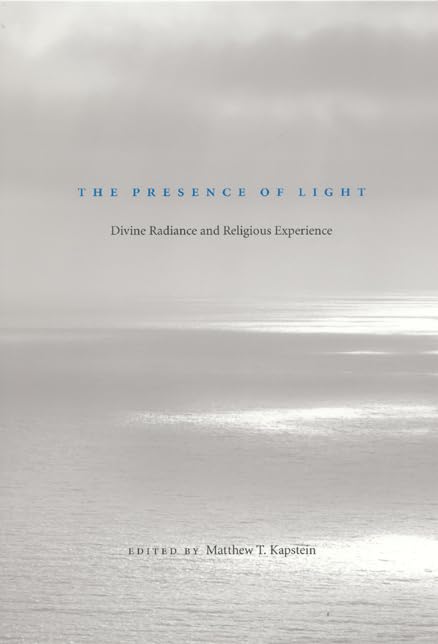
The Presence of Light: Divine Radiance and Religious Experience
$99.00
by Matthew T. Kapstein



There is perhaps no greater constant in religious intuition and experience than the presence of light. In spiritual traditions East and West, light is not only ubiquitous but something that assumes strikingly similar forms in altogether different historical and cultural settings. This study examines light as an aspect of religiously valued experiences and its entailments for mystical theology, philosophy, politics, and religious art. The essays in this volume make an important contribution to religious studies by proposing that it is misleading to conceive of religious experience in terms of an irreconcilable dichotomy between universality and cultural construction. An esteemed group of contributors, representing the study of Asian and Western religious traditions from a range of disciplinary perspectives, suggests that attention to various forms of divine radiance shows that there is indeed a range of principles that, if not universal, are nevertheless very widely occurring and amenable to fruitful comparative inquiry. What results is a work of enormous scope, demonstrating compelling cross-connections that will be of value to scholars of comparative religions, mysticism, and the relationship between art and the sacred. Contributors: * Catherine B. Asher * Raoul Birnbaum * Sarah Iles Johnston * Matthew T. Kapstein * Andrew Louth * Paul E. Muller-Ortega * Elliot R. Wolfson * Mimi Hall Yiengpruksawan * Hossein Ziai “ The Presence of Light is a significant contribution to the history of religions and the study of mysticism. This is a rich collection of essays and an exemplary model of comparative inquiry.”--William Darrow, Williams College -- William Darrow, Williams College There is perhaps no greater constant in religious intuition and experience than the presence of light. In spiritual traditions East and West, light is not only ubiquitous but something that assumes strikingly similar forms in altogether different historical and cultural settings. This study examines light as an aspect of religiously valued experiences and its entailments for mystical theology, philosophy, politics, and religious art. The essays in this volume make an important contribution to religious studies by proposing that it is misleading to conceive of religious experience in terms of an irreconcilable dichotomy between universality and cultural construction. An esteemed group of contributors, representing the study of Asian and Western religious traditions from a range of disciplinary perspectives, suggests that attention to various forms of divine radiance shows that there is indeed a range of principles that, if not universal, are nevertheless very widely occurring and amenable to fruitful comparative inquiry. What results is a work of enormous scope, demonstrating compelling cross-connections that will be of value to scholars of comparative religions, mysticism, and the relationship between art and the sacred. Contributors: * Catherine B. Asher * Raoul Birnbaum * Sarah Iles Johnston * Matthew T. Kapstein * Andrew Louth * Paul E. Muller-Ortega * Elliot R. Wolfson * Mimi Hall Yiengpruksawan * Hossein Ziai There is perhaps no greater constant in religious intuition and experience than the presence of light. In spiritual traditions East and West, light is not only ubiquitous but something that assumes strikingly similar forms in altogether different historical and cultural settings. This study examines light as an aspect of religiously valued experiences and its entailments for mystical theology, philosophy, politics, and religious art. The essays in this volume make an important contribution to religious studies by proposing that it is misleading to conceive of religious experience in terms of an irreconcilable dichotomy between universality and cultural construction. An esteemed group of contributors, representing the study of Asian and Western religious traditions from a range of disciplinary perspectives, suggests that attention to various forms of divine radiance shows that there is indeed a range of principles that, if not universal, are nevertheless very widely occurring and amenable to fruitful comparative inquiry. What results is a work of enormous scope, demonstrating compelling cross-connections that will be of value to scholars of comparative religions, mysticism, and the relationship between art and the sacred. Contributors: * Catherine B. Asher * Raoul Birnbaum * Sarah Iles Johnston * Matthew T. Kapstein * Andrew Louth * Paul E. Muller-Ortega * Elliot R. Wolfson * Mimi Hall Yiengpruksawan * Hossein Ziai Matthew T. Kapstein is the Numata Professor of Buddhist Studies in the Divinity School of the University of Chicago and directeur d’études at the École Pratique des Hautes Études, Paris. He is the coauthor of The Tibetan Assimilation of Buddhism: Conversion, Contestation, and Memory and Reason’s Traces: Identity and Interpretation in Indian and Tibetan Buddhist Thought .