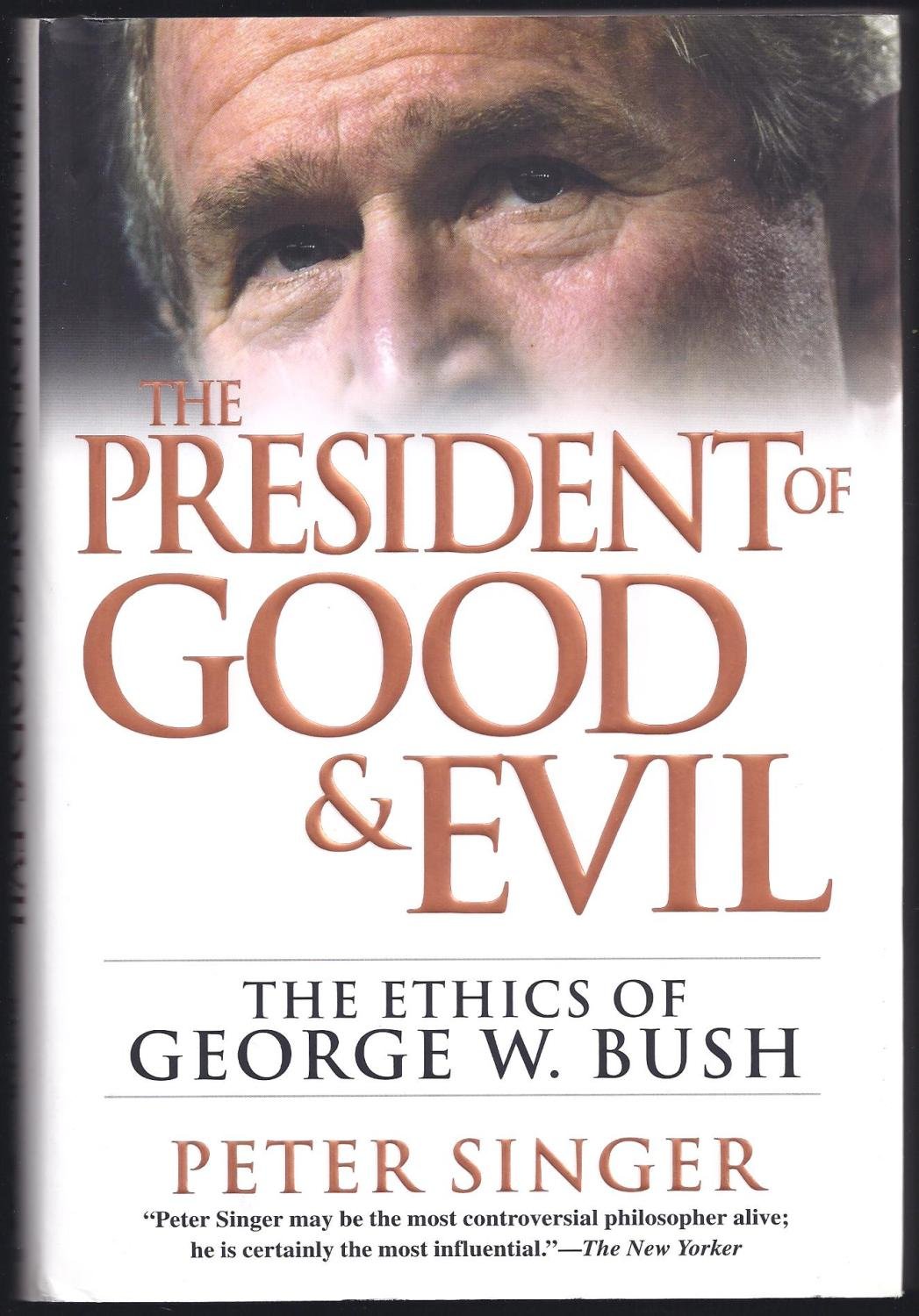



The ethicist and author of Animal Liberation offers a provocative look at moral failure of President George W. Bush, revealing a pattern of ethical confusion and self-contradiction when speaking out on such controversial issues as stem-cell research, tax cuts, the war in Iraq, and America as a global power. A president's vocabulary of moral judgment comes in for harsh scrutiny from a prominent ethicist. Whether examining the rhetoric with which Bush has explained the war against terrorism or parsing the justifications the president has marshaled to cut taxes and restrict stem-cell research, Singer identifies inconsistencies in ethical reasoning. Repeatedly, Singer accuses Bush of relying on moral terms that reflect only raw intuition, not systematic reflection. But in indicting Bush for an imperialistic foreign policy and for an incoherently religious domestic agenda, Singer must also criticize media commentators who have supported the president and a popular culture that has echoed his slogans. Readers who find their own views under attack may complain of authorial bias, especially since Singer's leftist premises guarantee a negative evaluation of almost any Republican. More cynical readers may question Singer's expectation of theoretical rigor in the real-world maneuvering of a politician from any party. In any case, the ideological controversy that Singer's critique will spark should only intensify public interest in this book. Bryce Christensen Copyright © American Library Association. All rights reserved "Peter Singer may be the most controversial philosopher alive; he is certainly among the most influential." -- The New Yorker Peter SingerÂs many books include Practical Ethics Animal Liberation and most recently Pushing Time Away: My Grandfather and the Tragedy of Jewish Vienna . He appears in the print media frequently, and has been on shows such as The OÂReilly Factor and the Today show. He is a professor of bioethics at Princeton UniversityÂs Center for Human Values. No doubt it would be a good thing if all presidents were required to pass a course in moral philosophy before taking office. There they would learn about rights-based moral systems, utilitarianism, conflicts of moral principles, the Golden Rule, the nature of virtue, the principles of justice, the relationship between morality and religion, and so on. Given that a president must make policy decisions in which these concepts are critical -- for example, on stem cell research -- it would help to have some articulate awareness of what they involve and how to apply them. It seems safe to assume that George W. Bush has never taken such a course and has no intention of doing so. Yet he came to office powered by moral rhetoric to a degree unusual in politics. There was much talk of restoring honor to the White House, of compassion, of the evils of poverty and injustice, of humility on the world stage -- and latterly of good and evil. This was to be an administration shaped by moral principle, decency and honesty. The President of Good & Evil, Peter Singer's timely and searching new book, is in effect an ethics tutorial directed toward the leader of the "free world." Singer, professor of bioethics at Princeton University, gives Bush a D, if not an outright fail. The bulk of the book is a litany of moral inconsistencies and failures, of persistent hypocrisy and doublethink. Singer's method is to contrast Bush's enunciations of principle with the realities of his policies, finding repeatedly that political expediency triumphs over declarations of principle. The list is by now familiar, but worth assembling. Bush began his presidency lamenting the injustice of children born to poverty and disadvantage: "And this is my solemn pledge: I will work to build a single nation of justice and opportunity." Yet his enormous cuts in taxation clearly entail the withdrawal of resources from social programs that would help ameliorate such problems. His position on stem cell research, which stressed the absolute sanctity of life, even in the form of frozen embryos, sits ill with his cavalier attitude toward capital punishment, in which innocent people are not infrequently sent to their death, and with his ready acceptance of "collateral" civilian casualties in time of war. The protection of the legal rights of American citizens abroad who are accused of crimes, even to the point of rejecting the legitimacy of the International Criminal Court, is flatly inconsistent with the policy of detaining terrorist suspects for long periods without access to a lawyer and without being charged -- not to mention the use of coercive techniques of interrogation (i.e., torture). Free trade is extolled, but then massive subsidies are handed out to the farming industry, with catastrophic effects on struggling farmers in the developing world, and prohibitive tariffs slapped on the import of foreign steel. States' rights are to be respected, except when gay marria