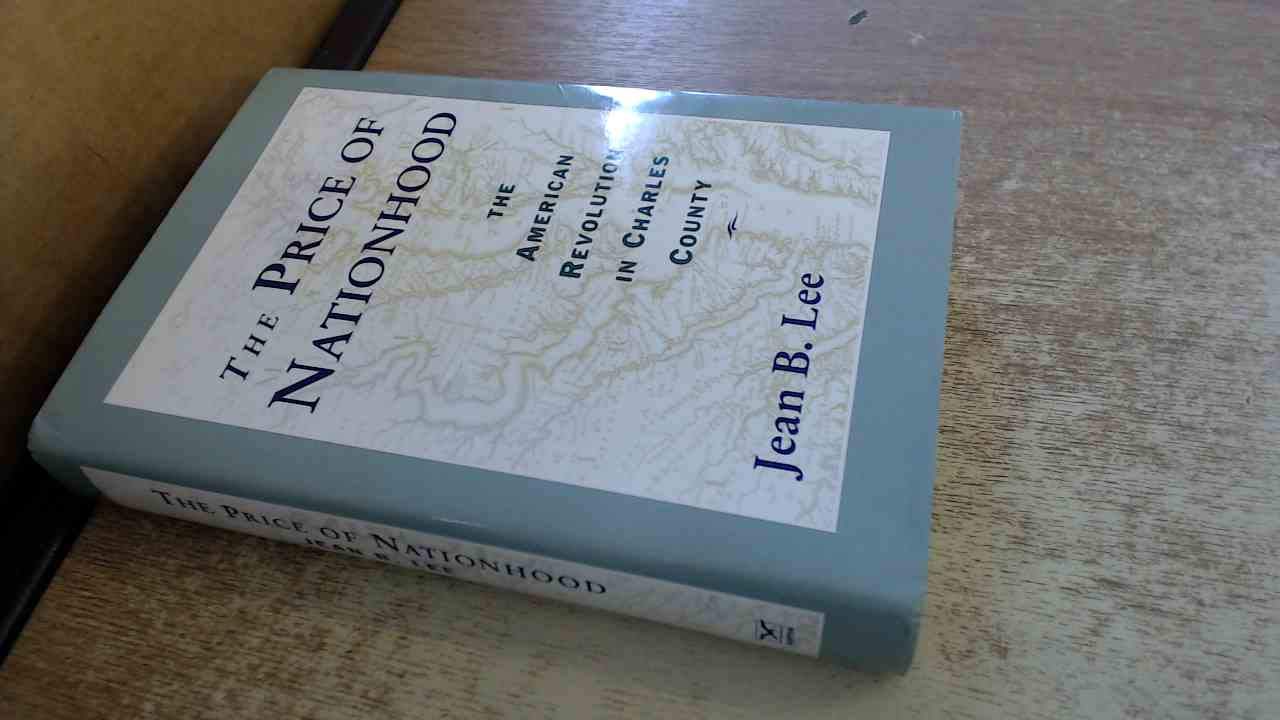



We see the American Revolution as a formative event, but it was also a shattering one for those who experienced it. For much of the eighteenth century, Maryland's Charles County, situated on the banks of the Potomac near Chesapeake Bay, enjoyed the prosperity born of its rich soil and thriving overseas trade in tobacco. Its social order, white planters at the top, enslaved blacks at the bottom, was stable. Its politics were local. This world was swept away by Independence and the war with Britain. Led by its accustomed elite, the county entered the maw of Revolution, fought battles local and distant, and emerged part of a nation, its society admitting greater degrees of freedom, but now a backwater, impoverished, depleted, its impulse gone. The Price of Nationhood reshapes the story of the American Revolution, bending the familiar contours imprinted by the New England revolutionary experience. At the same time, Jean Lee's narrative rewards us with history at the ground level, rich with the smells of the earth and sea in eighteenth-century coastal Maryland. Community studies have resuscitated interest in Colonial America. Here, Lee (history, Univ. of Wisconsin, Madison) demonstrates that the American Revolution, like many other revolutions before and since, had some of its most significant effects at the local level and not just in the halls of power. Examining Charles County, Maryland, where the wealth was based on the labor of enslaved blacks, Lee asserts that the forces of the revolution not only brought independence to the nation but also unanticipated disruption of the social and economic order at the local level. The effectiveness of the author's argument depends on his ability to re-create for the reader an understandable whole from the microcosmic data, including court proceedings, land records, and other personal papers. In this regard, Lee succeeds extremely well. Recommended even for those not familiiar with Maryland history or the society and politics of the Revolutionary era. Charles K. Piehl, Mankato State Univ., Minn. Copyright 1994 Reed Business Information, Inc. This sensitive study examines at the local level the radically transforming nature of what is often simplistically viewed as the world's most conservative revolution. In the 1760s, Charles County, Md., seemed a typically stable community: a Chesapeake society in which a Protestant male gentry expected and received deference from indentured servants, women, Roman Catholics (then disenfranchised), and slaves. Lee (History/Univ. of Wisconsin) demonstrates how, only three decades later, that world had changed utterly. The Revolutionary War sparked a hearts-and-minds effort to save the new republic, as residents made Tories unwelcome, rounded up munitions, food, and clothing, and joined the militia. With the war won, the county exhibited optimism about its commercial future and greater acceptance of previously marginalized groups. Many slaves had won freedom through lawsuits and manumission; bound labor among whites was almost eliminated; religious liberty was extended to all; women had improved their status substantially; and, of course, its inhabitants, like all others in the newly independent United States, no longer owed allegiance to a king. The toll was immense, however. Largely because of massive debt, soil depletion, and other economic dislocations caused by the war, Charles County began a period of long-term decline after 1790, with many residents departing for a new life elsewhere. By the Civil War, it had 20% fewer people than at the time of George Washington's inauguration. Lee makes excellent use of a variety of local records to explain how this society, having caught the winds of change, suddenly and ruefully discovered that those winds were of gale force. Her work vividly affirms what she calls ``the value of seeking the general through the particular--of finding in the close examination of one place the outlines of an entire era.'' An illuminating local history, reflecting an emerging nation's tribulations. (Photos and maps, not seen) -- Copyright ©1994, Kirkus Associates, LP. All rights reserved. Jean B. Lee is professor of history at the University of Wisconsin at Madison.