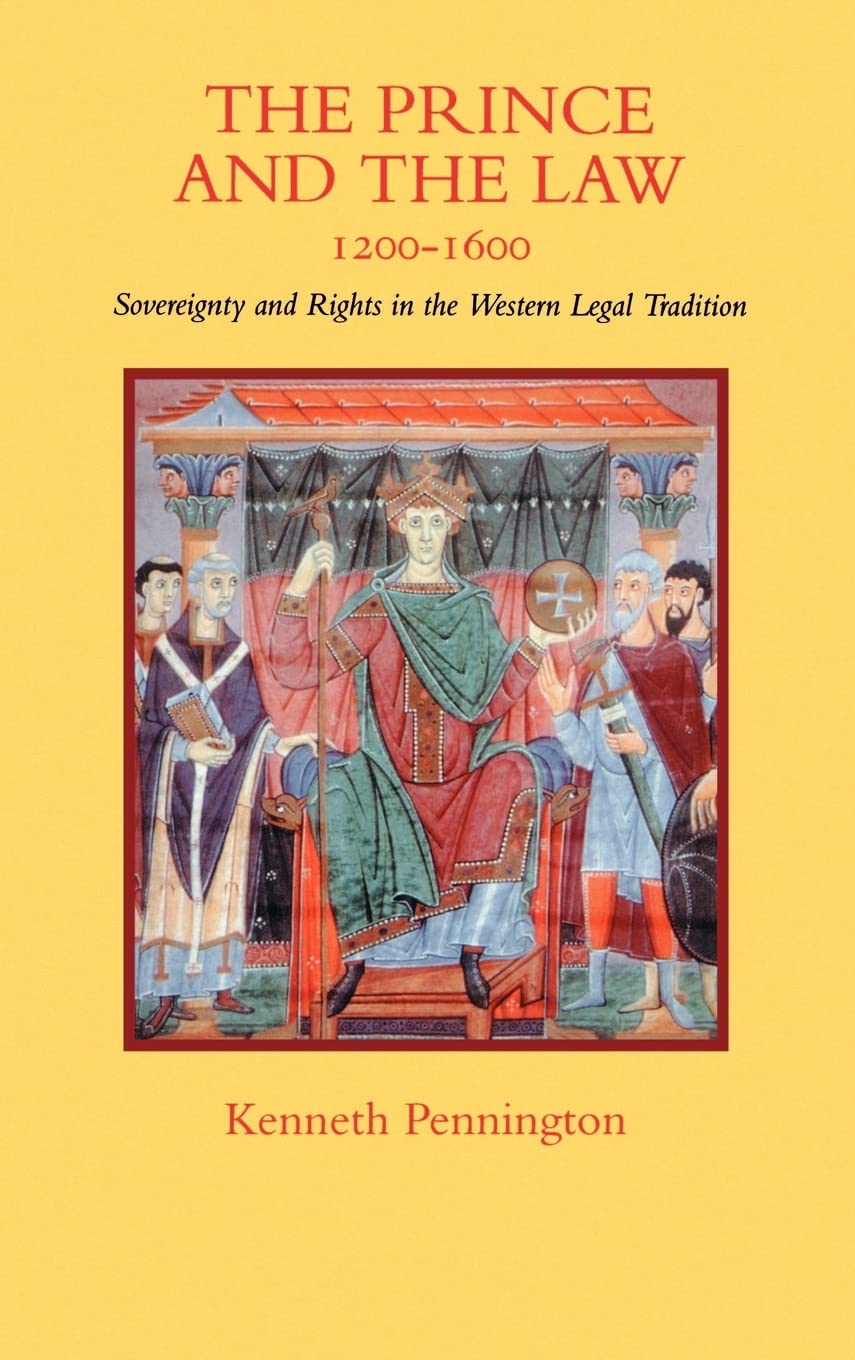
The Prince and the Law, 1200-1600: Sovereignty and Rights in the Western Legal Tradition (A Centennial Book)
$68.95
by Kenneth Pennington



The power of the prince versus the rights of his subjects is one of the basic struggles in the history of law and government. In this masterful history of monarchy, conceptions of law, and due process, Kenneth Pennington addresses that struggle and opens an entirely new vista in the study of Western legal tradition. Pennington investigates legal interpretations of the monarch's power from the twelfth to the seventeenth century. Then, tracing the evolution of defendants' rights, he demonstrates that the origins of due process are not rooted in English common law as is generally assumed. It was not a sturdy Anglo-Saxon, but, most probably, a French jurist of the late thirteenth century who wrote, "A man is innocent until proven guilty." This is the first book to examine in detail the origins of our concept of due process. It also reveals a fascinating paradox: while a theory of individual rights was evolving, so, too, was the concept of the prince's "absolute power." Pennington illuminates this paradox with a clarity that will greatly interest students of political theory as well as legal historians. "A work of synthesis that at the same time introduces new material to the treasury of studies on medieval political thought."Stanley Chodorov, University of California, San Diego "Specialists will find it not merely interesting, but exciting and significant."Robert L. Benson, University of California, Los Angeles "A work of synthesis that at the same time introduces new material to the treasury of studies on medieval political thought."―Stanley Chodorov, University of California, San Diego "Specialists will find it not merely interesting, but exciting and significant."―Robert L. Benson, University of California, Los Angeles Kenneth Pennington is Professor of History and Law at Syracuse University. Among his previous books is Popes and Bishops: The Papal Monarchy in the Twelfth and Thirteenth Centuries (1984). The Prince and the Law, 1200-1600: Sovereignty and Rights in the Western Legal Tradition By Kenneth Pennington University of California Press Copyright © 1993 Kenneth Pennington All right reserved. ISBN: 0520079957 Introduction In 1987, newspaper columnist Tom Wicker wrote that a former foreign minister of Israel, Abba Eban, preferred that the United States concentrate on new diplomatic initiatives in the Middle East rather than on a "prolonged investigatory ordeal" into the "Iran Affair" that was creating dangerous political storms for the Reagan ship of state. Mr. Eban's suggestion, inveighed Wicker:1 reflects a profound misunderstanding of the rule of law that is at the root of American democracy, and an even greater misreading of democracy's limits. Nothing undermines the rule of law, hence democracy, more than the ability of some temporary government, even for purposes believed good, to set aside law, or distort it, or ignore it. What worried Mr. Wicker also concerned the medieval jurists, even though they were lamentably ignorant of modem democratic principles. They did dabble in theories of representative government, created doctrines of consent to legislation, and believed in limited government. Through their writing and teaching jurists had created a powerful system of norms and rules derived from natural law, customary law, ancient Roman law, feudal law, and canon law that defined their conception of a properly ordered world.2 They conceived of law as a re- The International Herald Tribune, January 5, 1987, p. 4. The best introduction to these ideas is Ennio Cortese's brilliant book, La norma giuridica: Spunti teorici nel diritto comune classico (2 volumes; Ius nostrum 6; Milan: 1962-1964). pository of norms that created an unwritten constitution for society. Modern historians have dubbed this construct "Medieval Constitutionalism." Manlio Bellomo calls their system of thought a "common law" that reigned over medieval and early modern Europe.3 Wicker assumed that "rule of law" and "democracy" are tautological—one cannot logically exist without the other. "Rule of law," however, is an equivocal term: It can mean a society regulated by an ordered, just legal system, or it can mean a narrow legal principle.4 In any case, Wicker is probably right about modern democracies; the "rule of law" is a cornerstone of democratic institutions in the late twentieth century. But a reverential belief in the "rule of law" can and did exist long before Western democracies. In its earlier lives, "rule of law" was an important element in monarchical and republican (that is, non-monarchical, but not necessarily democratic) governments. When Wicker referred to "rule of law," he wanted to define a government's duty to uphold the rules of the legal system and to maintain the written constitution of the state. The implicit question he posed—could or should a government break the law for the public good?—has been asked regularly by Western thinkers since the twelfth century. Th