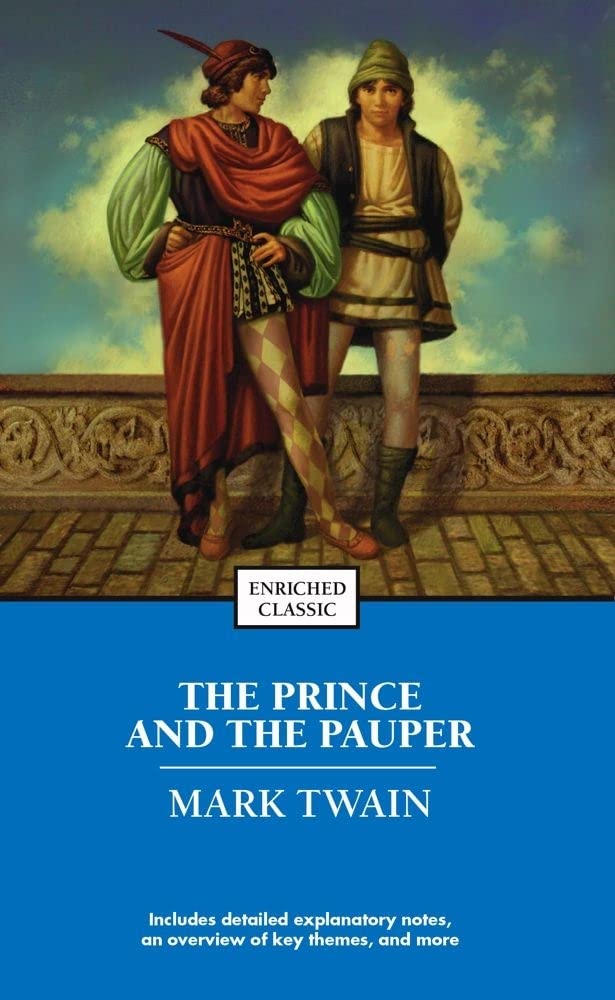



Two young men—one a child of the London slums, the other an heir to the throne—switch identities in this timeless novel about class and culture in sixteenth century England. Prince Edward inadvertently switches places with Tom Canty, a pauper. While both boys are interested in experiencing life in the other's shoes, they are dismayed by the realities of their new lives. Written before The Adventures of Huckleberry Finn was finished, this tale contains the elements of social criticism that were later to dominate Twain's writings. Enriched Classics enhance your engagement by introducing and explaining the historical and cultural significance of the work, the author’s personal history, and what impact this book had on subsequent scholarship. Each book includes discussion questions that help clarify and reinforce major themes and reading recommendations for further research. Mark Twain, born Samuel Langhorne Clemens in 1835, left school at age 12. His career encompassed such varied occupations as printer, Mississippi riverboat pilot, journalist, travel writer, and publisher, which furnished him with a wide knowledge of humanity and the perfect grasp of local customs and speech manifested in his writing. It wasn't until The Adventures of Huckleberry Finn (1885), that he was recognized by the literary establishment as one of the greatest writers America would ever produce. Toward the end of his life, plagued by personal tragedy and financial failure, Twain grew more and more cynical and pessimistic. Though his fame continued to widen--Yale and Oxford awarded him honorary degrees--he spent his last years in gloom and desperation, but he lives on in American letters as "the Lincoln of our literature." The Prince and the Pauper By Mark Twain Pocket Books Copyright © 2006 Mark Twain All right reserved. ISBN: 9781416523680 Chapter One Chapter I The Birth of the Prince and the Pauper In the ancient city of London, on a certain autumn day in the second quarter of the sixteenth century, a boy was born to a poor family of the name of Canty, who did not want him. On the same day another English child was born to a rich family of the name of Tudor, who did want him. All England wanted him, too. England had so longed for him, and hoped for him, and prayed God for him, that now that he was really come, the people went nearly mad for joy. Mere acquaintances hugged and kissed each other and cried; everybody took a holiday, and high and low, rich and poor, feasted and danced, and sang, and got very mellow?and they kept this up for days and nights together. By day, London was a sight to see, with gay banners waving from every balcony and house-top, and splendid pageants marching along. By night it was again a sight to see, with its great bonfires at every corner and its troops of revelers making merry around them. There was no talk in all England but of the new baby, Edward Tudor, Prince of Wales, who lay lapped in silks and satins, unconscious of all this fuss, and not knowing that great lords and ladies were tending him and watching over him?and not caring, either. But there was no talk about the other baby, Tom Canty, lapped in his poor rags, except among the family of paupers whom he had just come to trouble with his presence. Chapter II Tom's Early Life Let us skip a number of years. London was fifteen hundred years old, and was a great town-for that day. It had a hundred thousand inhabitants-some think double as many. The streets were very narrow, and crooked, and dirty, especially in the part where Tom Canty lived, which was not far from London Bridge. The houses were of wood, with the second story projecting over the first, and the third sticking its elbows out beyond the second. The higher the houses grew, the broader they grew. They were skeletons of strong criss-cross beams, with solid material between, coated with plaster. The beams were painted red or blue or black, according to the owner's taste, and this gave the houses a very picturesque look. The windows were small, glazed with little diamond-shaped panes, and they opened outward, on hinges, like doors. The house which Tom's father lived in was up a foul little pocket called Offal Court, out of Pudding Lane. It was small, decayed, and ricketty, but it was packed full of wretchedly poor families. Canty's tribe occupied a room on the third floor. The mother and father had a sort of bedstead in the corner, but Tom, his grandmother, and his two sisters, Bet and Nan, were not restricted-they had all the floor to themselves, and might sleep where they chose. There were the remains of a blanket or two and some bundles of ancient and dirty straw, but these could not rightly be called beds, for they were not organized; they were kicked into a general pile, mornings, and selections made from the mass at night, for service. Bet and Nan were fifteen years old-twins. They were good-hearted girls, unclean, clothed in rags, a