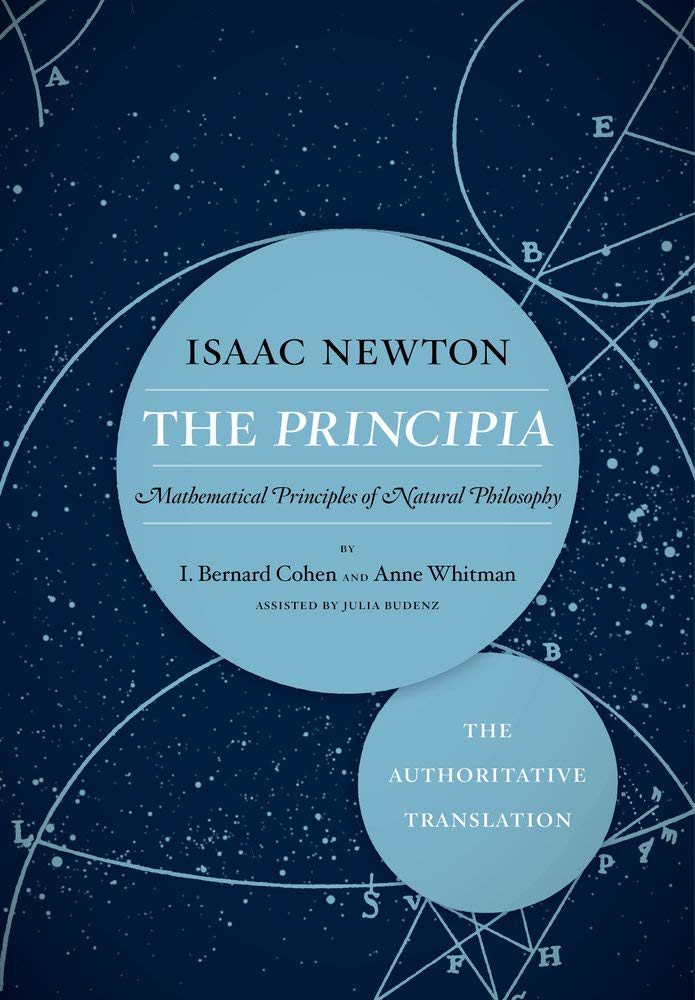
The Principia: The Authoritative Translation: Mathematical Principles of Natural Philosophy
$16.03
by Sir Isaac Newton



In his monumental 1687 work, Philosophiae Naturalis Principia Mathematica , known familiarly as the Principia , Isaac Newton laid out in mathematical terms the principles of time, force, and motion that have guided the development of modern physical science. Even after more than three centuries and the revolutions of Einsteinian relativity and quantum mechanics, Newtonian physics continues to account for many of the phenomena of the observed world, and Newtonian celestial dynamics is used to determine the orbits of our space vehicles. This authoritative, modern translation by I. Bernard Cohen and Anne Whitman, the first in more than 285 years, is based on the 1726 edition, the final revised version approved by Newton; it includes extracts from the earlier editions, corrects errors found in earlier versions, and replaces archaic English with contemporary prose and up-to-date mathematical forms. Newton's principles describe acceleration, deceleration, and inertial movement; fluid dynamics; and the motions of the earth, moon, planets, and comets. A great work in itself, the Principia also revolutionized the methods of scientific investigation. It set forth the fundamental three laws of motion and the law of universal gravity, the physical principles that account for the Copernican system of the world as emended by Kepler, thus effectively ending controversy concerning the Copernican planetary system. The translation-only edition of this preeminent work is truly accessible for today's scientists, scholars, and students. "Using freshly conceived methods and tools of inquiry in his 1687 publication of Principia Mathematica, Isaac Newton showed that the universe is knowable. But more importantly, he showed that the universe is predictable. We owe modern civilization to this towering genius of science."—Neil deGrasse Tyson, Astrophysicist, American Museum of Natural History "Newton's Principia Mathematica was the definitive achievement of seventeenth-century mathematics and natural philosophy. It has remained the indispensable foundation for all subsequent physical sciences. Thanks to this magnificent edition and detailed commentary, it has at long last become possible to make sense of that achievement in its own terms, and to follow exactly what it meant to its author and his readers. Lucid translation and the guide to the work's contents together offer an unmatched display of how the powers of mathematical reasoning and observational inquiry can help make sense of the system of the world."—Simon Schaffer, Professor of History and Philosophy of Science, University of Cambridge "Using freshly conceived methods and tools of inquiry in his 1687 publication of Principia Mathematica, Isaac Newton showed that the universe is knowable. But more importantly, he showed that the universe is predictable. We owe modern civilization to this towering genius of science."—Neil deGrasse Tyson, Astrophysicist, American Museum of Natural History "Newton's Principia Mathematica was the definitive achievement of seventeenth-century mathematics and natural philosophy. It has remained the indispensable foundation for all subsequent physical sciences. Thanks to this magnificent edition and detailed commentary, it has at long last become possible to make sense of that achievement in its own terms, and to follow exactly what it meant to its author and his readers. Lucid translation and the guide to the work's contents together offer an unmatched display of how the powers of mathematical reasoning and observational inquiry can help make sense of the system of the world."—Simon Schaffer, Professor of History and Philosophy of Science, University of Cambridge I. Bernard Cohen (1914–2003) was Victor S. Thomas Professor of the History of Science at Harvard University. He was the author of Benjamin Franklin's Science , Interactions , and Science and the Founding Fathers . Anne Whitman (1937–1984) was coeditor (with I. Bernard Cohen and Alexander Koyré) of the Latin edition, with variant readings, of the Principia . Julia Budenz , author of From the Gardens of Flora Baum , is a multilingual classicist and poet. The Principia Mathematical Principles of Natural Philosophy By Isaac Newton, I. Bernard Cohen, Anne Whitman UNIVERSITY OF CALIFORNIA PRESS Copyright © 1999 The Regents of the University of California All rights reserved. ISBN: 978-0-520-29074-7 Contents Publisher's Note, Preface to the 1999 Edition, A Brief History of the Principia, The Principia (Mathematical Principles of Natural Philosophy), Halley's Ode to Newton, Newton's Preface to the First Edition, Newton's Preface to the Second Edition, Cotes's Preface to the Second Edition, Newton's Preface to the Third Edition, Definitions, Axioms, or the Laws of Motion, Book 1: The Motion of Bodies, Book 2: The Motion of Bodies, Book 3: The System of The World, General Scholium, Notes, Notes Added in Second Printing,