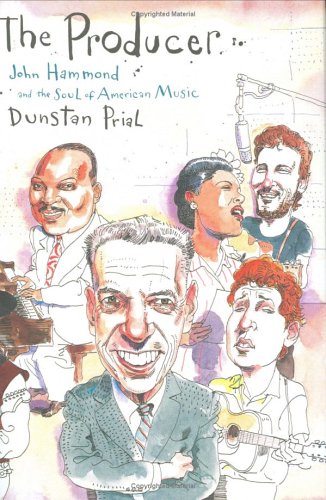



A "behind the music" story without parallel John Hammond is one of the most charismatic figures in American music, a man who put on record much of the music we cherish today. Dunstan Prial's biography presents Hammond's life as a gripping story of music, money, fame, and racial conflict, played out in the nightclubs and recording studios where the music was made. A pioneering producer and talent spotter, Hammond discovered and championed some of the most gifted musicians of early jazz—Billie Holliday, Count Basie, Charlie Christian, Benny Goodman--and staged the legendary "From Spirituals to Swing" concert at Carnegie Hall in 1939, which established jazz as America's indigenous music. Then as jazz gave way to pop and rock Hammond repeated the trick, discovering Bob Dylan, Aretha Franklin, Bruce Springsteen, and Stevie Ray Vaughan in his life's extraordinary second act. Dunstan Prial shows Hammond's life to be an effort to push past his privileged upbringing and encounter American society in all its rough-edged vitality. A Vanderbilt on his mother's side, Hammond grew up in a mansion on the Upper East Side of Manhattan. As a boy, he would sneak out at night and go uptown to Harlem to hear jazz in speakeasies. As a young man, he crusaded for racial equality in the music world and beyond. And as a Columbia Records executive—a dapper figure behind the glass of the recording studio or in a crowded nightclub—he saw music as the force that brought whites and blacks together and expressed their shared sense of life's joys and sorrows. This first biography of John Hammond is also a vivid and up-close account of great careers in the making: Bob Dylan recording his first album with Hammond for $402, Bruce Springsteen showing up at Hammond's office carrying a beat-up acoustic guitar without a case. In Hammond's life, the story of American music is at once personal and epic: the story of a man at the center of things, his ears wide open. A silver-spoon baby who felt the noblesse oblige and acted on it, John Hammond (1910-87) was, through his mother's family, a Vanderbilt. Fascinated in childhood by the family's black employees' music, he had by his midteens found Harlem, where he heard musicians who became international stars. Ditching Yale for jazz journalism and record production, he launched or boosted Billie Holiday, Benny Goodman, Count Basie, and Charlie Christian and began lifelong agitation for racial justice, starting with schemes to integrate jazz that bore famous fruit in Goodman's small groups with Teddy Wilson and Lionel Hampton and the Carnegie Hall concert "From Spirituals to Swing." Long Columbia Records and NAACP tenures enabled him to remain a star maker--Aretha Franklin, Bob Dylan, and Bruce Springsteen were later finds--and a social shaker after swing's demise. Attracting readers is done for Prial by the famous names Hammond's story obliges him to drop, and he neither probes Hammond's class-based arrogance and self-absorption nor more than hints at Hammond's personal financial decline. Still, this is gratifying reading for American pop mavens. Ray Olson Copyright © American Library Association. All rights reserved "The extraordinary John Hammond has long needed a good biography. This is it." --Pete Seeger "John Hammond must be grinning in his grave, because Dunstan Prial has brought back to life for 21st-century readers the man who animated much of the 20th century's greatest music. The Producer does justice not only to Hammond's legendary role in instigating and integrating American music, but also to his indefatigable efforts on behalf of civil rights and labor unions. To read this book is to bask, once again, in Hammond's toothy smile and marvel at his enthusiasm and insight." --Ken Emerson, author of Doo-Dah!: Stephen Foster and the Rise of American Popular Culture and Always Magic in the Air: The Bomp and Brilliance of the Brill Building Era. Dunstan Prial , born in New Jersey in 1970, has worked as a reporter with the Associated Press , and was led to Hammond's career by his admiration for Bruce Springsteen. He lives in Bristol, Rhode Island. Late in the evening of July 7, 1957, Count Basie and his orchestra took the stage to wrap up that year's Newport Jazz Festival. The all-black band was introduced by a tall, skinny, crew-cut white guy with a voice so plummy as to border on unintentional self-parody. I was there and remember it vividly, but anybody can hear it on the album "Basie at Newport," and to this day almost everybody is likely to agree that the contrast between the Manhattanite voice and the down-home Kansas City band is just about too exquisitely hilarious to be true. But it was, and is, no joke. The speaker was John Hammond, and he deserved to be there. Though little-known beyond the innermost circles of American popular music, Hammond was a man of almost incalculable influence on that music. Twenty years earlier, after hearing the Basie band on the radio -- the ba