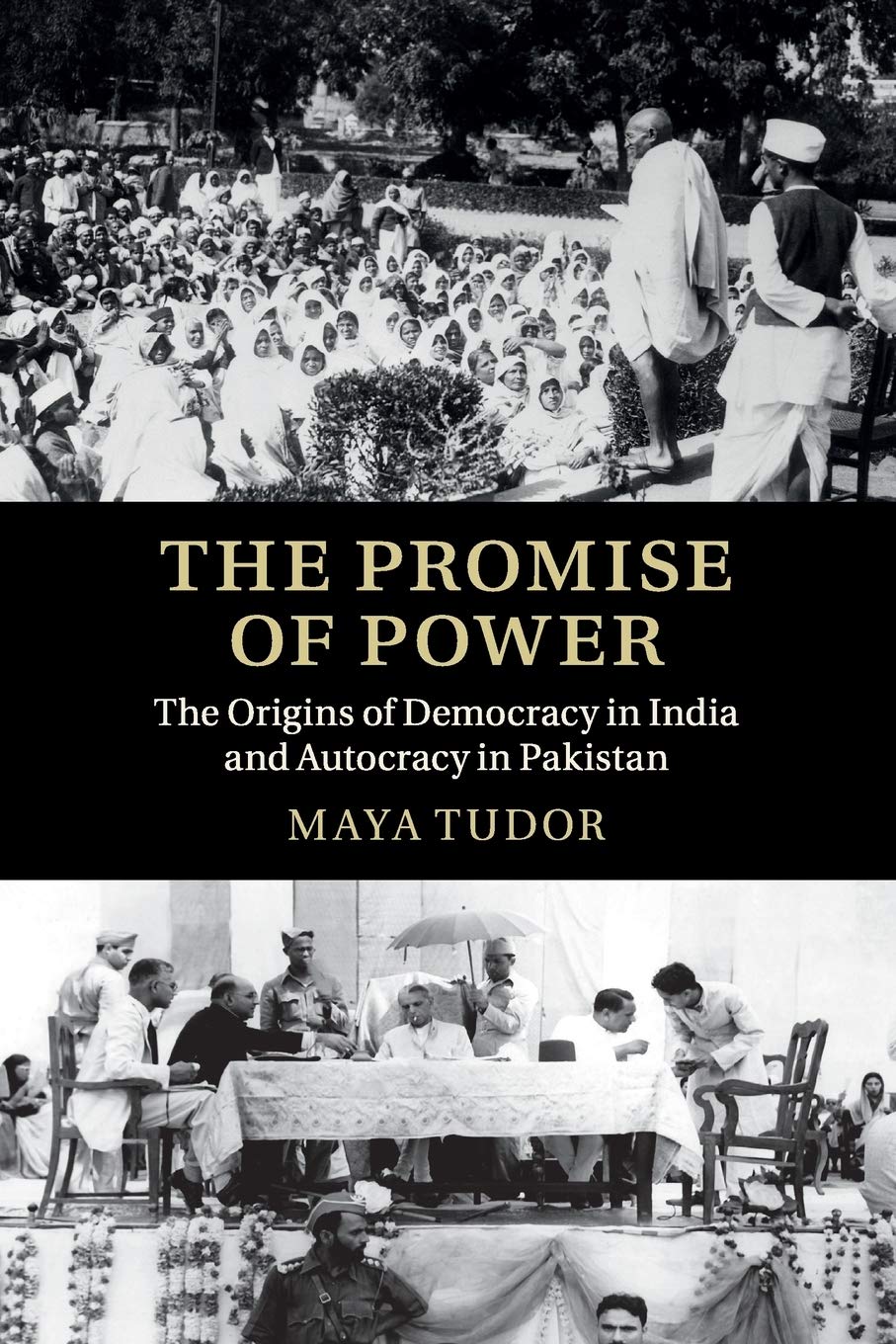
The Promise of Power: The Origins of Democracy in India and Autocracy in Pakistan
$28.57
by Maya Tudor



Under what conditions are some developing countries able to create stable democracies while others are perpetually prone to instability and authoritarianism? Despite broadly similar historical and political legacies, India's and Pakistan's regimes diverged radically after independence. In The Promise of Power, Maya Tudor seeks to explain why this occurred through a comparative historical analysis. Drawing on interviews, colonial records and early government documents, Tudor challenges the prevailing explanations of democratization, which attribute political outcomes directly to low levels of economic development and high levels of inequality. Instead, she suggests that the emergence of a stable democracy in India and an unstable autocracy in Pakistan is best explained by the historically-specific interests of the dominant social group which led each independence movement as well as by the varying strength of the political parties which were created to pursue those interests. "Acknowledging the importance of political parties to regime stability, Tudor moves further back the causal line of explanation by examining the conditions under which particular political parties first came into being and institutionalized the support of key elites. This monograph sheds new light on the origins of some of the systemic institutional, ideological and identity issues of India's and Pakistan's respective political regimes." Rosheen Kabraji, International Affairs "This is a carefully researched and clearly written study that not only makes a compelling argument but also offers perceptive insights into the history of the Indian and Pakistani political movements. While the broader political and social contexts that accompany the narratives in the chapters are not necessarily new to readers familiar with the political history of India and Pakistan, the author must be commended for the convincing manner in which the historical conditions and circumstances in the lead up to 1947 and beyond are marshaled to support her overarching argument … this illuminating book is an enjoyable read … [It] is a valuable study that has much to offer to those wishing to comprehend the political dynamics of India and Pakistan. It is, at the same time, an important contribution to the literature on the challenges of democratization in postcolonial developing countries." Tan Tai Yong, Pacific Affairs An examination of how, despite similar historical contexts, India became a stable democracy post-independence, whilst Pakistan became an unstable autocracy. Maya Tudor is a Fellow in Politics at St John's College, Oxford. Her dissertation, upon which this book is based, won the American Political Science Association's Gabriel Almond Award for the Best Dissertation in Comparative Politics.