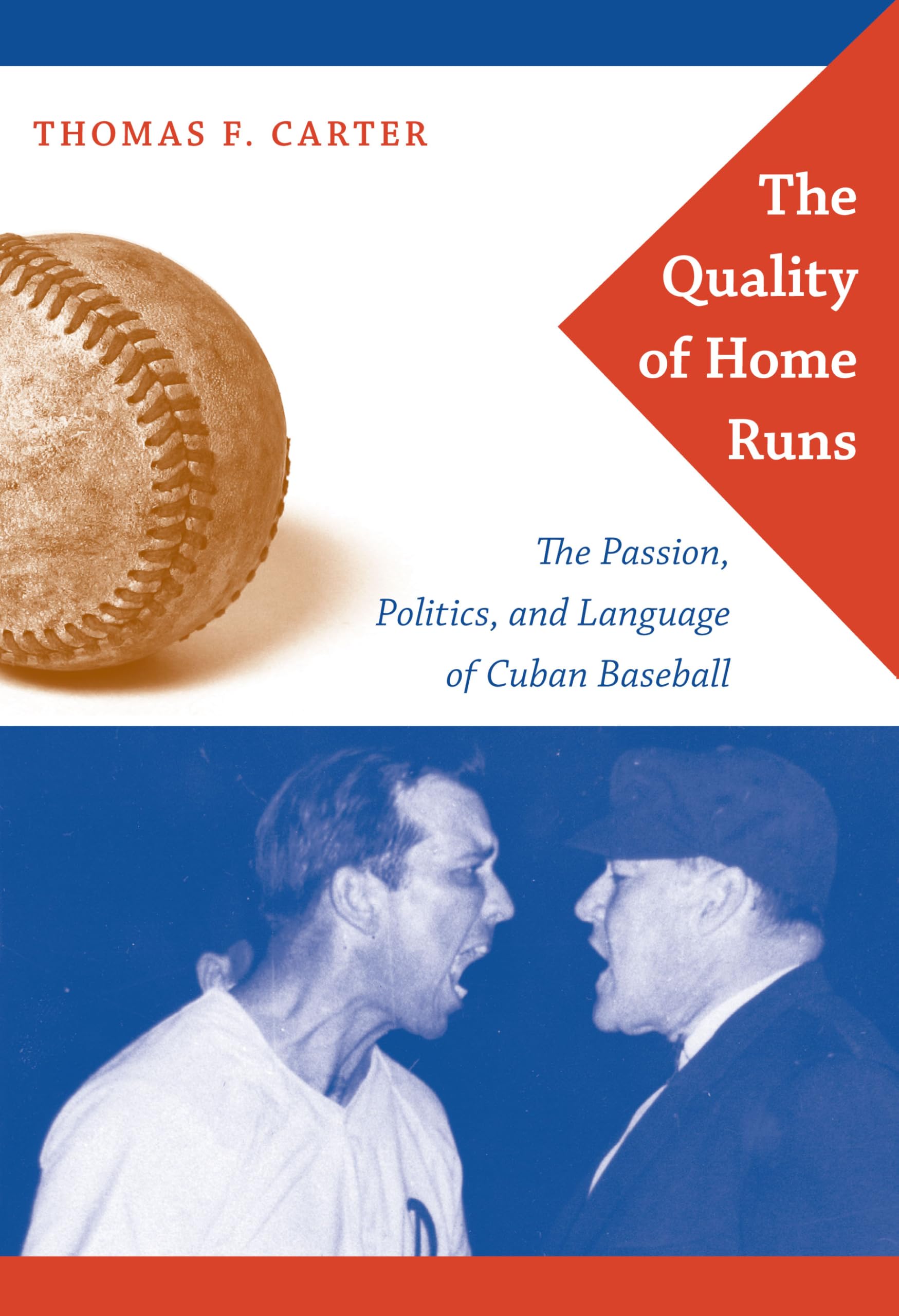
The Quality of Home Runs: The Passion, Politics, and Language of Cuban Baseball
$139.95
by Thomas F. Carter



In parks and cafes, homes and stadium stands, Cubans talk baseball. Thomas F. Carter contends that when they are analyzing and debating plays, games, teams, and athletes, Cubans are exchanging ideas not just about baseball but also about Cuba and cubanidad , or what it means to be Cuban. The Quality of Home Runs is Carter’s lively ethnographic exploration of the interconnections between baseball and Cuban identity. Suggesting that baseball is in many ways an apt metaphor for cubanidad, Carter points out aspects of the sport that resonate with Cuban social and political life: the perpetual tension between risk and security, the interplay between individual style and collective regulation, and the risky journeys undertaken with the intention, but not the guarantee, of returning home. As an avid baseball fan, Carter draws on his experiences listening to and participating in discussions of baseball in Cuba (particularly in Havana) and among Cubans living abroad to describe how baseball provides the ground for negotiations of national, masculine, and class identities wherever Cubans gather. He considers the elaborate spectacle of Cuban baseball as well as the relationship between the socialist state and the enormously popular sport. Carter provides a detailed history of baseball in Cuba, analyzing players, policies, rivalries, and fans, and he describes how the sport has forged connections (or reinforced divisions) between Cuba and other nations. Drawing on insights from cultural studies, political theory, and anthropology, he maintains that sport and other forms of play should be taken seriously as crucibles of social and cultural experience. “ The Quality of Home Runs offers engaging and provocative perspectives on socialism, nationalism, masculinity, and the embodiment and poetics of sport in Cuba, all seen from the vantage point of the stadium stands and the streets of Havana. Thomas F. Carter’s emphasis on themes such as spectacle, social drama, struggle, and discipline of both players and fans, on and off the field, builds a persuasive analysis of changing notions of what it means to be Cuban.”— Thomas M. Wilson , Binghamton University ""The Quality of Home Runs" offers engaging and provocative perspectives on socialism, nationalism, masculinity, and the embodiment and poetics of sport in Cuba, all seen from the vantage point of the stadium stands and the streets of Havana. Thomas F. Carter's emphasis on themes such as spectacle, social drama, struggle, and discipline of both players and fans, on and off the field, builds a persuasive analysis of changing notions of what it means to be Cuban."--Thomas M. Wilson, Binghamton University Thomas F. Carter, an anthropologist, is a Senior Lecturer at the University of Brighton, Chelsea School. The Quality of Home Runs THE PASSION, POLITICS, AND LANGUAGE OF CUBAN BASEBALL By THOMAS F. CARTER Duke University Press Copyright © 2008 Duke University Press All right reserved. ISBN: 978-0-8223-4253-3 Contents Preface: Entering the Field..............................................................viiAcknowledgments..........................................................................xvIntroduction. The Theoretical "Stretching" of Sport and the State........................11 Baseball and the Language of Contention................................................172 Circling the Base Paths: Baseball, Migration, and the Cuban Nation.....................363 The Spectacle of and for Cuba..........................................................634 The State in Play: The Politics of Cuba's National Sport...............................895 Fans, Rivalries, and the Play of Cuba..................................................1116 Talking a Good Game....................................................................1367 The Qualities of Cubanidad: Calidad and Lucha in Baseball..............................159Conclusion: Touching 'Em All: Recalling and Recounting Home Runs.........................183Notes....................................................................................203Works Cited..............................................................................213Index....................................................................................231 Chapter One Baseball and the Language of Contention In a tight game, Industriales have a runner on second with two outs. The more popular of the two teams that represent the capital in the Serie Nacional , the elite Cuban national league, Industriales need this victory as they strive to make the playos in the spring of 1998. They are two games out of the last spot with four games to play. Carlos Tabares, the team's emotional leader, leads o of second. He is fast and rather reckless when he plays. He loves dramatic gestures, and sometimes his desire for such gestures backfires. Juan Padilla, the second baseman, is jammed on the pitch and he hits a little flare of a