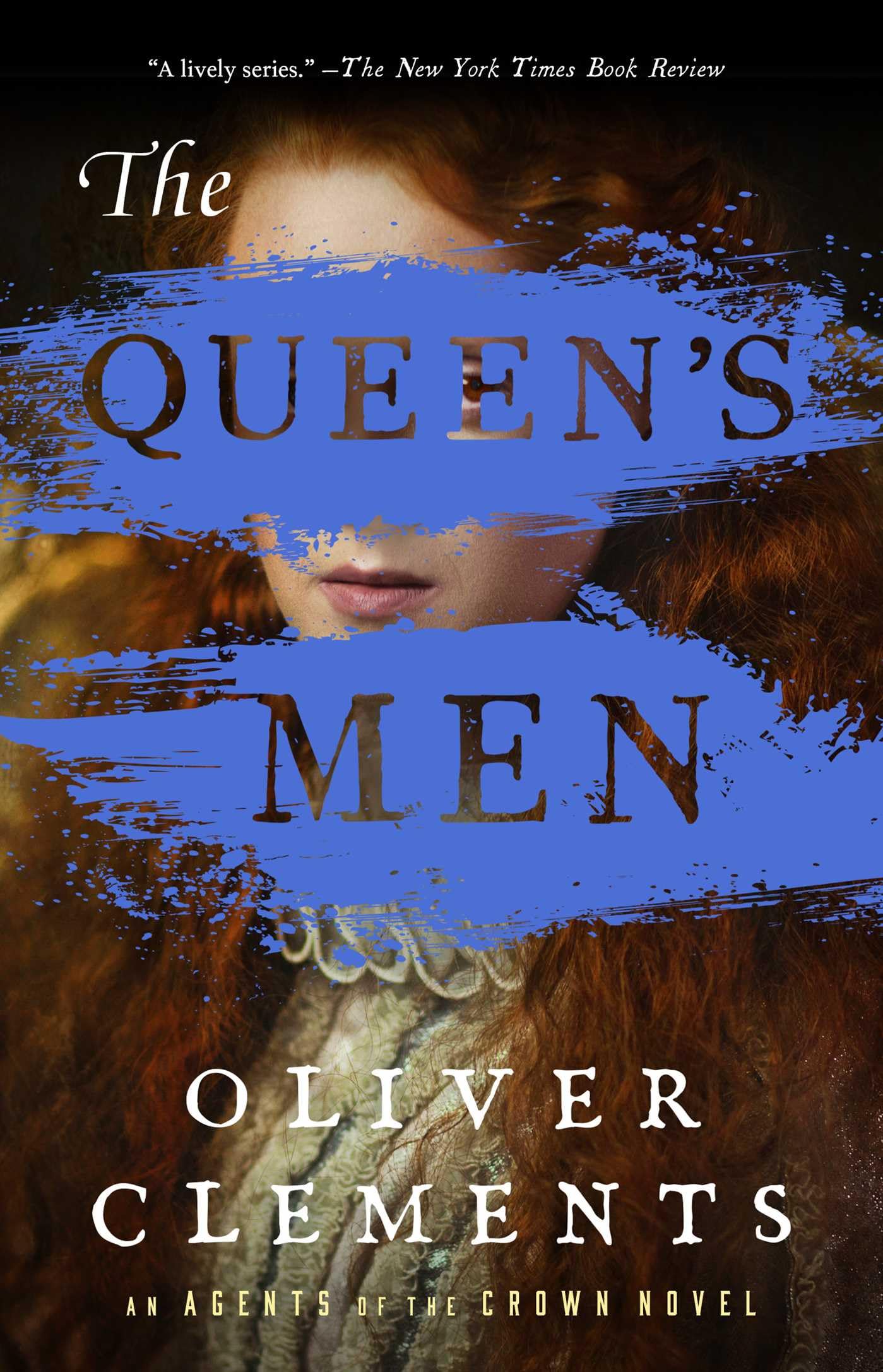



The unputdownable and “lively” ( The New York Times ) Agents of the Crown series continues with this riveting novel following the original MI6 agent as he is assigned a dangerous mission to recreate a weapon from antiquity. As she travels through Waltham Forest, Queen Elizabeth I is ambushed by masked gunmen who leave her carriage riddled with holes before disappearing into the night. Knowing that the perpetrators have the Queen’s carriage route, her Private Secretary, Sir Francis Walsingham, must find the mystery assailants before they can strike again. While Queen Elizabeth’s Privy Council debates how to best secure the throne in the wake of the attack and Catholic Spain’s further intrusion into the Low Countries, the queen herself searches for the ultimate weapon to protect her country and throne: Greek fire, the recipe of which disappeared with the collapse of the Byzantine Empire. She orders her friend John Dee—scientist, philosopher, and spy—to rediscover this vital secret, despite his misgivings. For he understands that in a world fraught with coded messages, ruthless adversaries, and deadly plot, his mission to secure his nation’s future may prove impossible, unless he deploys the most effective weapon of all: intelligence. "[A] rollicking new historical thriller . . . . taut, made-for-movie-theater tension and delicious, snickering-from-the-back-row wit." —New York Times Book Review "In The Eyes of the Queen , Oliver Clements conjures a remarkable hero: John Dee, an Elizabethan James Bond who dives headlong into a mystery sinister enough to make Le Carré green with envy." — Keith Thomas, author of The Clarity and Dahlia Black Oliver Clements is a novelist and screenwriter based in Mortlake, London. Chapter One CHAPTER ONE Whitehall Palace, London, same evening, first week of November 1577 Sir William Cecil, First Baron Burghley, stands in the darkness, in the middle of the great courtyard of Whitehall Palace, next to Sir Christopher Hatton, whom the Queen has recently appointed member of the Privy Council purely because—Cecil coined the rumor—he is an uncommonly graceful dancer. They are looking up at the Great Comet in the night’s sky. “There,” he says. “Do you not see, Sir Christopher? Its tail points to the Low Countries.” Cecil is half joking, extending a hand of friendship to patch up what has been a bitter few months of rancorous factionalism in the Privy Council, with two parties opposed to each other on the matter of sending troops to help the Dutch Protestant armies against the Spanish and Catholic Dutch. Cecil had hoped the argument was ended, this last week, when the Queen at last made up her mind in favor of sending troops, deciding in favor of the faction led by Cecil and Walsingham, and against the faction led by Hatton. But Hatton is obviously not yet ready to accept defeat, nor the proffered hand. “That might mean anything,” he scoffs. “No,” Cecil tells him. “It means good Protestant Englishmen will soon be coming to the aid of their Dutch cousins, and that together we will drive Spain back within her own borders and, God willing, strike such a blow as will rid Christendom of popish superstition for all time.” He, again, is only half joking. “I still believe it is a grave mistake,” Hatton says, seriously. “We should not even be sending them money, let alone troops. It will deplete our treasury, and our numbers, and it will unite France and Spain against us. More than that, also, it gives succor to any subject who rises up against his rightful king. Her Majesty is sowing the wind, and she shall reap the whirlwind.” Cecil sighs. “We’ve been hearing that same old refrain for years now,” he reminds Hatton. “The simple fact is that if we let the Spanish crush the Dutch, they will. And then they will turn to us and crush us. There will be fighting, I know, and it will cost gold, and blood, but so much less if it is done now, and in the Low Countries, and mostly by Dutchmen. Spend now, save later. I am glad the Queen has finally seen sense.” Hatton blows out air. “Twenty thousand pounds? Ten thousand men? It is the thin end of the wedge, Lord Treasurer.” Cecil knows Hatton hardly cares about the money. It is the old religion he hankers after. A return to Rome. And that is really why the Queen appointed him to the Privy Council: not because he has a well-turned calf, though he does that, but because she is naturally cautious in these affairs—or is too aware of the risks they involve—and Hatton is there to serve as a bulwark against Master Walsingham’s zeal. “Well,” Cecil tells him, “it is done now in any event.” “We shall see,” Hatton says. “There is many a slip between cup and lip.” Cecil wheels on him, suddenly furious. This argument has been had! It has been lost and won and now there is nothing more to be said. “What do you mean by that, Hatton?” Hatton is taller and younger, and infinitely more agile, but Cecil is Sir William Cecil,