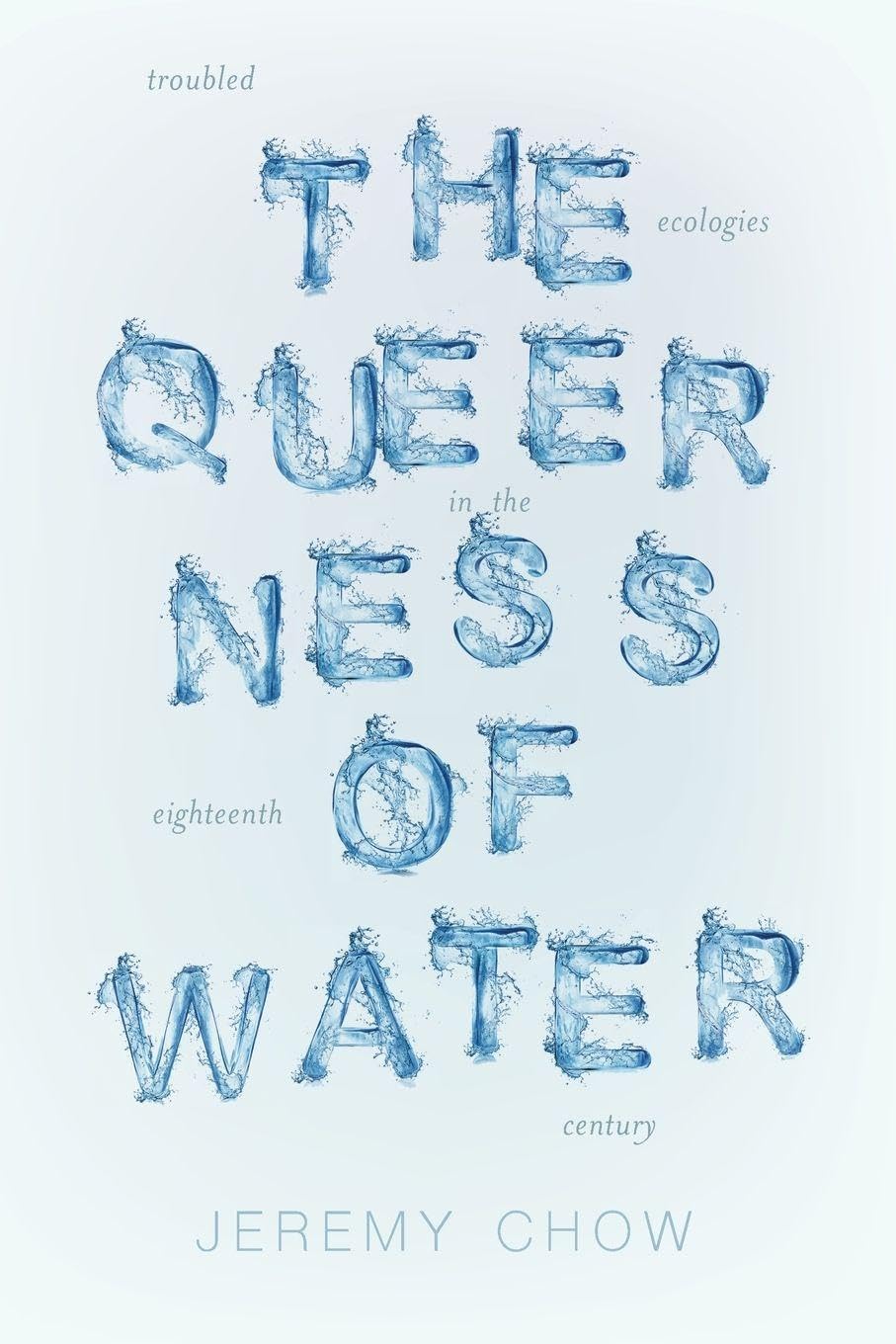
The Queerness of Water: Troubled Ecologies in the Eighteenth Century (Under the Sign of Nature: Explorations in Environmental Humanities)
$20.33
by Jeremy Chow



This highly original book reconsiders canonical long eighteenth-century narratives through the conjoined lenses of queer studies and the environmental humanities. Moving from Daniel Defoe’s Robinson Crusoe and Jonathan Swift’s Gulliver’s Travels to Gothic novels including Mary Shelley’s Frankenstein , Jeremy Chow investigates the role that bodies of water play in reading these central texts. Chow navigates various representations and phases of water to magnify the element’s furtive yet pronounced effects on narrative, theory, and identity. Water, Chow reveals, is both a participant and a stage upon which bodily violation manifests. The sea, rivers, pools, streams, and glaciers all participate in a violent decolonialism that fractures, revises, and reshapes notions of colonial masculinity emerging throughout the long eighteenth century. Through an innovative series of intermezzi, The Queerness of Water also traces the afterlives of eighteenth-century literature in late twentienth- and twenty-first-century film, television, and other popular media, opening up conversations regarding canon, literary criticism, pedagogy, and climate change. Clearly and energetically written, Chow makes a valuable and important contribution to blue humanities criticism in the context of eighteenth-century English literary studies. The Queerness of Water moves beyond salt water to river banks, water torture, and ice-scapes, to show how a 'beyond the oceans' approach can renovate blue thinking in the eco-humanities. It builds on existing queer ecostudies by connecting contemporary theorists to historical English literature and by making queer studies more watery and watery studies more queer. ― Steven Mentz, St. John's University, author of Ocean (Object Lessons) Chow makes an original and substantial contribution to at least three fields: 18th-century literary studies, ecocriticism and the environmental humanities, and queer studies. Such a multi-pronged contribution is rare and important. Queerness also features many excellent close readings, including of authors―such as Jonathan Swift―who have rarely been read through a queer lens. ― Nicole Seymour, California State University, Fullerton, author of Bad Environmentalism: Irony and Irreverence in the Ecological Age Chow’s call to “ welcome our queer becomings in troubled waters ” is particularly trenchant in an era defined by accelerating climate change and weather precarity, driven by the imperatives of late capitalism and settler colonialism (185). Chow thus models a deeply ethical critical praxis by making visible why studying eighteenth-century literary archives—and how their depictions of queer becomings with water exceed the texts’ colonialist frames— matters today.― Eighteenth-Century Fiction Chow’s study is masterful, landmark, and witty . . . There is something urgent about Chow’s writing that might seem overly sharp if it were not also balanced with the obvious care that animates his scholarship: care for rigor, care for us as readers. Whether Chow is writing about the natural histories of eighteenth-century simians or the fate of the hunted sea cow and those who wrote about it, his argument dazzles with empathy for the human and non-human alike.― Eighteenth-Century Studies A surprising, often demanding, but always interesting contribution to queer environmental humanities and queer eighteenth-century studies.― GLQ: A Journal of Lesbian and Gay Studies Chow makes an original and substantial contribution to at least three fields: 18th-century literary studies, ecocriticism and the environmental humanities, and queer studies. Such a multi-pronged contribution is rare and important. Queerness also features many excellent close readings, including of authors—such as Jonathan Swift—who have rarely been read through a queer lens. Jeremy Chow is Assistant Professor of English at Bucknell University.