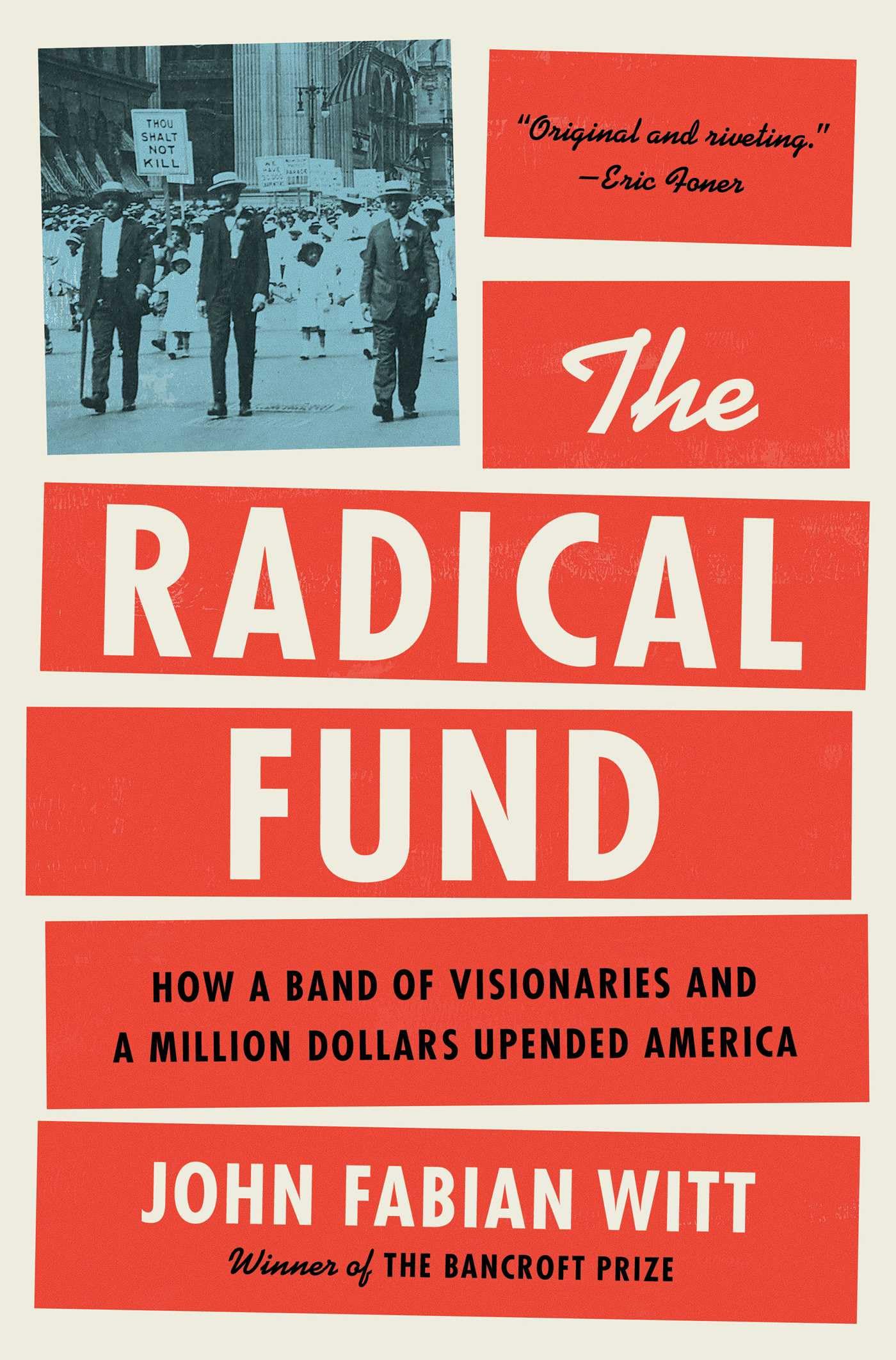
The Radical Fund: How a Band of Visionaries and a Million Dollars Upended America
$26.44
by John Fabian Witt



From Pulitzer Prize finalist John Fabian Witt comes the “engrossing” ( The New York Times ) secret history of an epic experiment to remake American democracy. Before the dark money of the Koch Brothers, before the billions of the Ford Foundation, there was the Garland Fund. In 1922, a young idealist named Charles Garland rejected a million-dollar inheritance. In a world of shocking wealth disparities, shameless racism, and political repression, Garland opted instead to invest in a future where radical ideas—like working-class power, free speech, and equality—might flourish. Over the next two decades, the Garland Fund would nurture a new generation of wildly ambitious progressive projects. The men and women of the Fund were rich and poor, white and Black. They cooperated and bickered; they formed rivalries, fell in and out of love, and made mistakes. Yet shared beliefs linked them throughout. They believed that American capitalism was broken. They believed that American democracy (if it had ever existed) stole from those who had the least. And they believed that American institutions needed to be radically remade for the modern age. By the time they spent the last of the Fund’s resources, their outsider ideas had become mass movements battling to transform a nation. A “fascinating” testament to how “radical philanthropy can foster important and necessary changes in American life” ( The Wall Street Journal ), The Radical Fund is a hopeful book for our anxious, angry age—and an empowering roadmap for how people with heretical ideas can bring about audacious change. “Engrossing.” — The New York Times “A brilliant account of how one modestly endowed organization helped transform America.” —Annette Gordon-Reed, Pulitzer Prize-winning author of The Hemingses of Monticello “Original and riveting. A remarkable reminder that people who adhere to diverse ideas about how to make this a better society can—indeed must—work together to bring about social change.” —Eric Foner, Pulitzer Prize-winning author of The Fiery Trial “A chronicle of how vision survives contact with reality.... The book moves with the calm authority of a historian and the moral curiosity of a storyteller who knows that conviction is rarely simple.... Witt writes with the quiet intensity of someone sifting through ashes, discovering warmth where one expects only dust.” — Arkansas Democrat Gazette “There is a great mind at work in this book; Witt has meticulously uncovered and documented the lost history of one of the United States’ most efficient charitable funds…. Witt seems to be showing us… how badly we need efforts like this again....” — Los Angeles Times “Witt’s brilliant new book . . . looks to the past to show how Americans have repeatedly grappled with inequality, economic upheaval, and threats to democracy . . . The Radical Fund makes clear that repairing democracy has always been a collective effort whose greatest victories often take years to fully emerge.” —Melissa Murray on MS Now “A rare achievement by a gifted historian at the peak of his powers.” —David W. Blight, Pulitzer Prize-winning author of Frederick Douglass “Fascinating… [Witt] shows that radical philanthropy can foster important and necessary changes in American life.” — The Wall Street Journal “Profoundly human... A reason to hope for our own future, especially if we are willing to take it into our own hands.” —Martha Jones, author of Vanguard “Written with elegance, wit, and penetrating historical insight, this richly textured story is as useful today as a century ago.” —Nelson Lichtenstein, author of Labor’s Partisans John Fabian Witt is the Allen H. Duffy class of 1960 professor of law at Yale Law School and a professor in the Yale history department. He is the author of a number of books, including Lincoln’s Code , which was awarded the Bancroft Prize and was a finalist for the Pulitzer Prize. His writing has appeared in The New York Times , The Wall Street Journal , The Washington Post , The Atlantic , The Nation , and The New Republic , among other publications. He lives with his family in Connecticut where he tends an orchard, watches baseball, and fishes in the Long Island Sound. Prologue: A Curious Inheritance PROLOGUE A Curious Inheritance In November 1920, three weeks after Warren Harding won election to the presidency on a promise to restore normalcy, a restless young man on a farm in Cape Cod, Massachusetts, did something that was not normal at all. Charles Garland was coming into his adulthood, like many young people, with a growing dismay at the world into which he had been thrust. Just past his twenty-first birthday, he was tall, with dark hair, a soft mustache, and a generous if distant smile. He had a slightly brooding disposition. And he saw grievous inequalities all around him. He recoiled at the gap between the haves and the have-nots. He was a white man who deplored the postwar mob