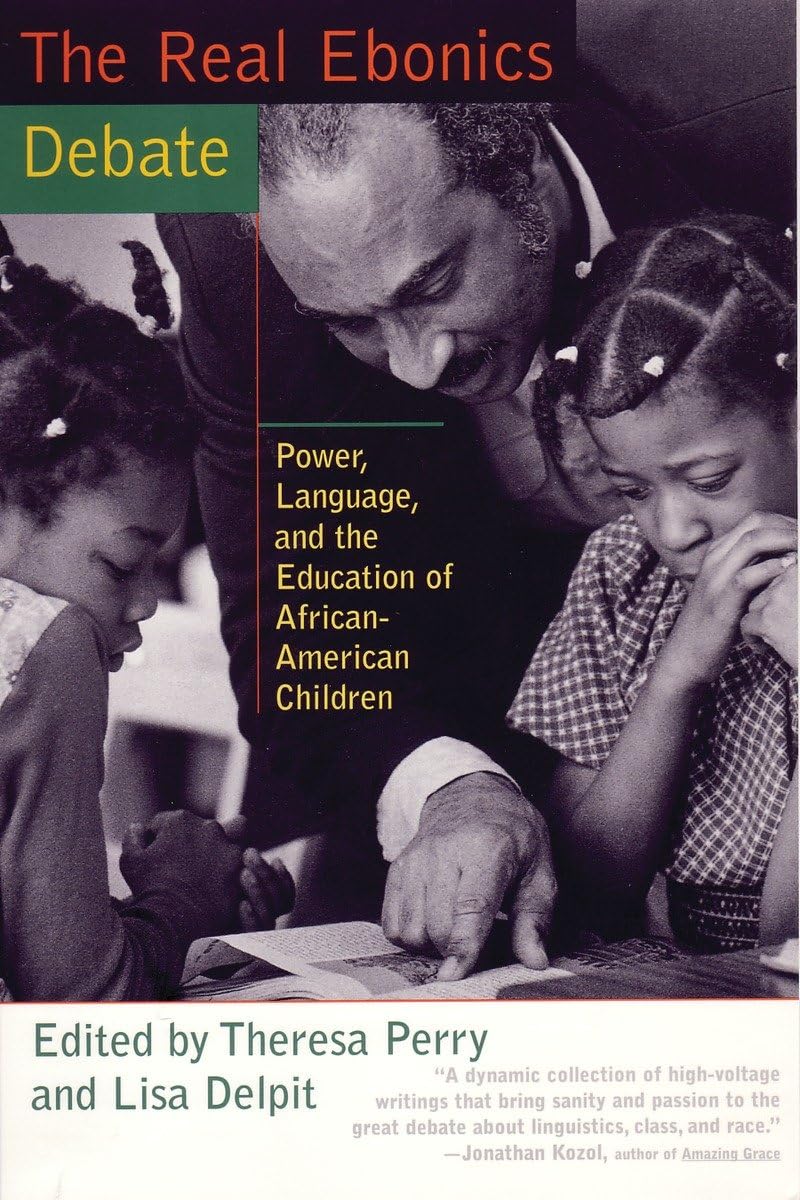
The Real Ebonics Debate: Power, Language, and the Education of African-American Children
$17.80
by Theresa Perry



In the winter of 1996, the Oakland school board's resolution recognizing Ebonics as a valid linguistic system generated a brief firestorm of hostile criticism and misinformation, then faded from public consciousness. But in the classrooms of America, the question of how to engage the distinctive language of many African-American children remains urgent. In The Real Ebonics Debate some of our most important educators, linguists, and writers, as well as teachers and students reporting from the field, examine the lessons of the Ebonics controversy and unravel the complex issues at the heart of how America educates its children. The term "Ebonics" exploded onto the mainstream media in 1996 due to a controversial resolution by the Oakland school board recognizing Vernacular Black English in their efforts to teach their inner-city youth. This book offers some well-needed definitions and defenses of Ebonics as a legitimate language and grammar system of West African origin that should be understood by teachers. As Lisa Delpit writes, "The teacher's job is to provide access to the national 'standard' as well as to understand the language the children speak sufficiently to celebrate its beauty." The Real Ebonics Debate details the history of Ebonics (a name combining the words "ebony" and "phonics") since 1973, including the Eurocentric bias in determining what language is and the American racism and coded media phrases that mark the debate. The book will be crucial to the understanding of this controversial issue for years to come. Along with famous essays and poetry by Toni Morrison, James Baldwin, and Paul Laurence Dunbar, the most important documents in this collection are copies of the actual Oakland Ebonics Resolution and the Ebonics Resolution Revision, which stated, "The superintendent ... shall immediately devise and implement the best possible academic program for the combining purposes of facilitating the acquisition and mastery of English language while respecting and embracing the legitimacy and the richness of the language patterns." --Eugene Holley Jr. YA-Perry and Delpit invited a dozen scholars and practicing classroom teachers to contribute essays on the topic of "Power, Language, and the Education of African-American Children." In addition to these contributors, the editors include pieces by James Baldwin and Paul Laurence Dunbar; relevant full-text resolutions and policies from the Oakland, CA, school board, whose Ebonics Resolution in 1996 opened a national debate; and interviews. After setting the scene, the book is divided into sections that examine the role language plays in a developing student's life and in the power structure of the society; how teachers have used their own language skills (which include listening and understanding as well as speaking and correcting) to enfranchise their students; the ways white America has interpreted the use of Ebonics among African-American children and in adult culture; and when, where, how, and perhaps why journalists across the country misrepresented the Oakland Ebonics Resolution. This is a powerful, accessible and valuable volume not only for teachers and those who hold themselves to the duty of providing educational opportunity for all American children, but also for teens who are looking to understand their own language experiences and those of their classmates. Francisca Goldsmith, Berkeley Public Library, CA Copyright 1998 Reed Business Information, Inc. A dynamic collection of high-voltage writings that bring sanity and passion to the great debate about linguistics, class, and race. --Jonathan Kozol, author of Amazing Grace "Anyone in the field of education-teacher, administrator, researcher, policy maker-who is seriously concerned with issues of race, class, and the politics of language in America's schools should read this book. It presents the most comprehensive and thoughtful discussion of Ebonics in education that I have yet encountered." --Frederick Erickson, University of Pennsylvania "This is the best pragmatic and theoretical treatment of the recent Ebonics controversy. Great clarity and common sense come from an excellent selection of scholar-practitioners." --Asa Hilliard, Georgia State University "At last there is a book that talks sense about the Ebonics debate and makes a powerful case for honoring the many languages we speak. A must read." --Herbert Kohl, Georgia State University "The comprehensive source for teachers who want to be successful teachers of African-American children." --Gloria Ladsen-Billings, author of The Dreamkeepers In The Real Ebonics Debate some of our most important educators, linguists, and writers, as well as teachers and students reporting from the field, examine the lessons of the Ebonics controversy and unravel complexities of the issue that have never been acknowledged. An insightful look at the political nature of language and its inseparability from race and class in America, The Real E