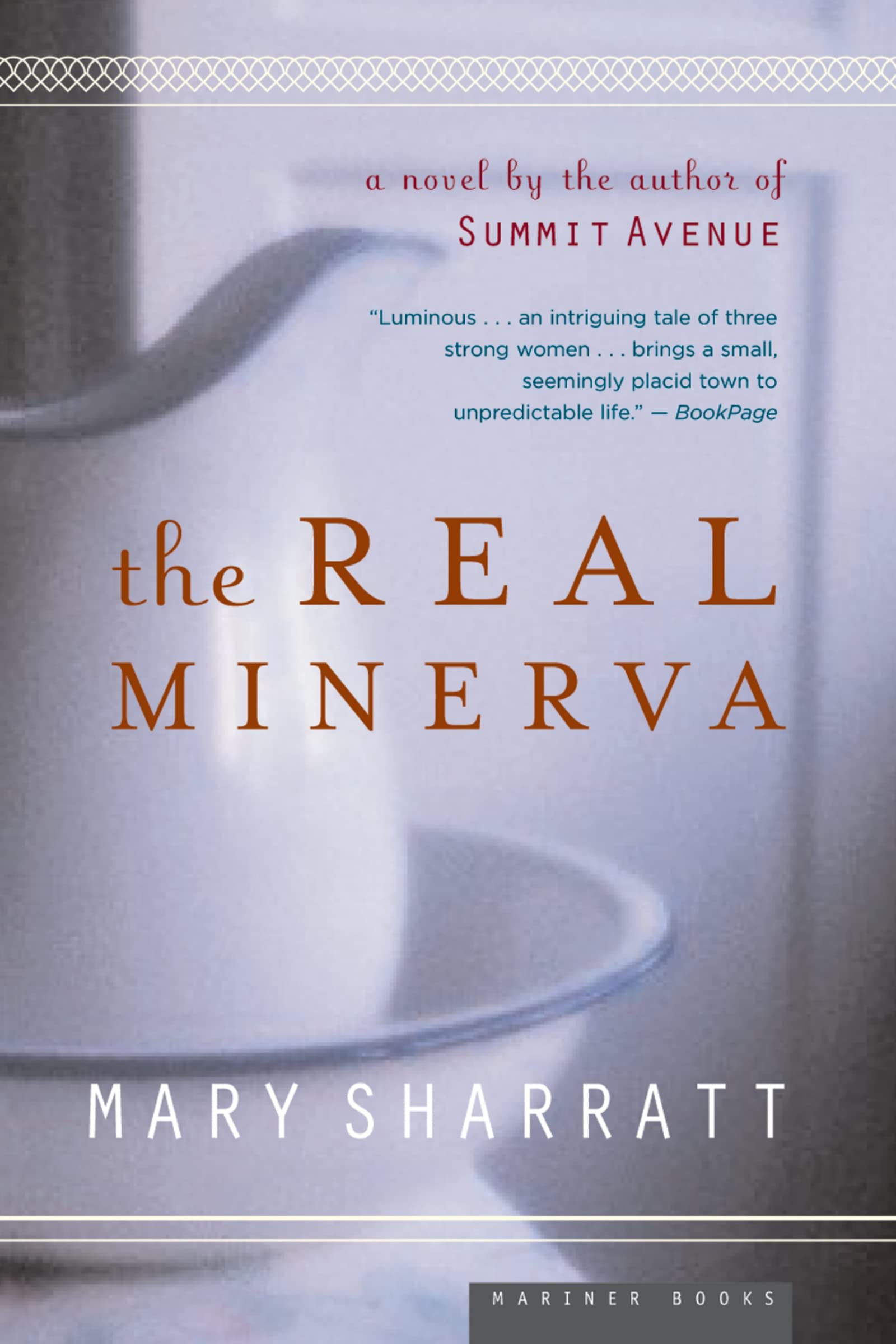
The Real Minerva: A Literary Historical Fiction of Three Women's Courage and Identity in Rigid 1920s Midwest
$10.67
by Mary Sharratt



Minerva, Minnesota, in 1923 is the picture of Willa Cather-like gentility: the Northern Pacific Railway runs through a town center dominated by church steeples and the Hamilton Creamery and Pop Factory. But Minerva is also a small town of limited opportunity, a place where the status quo is firmly entrenched and rigidly enforced. Against this tableau of midwestern placidity and calm, three Minerva women assert their dignity and independence against all odds. The troubled relationship between young Penny and her mother, Barbara, is getting worse. Disturbed by her mother's affair with the man they clean house for, Penny answers an ad to work for Cora Egan, a Chicago society woman who has fled a bad marriage and intends to raise her child alone on her grandfather's farm. Cora's situation shocks the town, but over time her presence opens a door in Penny's and Barbara's lives. Through these women, Mary Sharratt considers what it takes to reinvent the self, to claim one's true identity. Mary Sharratt's first novel, Summit Avenue, was hailed as a "remarkablel debut . . . [that] weaves dark, evocative fairy tales and passionate longings into an incandescent coming-of-age story" (Publishers Weekly, starred review). Readers interested in feminine archetypes and women in myth will be similarly drawn to Sharratt's newest novel. Exquisite historical detail and emotional resonance infuseThe Real Minerva,an old-fashioned story with a modern spirit. MARY SHARRATT, the author of seven critically acclaimed novels, is on a mission to write strong women back into history. Her novels include Daughters of the Witching Hill , the Nautilus Award–winning Illuminations: A Novel of Hildegard von Bingen, The Dark Lady’s Mask: A Novel of Shakespeare’s Muse, and Ecstasy, about the life, loves, and music of Alma Mahler. She is an American who lives in Lancashire, England. The Real Minerva By Mary Sharratt Mariner Books Copyright © 2006 Mary Sharratt All right reserved. ISBN: 9780618618880 1 Minerva, 1923 The day before the heat wave began, Penny Niebeck cleaned Irene Hamilton"s room. Stooping to her knees, she picked the strewn stockings and underwear off the floor, and the dress that had been worn only once since its last washing and was now crumpled and stained. She was stuffing it all into the laundry bag when Irene marched in, pale and plump, white-gloved hands clenched. Penny struggled to her feet and steeled herself, sweat beading under her armpits as she met Irene"s colorless eyes. Irene"s hot breath, smelling of breakfast bacon, fanned Penny"s cheeks. Both girls were fifteen, their birthdays five days apart. For the past eight years, Penny"s mother had worked as the Hamiltons" cleaning woman. For almost as long as she could remember, Penny had clothed herself in whatever Irene had worn out and cast away. "You want to know something?" Irene let out a swift exhalation that lifted the hairs on the back of Penny"s neck. "Your mother named you Penny because she"s cheap, and so are you." Penny took a step backward, nearly stumbling over the laundry bag. "You have to go catch your train," she said. Irene and her sisters were leaving for summer camp that day. "Doesn"t it leave at noon?" A glance at the porcelain-faced clock on the dresser told her that it was nearly half past eleven. "I forgot something." Irene turned to snatch her mother"s photograph from the lace-topped vanity and clutched it to her chest, her arms carefully folded around it. The photograph had been taken before Mrs. Hamilton fell ill from the sleeping sickness. For the past four years, Mrs. H. had been an invalid in the Sandborn Nursing Home. Her face was frozen up like a statue"s. She didn"t talk anymore, didn"t do anything but sleep and let the nurses feed and change her like a baby. The doctors couldn"t say how long she would live or if she would ever get better. "You know why Daddy"s sending us away." Irene spoke accusingly. Penny breathed hard. "No, I don"t." But her voice faltered and blood began to pound at her temples. "You know." Irene spoke so vehemently that her spit landed on Penny"s face. "Even someone as dumb as you could figure it out." "I"m not dumb." "Oh, yeah? Then why aren"t you going to high school this fall?" Penny looked down at her cracked old shoes, the color of potatoes left to rot in the cellar. When she had finished ninth grade that spring, her mother had told her it was time to leave school and earn her own keep. High school was for people from well-off families or children whose parents cared about education and that sort of thing. At fifteen, Penny had hands already as swollen and red from all the cleaning as her mother"s were. "Your mother"s too cheap to keep you in school," Irene said, sticking her face into Penny"s so that she couldn"t look away. "She"s as cheap as they come." "Is that so?" Penny shot back. "Well, your father seems to think she"s just fine.