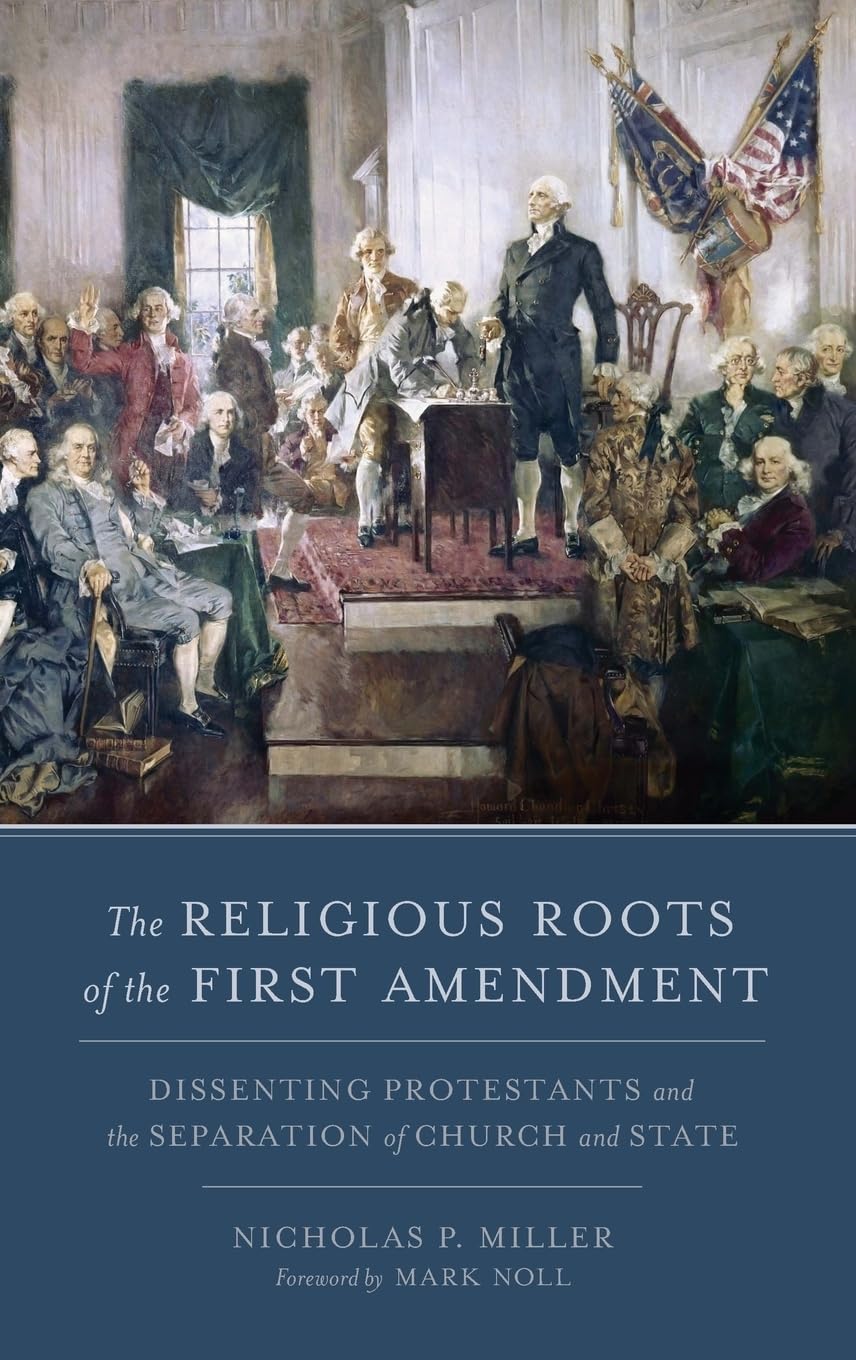
The Religious Roots of the First Amendment: Dissenting Protestants and the Separation of Church and State
$28.00
by Nicholas P. Miller



Traditional understandings of the genesis of the separation of church and state rest on assumptions about "Enlightenment" and the republican ethos of citizenship. In The Religious Roots of the First Amendment , Nicholas P. Miller does not seek to dislodge that interpretation but to augment and enrich it by recovering its cultural and discursive religious contexts--specifically the discourse of Protestant dissent. He argues that commitments by certain dissenting Protestants to the right of private judgment in matters of Biblical interpretation, an outgrowth of the doctrine of the priesthood of all believers, helped promote religious disestablishment in the early modern West. This movement climaxed in the disestablishment of religion in the early American colonies and nation. Miller identifies a continuous strand of this religious thought from the Protestant Reformation, across Europe, through the English Reformation, Civil War, and Restoration, into the American colonies. He examines seven key thinkers who played a major role in the development of this religious trajectory as it came to fruition in American political and legal history: William Penn, John Locke, Elisha Williams, Isaac Backus, William Livingston, John Witherspoon, and James Madison. Miller shows that the separation of church and state can be read, most persuasively, as the triumph of a particular strand of Protestant nonconformity-that which stretched back to the Puritan separatist and the Restoration sects, rather than to those, like Presbyterians, who sought to replace the "wrong" church establishment with their own, "right" one. The Religious Roots of the First Amendment contributes powerfully to the current trend among some historians to rescue the eighteenth-century clergymen and religious controversialists from the enormous condescension of posterity. Miller's tracing of the intellectual threads, strings, and ropes of Protestant dissenting thought demonstrates an impressive familiarity with history and theology, and his book is a valuable historic and intellectual review of the influence of the right of private judgment on separation of church and state. John Ragosta, American Historical Review. It is always a joy to read a book that asserts as one of its major arguments that "ideas and beliefs do matter and that they often explain why people act as they do" and that "religious reasons should be accepted as valid" explanations of choice and behavior. Mark McGarvie, Journal of American History Miller's volume . . . deserves a place on the shelf of all interested in the development of religious liberty in the Anglo-American tradition. Andrew Murphy, Journal of American Studies Miller is surely correct that Protestant dissenters, such as the Baptists and the Quakers, have not been duly credited for their intellectual contributions to the development of religious liberty, and he effectively marshals compelling evidence to support his thesis. This volume is a welcome addition to the literature on the pursuit of religious liberty in America. Daniel Dreisbach, The Historian. "Nicholas P. Miller's splendid survey of the distinctly Protestant concept of the right of private judgment makes a major contribution to the debate over the religious origins of the First Amendment. The author traces the idea of the sacred freedom of an individual's conscience through an array of pivotal thinkers and offers compelling evidence that the concept contributed to the understanding of James Madison, a leading framer of the separation clause of the Constitution." Geoffrey W. Bromiley, Professor of Church History, Fuller Seminary. "The Religious Roots of the First Amendment provides a needed counterbalance to the emphasis on the secular origins of American religious liberty. The author promises to take religion seriously and he fulfills his promise. Especially important is his restoration of William Penn to central importance in the emergence of American religious liberty." Thomas J. Curry, author of Farewell to Christendom: The Future of Church and State in America . "Nicholas Miller carefully and persuasively demonstrates that many of the most ardent and effective American advocates of the disestablishment of religion were people of faith. These Americans argued that government does faith no favors when it seeks to use civil power to advance religion, and that all people must have liberty to choose or reject God, or faith commitments are meaningless. Miller is exactly right to suggest that it is long past time for us to give the religious case for church-state separation and religious liberty its due." Melissa Rogers, Director, Center for Religion and Public Affairs at Wake Forest University Divinity School. Associate Professor of Church History at Andrews University Seminary and Director of the Andrews University International Religious Liberty Institute, Dr. Miller has a JD from Columbia University and a PhD in American Religious History