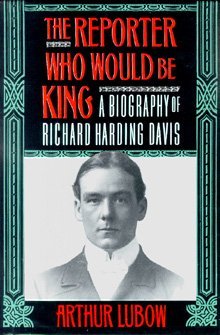
The Reporter Who Would Be King: A Biography of Richard Harding Davis
$19.49
by Arthur Lubow



A biography of the most recognizable face during the turn of the century describes how a generation of writers tried to emulate Richard Harding Davis in their writing and explores why this quintessential incarnation of Victorian life passed into obscurity. This is an engaging biography of a man who, although he had much more than the 15 minutes of fame we are all supposed to be allotted, is, nevertheless, mostly forgotten. Richard Harding Davis was a flamboyant journalist who covered the world for several newspapers and magazines; he also wrote popular fiction and plays. He was known at the turn of the century for his lifestyle as much as for his writing. Lubow, a contributing editor at Vanity Fair , has written a well-researched, absorbing picture not only of a man but of a way of life that has disappeared. Recommended for all libraries. - Rebecca Wondriska, Trinity Coll. Lib., Hartford, Ct. Copyright 1992 Reed Business Information, Inc. Sporadically engaging biography of Richard Harding Davis (1864-1916), the once-celebrated journalist who, among other accomplishments, reported on nearly every international conflict from the 1897 Cuban Revolution to WW I, posed for the male counterpart of the Gibson girl, and introduced the avocado to American dining tables. The eldest child of a newspaperman and a novelist remarkable only for the mawkishness of her literary romances and for her limpet-like attachment to her firstborn, Davis, explains Lubow, came to his writing career quite predictably. When barely out of his teens, the immensely gregarious Davis was already turning out society columns, special reports, and short stories for Charles Scribner and William Randolph Hearst. In addition, he counted Stanford White, Charles Dana Gibson, Ethel Barrymore, and Stephen Crane among his somewhat raffish circle of friends and associates. Interestingly, Davis himself, Lubow notes, was deeply priggish, a legacy of his repressively ``proper'' upbringing. He was also sexually unadventurous and didn't marry until his late 30s, when he formed an alliance with a much younger, ``liberated'' woman. Later divorced, he remarried and fathered a daughter. Harding evidently was a complex figure, but Lubow (a contributing editor to Vanity Fair) fails to plumb the societal implications of his life. A closer examination of the reasons for the championing by contemporary feminists of marriages--like Harding's first--in which spouses were more friends than lovers would have added depth to the portrait, for example. Lubow is more successful in comparing Davis's literary methods and objectives in his several successful novels to those of Stephen Crane. Both writers dealt with life among slum dwellers, Lubow points out; Crane, however, depicted his characters in starkly realistic terms, hoping to underline the need for reform, while Davis sketched his dramatis personae as lovable caricatures, thus reassuring his middle-class audience. Competently organized and smoothly written but lacking significant insights into a potentially intriguing protagonist. (Two eight-page photo inserts--not seen.) -- Copyright ©1992, Kirkus Associates, LP. All rights reserved.