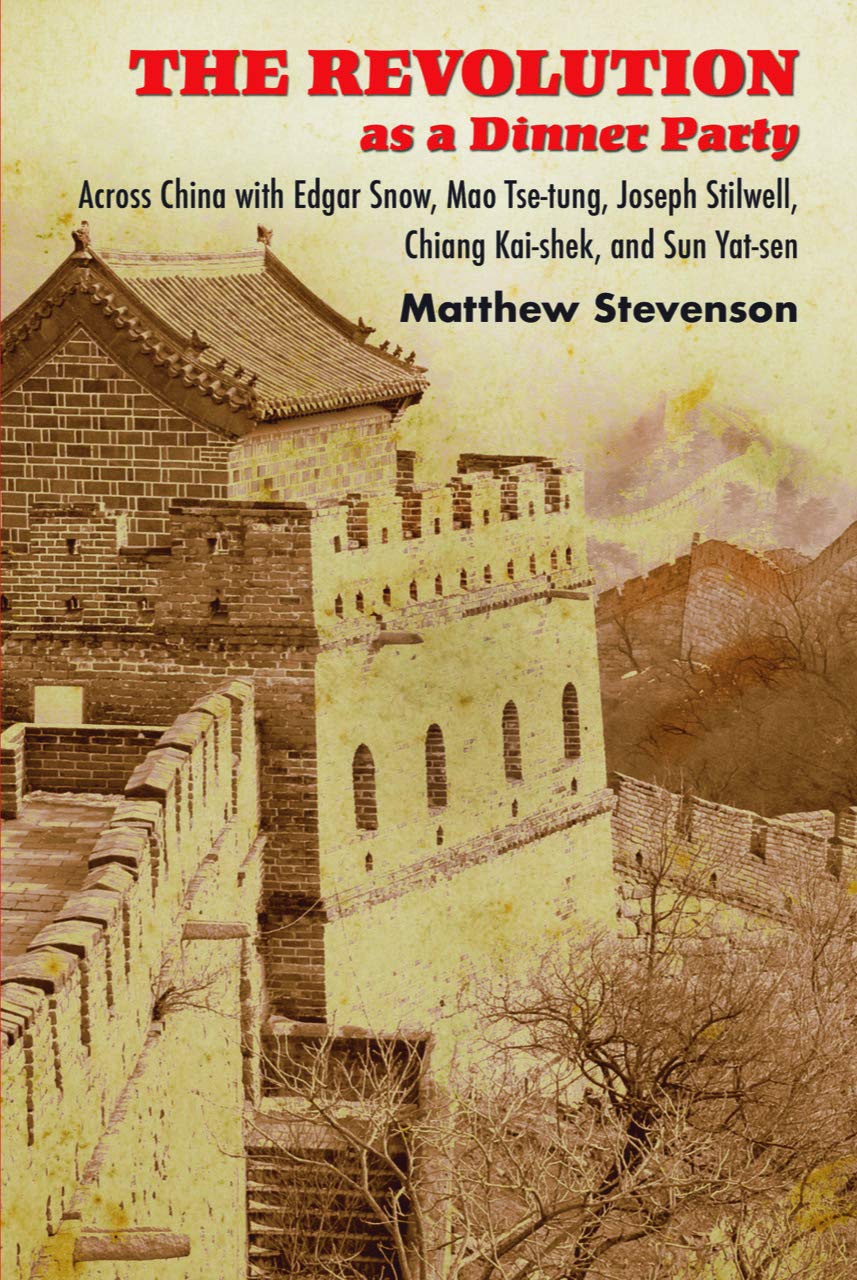
The Revolution as a Dinner Party: Across China with Edgar Snow, Mao Tse-tung, Joseph Stilwell, Chiang Kai-shek, and Sun Yat-sen
$15.00
by Matthew Mills Stevenson



From the author of Letters of Transit, Reading the Rails, and Appalachia Spring comes this delightful account of a journey across the People’s Republic of China, in search of the men who shaped its modern history. Along the way Matthew Stevenson visits Mao’s cave house in Yenan, where Chiang was kidnapped in Xian, General Joseph Stilwell’s house in Chongqing, and Sun Yat-sen’s hideouts in Guangzhou and Hong Kong. Between Beijing and Hong Kong, and many places in between, Stevenson moves around by bicycle, train, and foot, allowing him to describe the places that shaped the lives of China’s founders. Of Mao’s cave in Yenan, Stevenson writes: “The simple houses are dug into the side of the hill and are reached by climbing steps from the parking lot. Most have nothing more than a bed, a few chairs, a table, and a cupboard—the revolution playing out in what New Yorkers would call a ‘single-room occupancy.’” The Revolution as a Dinner Party is a graceful book, full of observation and humor, that is perfect for one today thinking about China—either its past or future. It also an accessible history of China’s last hundred years and biographies of the men at the heart of the country’s many conflicts. From the author of Letters of Transit , Reading the Rail s, and Appalachia Spring comes this delightful account of a journey across the People's Republic of China, in search of the men who shaped its modern history.Beginning with a bicycle ride in Beijing, to find where the American journalist Edgar Snow is buried, Matthew Stevenson travels in the footprints of Mao Tse-tung, Joseph Stilwell, Chiang-shek, and Sun Yat-sen, all of whom played a key role in China's evolution from warlordism to the current state. He writes: At least after my rail odyssey this time--from Beijing to Hong Kong through the interior--I could associate each man with an important place in his life, and that, I hoped, would lead me to a deeper understanding of the fives lives that often crossed each other as China endured its many revolutions throughout the twentieth century. It is a graceful book, full of wry observations and humor, that is the perfect companion, whether you are visiting China or just curious about it. But it is also an accessible history of China's last hundred years and biographies of the men at the heart of the many conflicts. All aboard for the most fascinating train journey you'll ever take--a trip across China with Matthew Stevenson from Beijing to Xi'an, from Chongqing and Wuhan to Guangzhou and Hong Kong to visit places where Sun Yat-sen replaced imperial dynasty with the first Chinese republic, where Chiang Kai-shek was briefly kidnapped by the Communists, where Mao Tse-tung hid out from Chiang's Nationalists, and other places where historical memories come alive. You'll see vividly how wrong Senator Joseph McCarthy was: We never "lost" China because we never understood it, never had a clue how either Mao or Chiang thought about China or about us. Stevenson has plenty of time on his trains to read up on what the monuments and memorials he saw didn't tell about the past. By the time you finish this book, you, too, will be able to imagine the revolution as a dinner party, with these characters telling how the history really went down. --Craig Whitney, former foreign correspondent and editor for the New York Times and author of numerous books, including Unraveling Time , his memoir. Matthew Stevenson was born in New York City and grew up on Long Island, attending Buckley Country Day School and Friends Academy. His university degrees are from Bucknell and Columbia universities, and he spent a year abroad with the Institute of European Studies in London and Vienna. He moved to Geneva, Switzerland, in 1991. He is a contributing editor to Harper’s Magazine and host of the syndicated radio program, The Travel Hour . He has worked professionally in finance and investing. His essays and reporting have been published in many magazines, including, most recently, in CounterPunch .