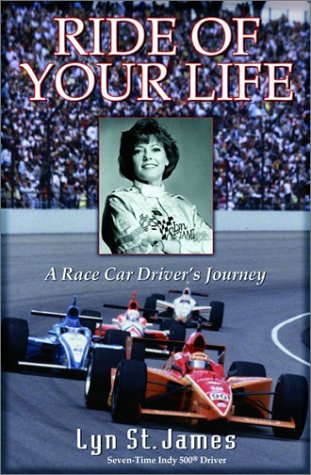



Fasten your seat belts! Indy 500 driver Lyn St. James provides inspirational advice for everyone as she recounts her inspiring career as a world-renowned Indy driver. Lyn St. James was 45 years old when she joined the world of Indy racing. Now known as the American Woman Racing Icon of the Century, Lyn is a testament to the power of determination and positive thinking. In this inspiring, motivational book, St. James chronicles her last Indy 500 and looks back on a career filled with challenges. She recounts years of adversity and the struggle to obtain corporate sponsorships, despite being named the Indy 500 Rookie of the Year. She recalls record-breaking runs at Talladega and Daytona, terrifying crashes, and the joys of mentoring young women drivers. On every page of this story people will find the motivation and encouragement to follow their dreams and reach their goals. Few people get the opportunity to strap themselves into an Indy car and compete at speeds in excess of 200 miles per hour. Such an experience would certainly be the "ride of your life." This book chronicles the impressive career of race car driver St. James, the first woman to win the Indy 500 Rookie of the Year Award, a two-time winner of the 24 Hours of Daytona, and a two-time competitor in the 24 Hours of Le Mans race who has made 15 Indy car starts and was named by Sports Illustrated for Women as one of the top 100 Women Athletes of the Century. The author, whose Indy career didn't even begin until age 45, succeeds in describing the sport from behind the scenes as she vividly explains what it is like to sit in the car during a race. St. James's title is an inspirational journey, a remarkable story of an individual who reached for her dream and worked hard through adversity to become a professional driver. A testimony to determination and positive thinking; recommended for sports collections in public libraries.DLarry R. Little, Penticton P.L., BC Copyright 2002 Reed Business Information, Inc. Lyn St. James has had 15 Indy car starts. She is founder of the Lyn St. James Foundation and Driver Development Program training young racers and served as president of the Womens Sport Foundation (1990-1993) and currently serves on their Board of Stewards. She lives in Indianapolis. Ride of Your Life A Race Car Driver's Journey By Lyn St. James HYPERION Copyright © 2002 Lyn St. James. All rights reserved. ISBN: 0-7868-6866-X Chapter One Drive the Course You're Given Unlike racing, life isn't run on a predetermined course, and you aren't given a map of all the bumps and turns along the way. My life certainly didn't follow any predestined track. I can't remember a time when I developed any grand strategy to become a race car driver. Neither of my parents worked in racing, and aside from the occasional teenage drag race, we had no racing history or culture. We were a working-class family (my father worked in a family-owned sheet metal business) in the small Cleveland suburb of Willoughby, Ohio, and I, like millions of other little girls, was a child of the baby boom. As young Evelyn Cornwall growing up in the '50s and '60s in Middle America, I never lay awake at night dreaming of one day revving my engine and racing my way around the Indianapolis Motor Speedway. I was far too shy to consider such things, and even if I'd had those kinds of dreams, sharing them with anyone would have been laugh-out-loud embarrassing. Women didn't drive race cars. Women didn't even set foot inside the garages, at least not at Indy. Gasoline Alley was for men only. Women weren't even allowed inside the garage compound. That rule raised a few eyebrows in the early '50s when a wealthy woman named Bessie Lee Paoli fielded a car in the 500-mile race and became the first team owner in history to be forced to watch her car from the grandstands. Actress Barbara Stanwyck of The Big Valley fame also elevated the acrimony when she appeared in the movie To Please a Lady with Clark Gable. In the film, Gable, an Indy car driver, is seen chatting with Stanwyck in the garage area. This sent racing traditionalists into a tizzy. Movie or not, women, including Dame Barbara Stanwyck, weren't allowed in Gasoline Alley, period. Officials at the Speedway later admitted that Stanwyck hadn't actually been in the restricted area. The film's director had cut a hole in the fence to create the illusion of Stanwyck in the garage compound when, in fact, her feet never crossed the neutral zone. For many years I never thought mine would, either. Mom loved to drive, and she would spend hours telling me how a car talks to you; gives you warnings and signals when things aren't right and gives you positive feedback when things are running well. She taught me to drive in the summer of my fifteenth year, but she taught me more than the rudimentary mechanics of driving; she taught me how to listen to a car and how to identify the sounds and smells it gives you. Mom was