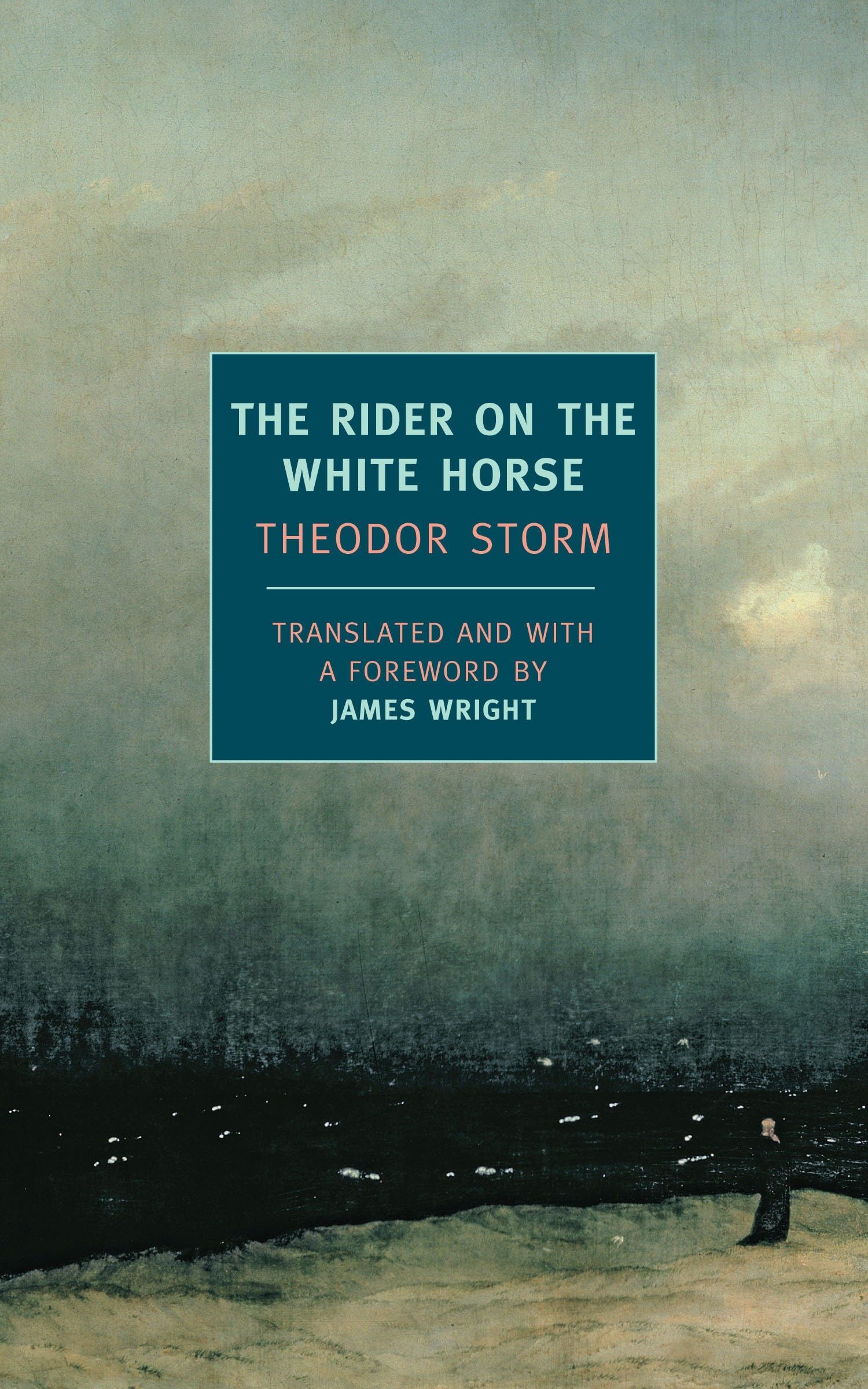



“The Rider on the White Horse” begins as a ghost story. A traveler along the coast of the North Sea is caught in dangerously rough weather. Offshore he glimpses a spectral rider rising and plunging in the wind and rain. Taking shelter at an inn, the traveler mentions the apparition, and the local schoolmaster volunteers a story. The story is both simple and subtle, and its peculiar power is to surprise us slowly. It is a story of determination, of a young man, Hauke Haien, living in a remote community (Storm depicts the village with the luminous precision of a Vermeer), who is out to make a name for himself and to remake his world. It is a story of devotion and disappointment, of pettiness and superstition, of spiritual pride and ultimate desolation, and of the beauty and indifference of the natural world. It is a story that opens up in the end to uncover the foundation of savagery on which human society rests. Theodor Storm’s great novella, which will remind readers of the work of Thomas Hardy, is one of the supreme masterpieces of German literature. It is here limpidly translated by the American poet James Wright, along with seven other shorter works, including the lyrical love story “Immensee.” The novella was a form beloved of nineteenth-century Germans, who favored the spooky variety. This, from 1888, is one of the greats. Hauke Haien, a young Frisian man, builds a new dike for his town, to shield it from the furies of the North Sea. The townspeople are against him; in the end, so is God, or nature. Like other novellas, “The Rider” is short on psychology but long on atmosphere; no one has ever described storms like Storm. (Hauke on his white horse, gazing at the sea: “Where was the other shore? He stood there face to face with sheer mountains of water.”) Hauke is defeated. Yet in the dark and stormy night outside the inn where this tale is told around the hearth, a ghost rider gallops past on a ghostly white horse. Storm is neglected. This republication of Wright’s gorgeous translation, with a selection of Storm’s other stories, should correct that. Copyright ©2008 Click here to subscribe to The New Yorker Theodor Storm (1817–1888) was born in Husum, a town on the North Sea in the region of Schleswig, a German-speaking area that was then under Danish rule but is now part of Germany. His mother came from a rich family, and his father, whose people had been farmers and milliners, was a lawyer. Husum was notorious for its violent weather, and a sea storm devastated the town when Storm was a boy, an experience that would leave a deep mark on his writing. On completing his studies, Storm settled down as a lawyer in Husum (which he famously called “the gray town by the sea”), though his opposition to Danish rule led to an extended period of exile during which he wrote his celebrated story “Immensee” and made his name as a poet (often writing in response to the romantic complications of his personal life) and as the author of short fiction. In the 1864 Treaty of Vienna, which brought an end to the Prusso-Danish wars, Schleswig was ceded to Prussia, and Storm returned home where he served as a judge until his retirement in 1881. Suffering from stomach cancer, he completed his masterpiece, “The Rider on the White Horse,” in 1884 and died four months later. Storm refused religious rites, and by his request his funeral was conducted in silence. James Wright (1927–1980) was born in Martins Ferry, Ohio, the son of a factory worker. After graduating from high school in 1946, he was stationed with the United States Army in occupied Japan. He attended Kenyon College on the G.I. Bill, then traveled as a Fulbright fellow to Austria, where he studied the work Theodor Storm and Georg Trakl at the University of Vienna. In 1957, Wright’s first book of poems, The Green Wall , was chosen by W.H. Auden for the Yale Younger Poets Series. Wright was elected a fellow of the Academy of American Poets in 1971 and in 1972 he received the Pulitzer Prize for poetry for his Collected Poems . Used Book in Good Condition