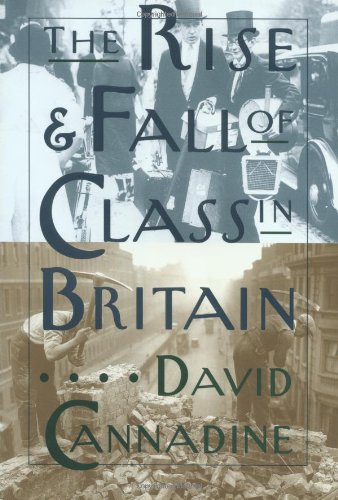



Although it is widely believed that the British are obsessed with class to a degree unrivaled by any other nation, politicians in Britain are now calling for a "classless society," and scholars are concluding that class does not matter any more. But has class -- once considered the master narrative of British history -- fallen, failed, and been dismissed? In this wholly original and brilliantly argued book, David Cannadine shows that Britons have indeed been preoccupied with class, but in ways that are invariably ignorant and confused. Cannadine sets out to expose this ignorance and banish this confusion by imaginatively examining class itself, not so much as the history of society but as the history of the different ways in which Britons have thought about their society. Cannadine proposes that "class" may best be understood as a shorthand term for three distinct but abiding ways in which the British have visualized their social worlds and identities: class as "us" versus "them;" class as "upper," "middle," and "lower"; and class as a seamless hierarchy of individual social relations. From the eighteenth through the twentieth century, he traces the ebb and flow of these three ways of viewing British society, unveiling the different purposes each model has served. Encompassing social, intellectual, and political history, Cannadine uncovers the meanings of class from Adam Smith to Karl Marx to Margaret Thatcher, showing the key moments in which thinking about class shifted, such as the aftermath of the French Revolution and the rise the Labor Party in the early twentieth century. He cogently argues that Marxist attempts to view history in terms of class struggle are often as oversimplified as conservative approaches that deny the central place of class in British life. In conclusion, Cannadine considers whether it is possible or desirable to create a "classless society," a pledge made by John Major that has continued to resonate even after the conservative defeat. Until we know what class really means-and has meant-to the British, we cannot seriously address these questions. Creative, erudite, and accessible, The Rise and Fall of Class in Britain offers a fresh and engaging perspective on both British history and the crucial topic of class. "Class," the greengrocer's daughter Margaret Thatcher once remarked, "is a Communist concept. It groups people as bundles, and sets them against one another." The notion of social and economic classes has certainly been a durable one, and it has proven useful to not only Communist theoreticians but also historians and social scientists of all stripes. Nowhere does the idea of class seem quite so powerful as in Britain, writes London University historian David Cannadine in this engrossing study: Although his fellow historians there have largely abandoned class analysis in their work, social distinctions and divisions persist and remain powerful. That historians (notably among them the Marxist scholars E. P. Thompson and Eric Hobsbawm) and politicians now prefer to disregard those distinctions, Cannadine believes, is the result of "the shift from the traditional preoccupation with people as collective producers to the alternative notion of people as individual consumers"--the triumph, in other words, of market capitalism. Yet, Cannadine continues, it is through the lens of class that Britons "understand and describe their social worlds," and not through other idealized models. Cannadine examines the work of scholars and political thinkers who have attempted to alter that view, among them Conservative leader Stanley Baldwin, whose "main concern was to change the way the British looked and felt and thought about their society and themselves." However well intentioned, such efforts are doomed to failure, Cannadine argues, and although Tories and Labourites promise a classless society to come, the British view will likely remain class-bound. --Gregory McNamee Cannadine (history, London Univ.; Aspects of Aristocracy: Grandeur and Decline in Modern Britain, LJ 6/15/94) considers whether a classless society in Britain, as called for by recent politicians, is really possible. Cannadine believes that class is best understood not according to society's history as a whole but according to what culture does to inequality and social structure. The author visualizes class in three ways: us vs. them; upper, middle, and lower class; and the seamless hierarchy of individual social relations. Tracing these definitions of class in British society from the 18th century to the present day, he shows the different purposes these models have served in history and how attitudes toward class have changed. A unique discussion of class obsession in Britain supported by detailed research.?Mary F. Salony, West Virginia Northern Community Coll. Lib., Wheeling Copyright 1998 Reed Business Information, Inc. An original contribution to an old topic. Originally presented as the 1993 Leonard Hastings Schof