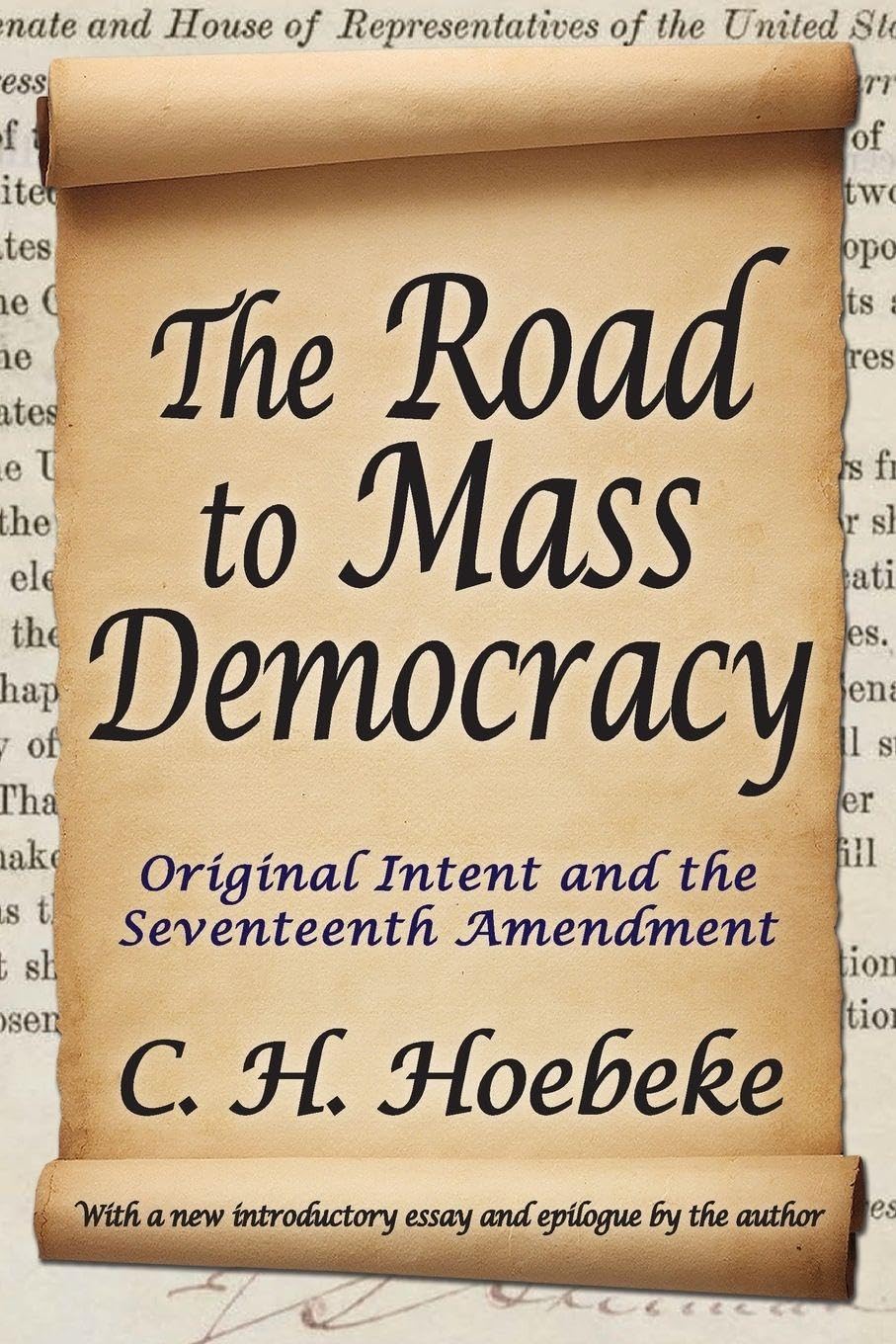
The Road to Mass Democracy: Original Intent and the Seventeenth Amendment
$49.59
by C. H. Hoebeke



Before the Seventeenth Amendment, US senators were elected by state legislatures. To end the supposed corruption of state "machines" and make the Senate more responsive to the legislative needs of the industrial era, the Senate was made a popularly elected body in 1913. Meanwhile, the spread of information and communications technology, it was argued, had rendered indirect representation through state legislators unnecessary. However, C. H. Hoebeke contends, none of these reasons accorded with the original intent of the Constitution's framers. To the founders, democracy simply meant the absolute rule of the majority. They proposed instead a "mixed" Constitution, an ancient ideal under which democracy was only one element in a balanced republic. Hoebeke demonstrates that the states, which were to provide the aristocratic Senate and the monarchical president, never resisted egalitarian encroachments, and settled for popular expedients when electing both presidents and senators long before the formal cry for amendment. The Road to Mass Democracy addresses the corruption, character and conduct of senate candidates and other issues relating to the triumph of "plebiscitary government" over "representative checks and balances." This work offers a provocative, readable, and often satiric reexamination of America's attempt to solve the problems of democracy with more democracy. -Hoebeke explores the contradictions present in the movement to adopt the Seventeenth Amendment and shows how this electoral change flies in the face of the intent of the framers of the Constitution . . . Well researched and clearly written, this work will be enjoyed by both general readers and scholars interested in either the Constitution or the US Senate.- --C. P. Chelf, Choice -This book is both an account of the passage of the Seventeenth Amendment and a meditation on the problems of representative government. . . . The reader need not share Hoebeke's political views to find something of value in his discussion of the Seventeenth Amendment. He succeeds in placing the push for the amendment into the larger political context of the progressive reform movement. He also does well in highlighting the excessive expectations, dubious arguments, and questionable motives of some of the amendment's advocates.- --Charles Byler, The American Journal of Legal History -Hoebeke's interesting and provocative book is an important contribution to our understanding of the political and institutional issues at stake in the Progressive Era.- --Raffaella Baritono, The Journal of American History -The Constitution of 1787 provided for the appointment of United States senators by state legislatures. In 1913, the Seventeenth Amendment was ratified, installing the current regime of direct elections of U.S. senators. The bloated and special-interest-driven nature of the federal government during this century has led scholars in recent years to reexamine the original framework of the Senate and to consider the causes of the Seventeenth Amendment and its consequences for U.S. twentieth-century politics and society. C. H. Hoebeke's The Road to Mass Democracy is an important addition to this growing literature.- --Todd J. Zywicki, Independent Review "Hoebeke explores the contradictions present in the movement to adopt the Seventeenth Amendment and shows how this electoral change flies in the face of the intent of the framers of the Constitution . . . Well researched and clearly written, this work will be enjoyed by both general readers and scholars interested in either the Constitution or the US Senate." --C. P. Chelf, Choice "This book is both an account of the passage of the Seventeenth Amendment and a meditation on the problems of representative government. . . . The reader need not share Hoebeke's political views to find something of value in his discussion of the Seventeenth Amendment. He succeeds in placing the push for the amendment into the larger political context of the progressive reform movement. He also does well in highlighting the excessive expectations, dubious arguments, and questionable motives of some of the amendment's advocates." --Charles Byler, The American Journal of Legal History "Hoebeke's interesting and provocative book is an important contribution to our understanding of the political and institutional issues at stake in the Progressive Era." --Raffaella Baritono, The Journal of American History "The Constitution of 1787 provided for the appointment of United States senators by state legislatures. In 1913, the Seventeenth Amendment was ratified, installing the current regime of direct elections of U.S. senators. The bloated and special-interest-driven nature of the federal government during this century has led scholars in recent years to reexamine the original framework of the Senate and to consider the causes of the Seventeenth Amendment and its consequences for U.S. twentieth-century politics and society. C. H. Hoebeke's T