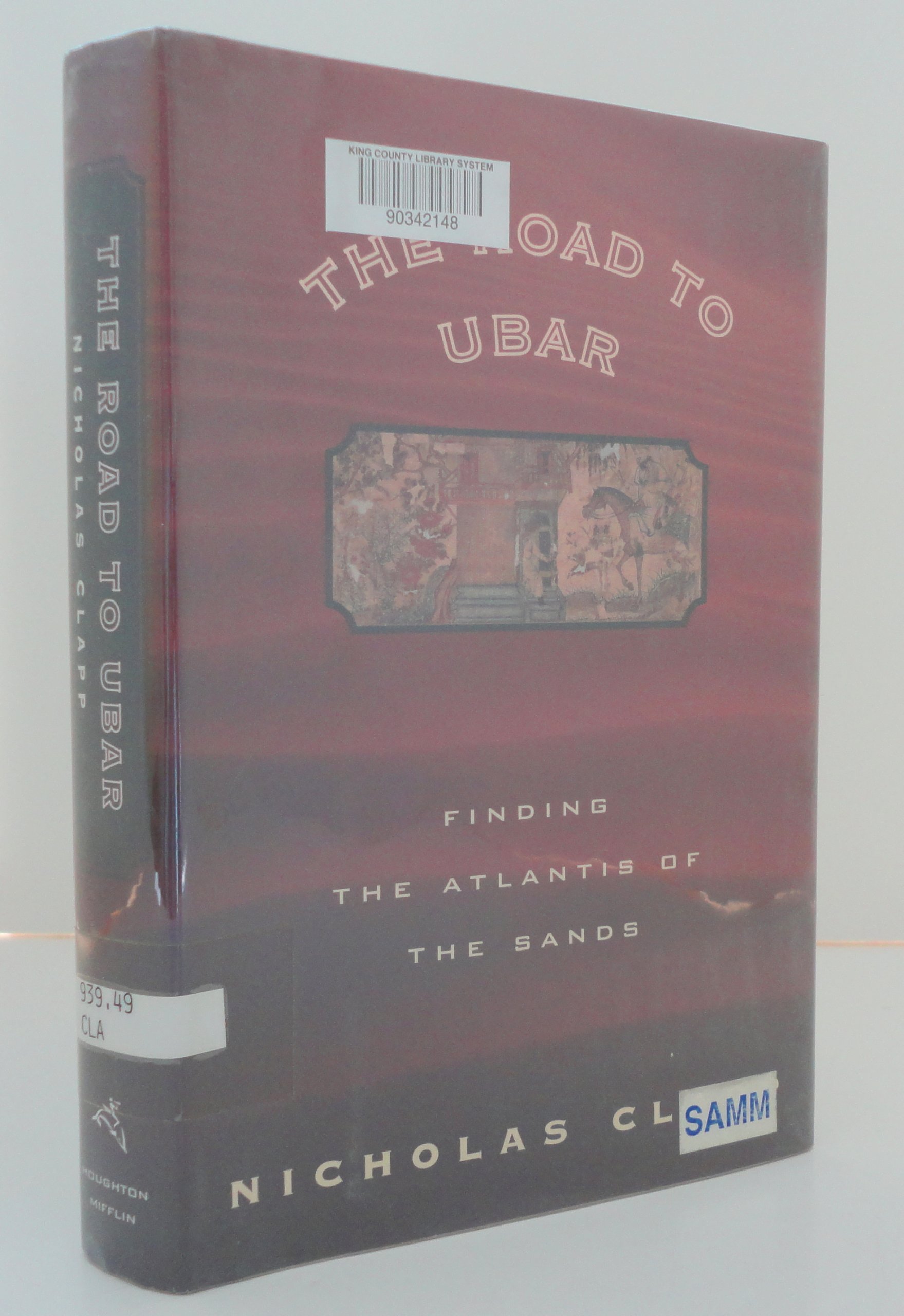



The most fabled city in ancient Arabia was Ubar, described in the Koran as "the many-columned city whose like has not been built in the entire land." But like Sodom and Gomorrah, Ubar was destroyed by God for the sins of its people. Buried in the desert without a trace, it became known as "the Atlantis of the Sands." Over the centuries, many searched for it unsuccessfully, including Lawrence of Arabia, and skepticism grew that there had ever been a real place called Ubar. Then in the 1980s Nicholas Clapp stumbled on the legend. Poring over ancient manuscripts, he discovered that a slip of the pen in a.d. 1460 had misled generations of explorers. In satellite images he found evidence of ancient caravan routes that were invisible from the ground. Finally he organized two expeditions to Arabia with a team of archaeologists, geologists, space scientists, and adventurers. After many false starts, dead ends, and weeks of digging, they uncovered a remarkable walled city with eight towers What is it about the inhospitable corners of the world that so attracts the imagination? Scott in the Antarctic, Hillary on top of Everest, and a multitude of wanderers--from Wilfred Thesiger and T. E. Lawrence to Gertrude Bell--wandering through the vast, empty sands of "the empty quarter" in what is now Saudi Arabia; each of these explorers has been drawn to places most of us would never think of going and found there an unexpected window onto their own souls. In The Road to Ubar , filmmaker Nicholas Clapp follows in the footsteps of earlier visitors to the Arabian peninsula as he seeks the legendary city of Ubar. Going back at least two millennia, stories about a vast city filled with gold that disappeared almost in an instant haunt the literature and lore of Arabia. And for almost as long as the stories have been around, so have the rogues and dreamers who have tried to find it. His interest sparked by the accounts of earlier travelers in the region such as Thesiger and Bertram Thomas, Clapp decided to put together his own team in hopes of finding and filming the lost city. Using both modern tools (photographs taken from space, courtesy of NASA) as well as old ones (maps, descriptions, and written accounts), Clapp and his team slowly pieced together the clues until they arrived, at last, at the site where they would spend the next four years digging. How they got to the end of The Road to Ubar and what they found there is at the heart of this unusual travel memoir. YA-When Clapp flew to the Sultanate of Oman to film a National Geographic documentary, he developed a love for this desert that would lead him to one of the top scientific discoveries of 1992. On that trip he heard of a fabled city destroyed by God for its sins of greed. It was in a place known as the Empty Quarter, but explorers, including Lawrence of Arabia, had failed to locate it. Clapp became obsessed. With only the slimmest of clues with which to work, he began to seek other ways to search for Ubar. Almost on a whim, he contacted NASA, hoping to use its imaging technology that could see through up to 18 feet of sand dunes. After several strokes of amazing luck, his contacts successfully retrieved and enhanced a satellite image that clearly indicated a major caravan route. Though delayed by lack of funding and the military operations of Desert Storm, he managed to launch two archaeological expeditions that eventually uncovered the lost city. Clapp's unusual interdisciplinary approach utilized the cultural myths relating to Ubar, as well as the historical chronicles and maps, and applied the hard scientific analysis of satellite images. Not only is the discovery aptly chronicled here but the author also gives an excellent view of the culture of ancient Arabia. The story is told with all the intrigue and humor of a low-key Indiana Jones adventure, and is documented with voluminous notes and a bibliography. It also includes black-and-white drawings, diagrams, and maps. A thoroughly engrossing book. Robin Deffendall, Bull Run Regional Library, Manassas, VA Copyright 1998 Reed Business Information, Inc. The discovery of the mythical city of Ubar in Oman, aided by satellite images, was hailed as one of the most remarkable archaeological discoveries of 1992. Ubar, once a center of the frankincense trade, sank without a trace into the desert sands somewhere between A.D. 300 to 500. In this definitive and enthralling work, Clapp, a documentary filmmaker who spearheaded the search for Ubar, weaves together several trends: clues found in ancient texts, remote sensing technology, and the modus operandi of an archaeological expedition. Legend, myth, earlier accounts (the bibliography and notes are considerable), and archaeological evidence are pieced together to reconstruct Ubar's history. The epilog describes an entertaining foray into neighboring Yemen to visit the Prophet Hud's tomb. The only criticism is the lack of photographs. The wide media interest in the exp