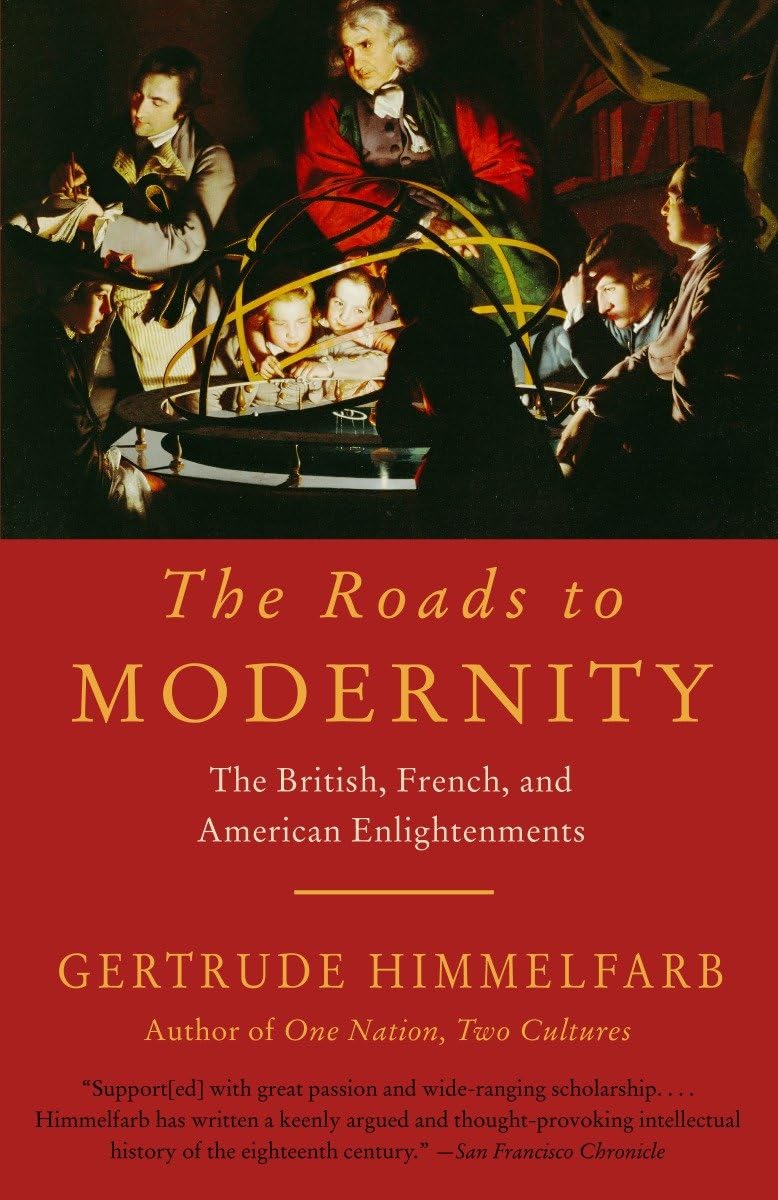
The Roads to Modernity: The British, French, and American Enlightenments (Vintage)
$13.50
by Gertrude Himmelfarb



In an elegant, eminently readable work, one of our most distinguished intellectual historians gives us a brilliant revisionist history. The Roads to Modernity reclaims the Enlightenment–an extraordinary time bursting with new ideas about human nature, politics, society, and religion--from historians who have downgraded its importance and from scholars who have given preeminence to the Enlightenment in France over concurrent movements in England and America. Contrasting the Enlightenments in the three nations, Himmelfarb demonstrates the primacy and wisdom of the British, exemplified in such thinkers as Adam Smith, David Hume, and Edmund Burke, as well as the unique and enduring contributions of the American Founders. It is their Enlightenments, she argues, that created a social ethic–humane, compassionate, and realistic–that still resonates strongly today, in America perhaps even more than in Europe. The Roads to Modernity is a remarkable and illuminating contribution to the history of ideas. “Support[ed] with great passion and wide-ranging scholarship. . . . Himmelfarb has written a keenly argued and thought-provoking intellectual history of the 18th century.” – San Francisco Chronicle “Exciting intellectual pugilism É Himmelfarb mounts a vigorous argument that the British [Enlightenment] was reformist rather than subversive, respectful of the past and present even while looking forward to a more egalitarian future.” – The New York Times Book Review “[Himmelfarb’s] writing . . . has a verve and sharpness. . . . It is a pleasure to read.” – The New York Review of Books “Exceptionally well written and clever.”– The Washington Post Book World “Himmelfarb has one of the keenest intellects of our time.” – The Houston Chronicle In an elegant, eminently readable work, one of our most distinguished intellectual historians gives us a brilliant revisionist history. The Roads to Modernity reclaims the Enlightenment-an extraordinary time bursting with new ideas about human nature, politics, society, and religion--from historians who have downgraded its importance and from scholars who have given preeminence to the Enlightenment in France over concurrent movements in England and America. Contrasting the Enlightenments in the three nations, Himmelfarb demonstrates the primacy and wisdom of the British, exemplified in such thinkers as Adam Smith, David Hume, and Edmund Burke, as well as the unique and enduring contributions of the American Founders. It is their Enlightenments, she argues, that created a social ethic-humane, compassionate, and realistic-that still resonates strongly today, in America perhaps even more than in Europe. The Roads to Modernity is a remarkable and illuminating contribution to the history of ideas. Gertrude Himmelfarb taught for twenty-three years at Brooklyn College and the Graduate School of the City University of New York, where she was named Distinguished Professor of History in 1978. Now Professor Emeritus, she lives with her husband, Irving Kristol, in Washington, D.C. Her previous books include: The De-Moralization of Society: From Victorian Virtues to Modern Values; On Looking into the Abyss: Untimely Thoughts on Culture and Society; Poverty and Compassion: The Moral Imagination of the Late Victorians; The New History and the Old; Marriage and Morals Among the Victorians; The Idea of Poverty: England in the Early Industrial Age; On Liberty and Liberalism: The Case of John Stuart Mill; Victorian Minds (nominated for a National Book Award) ; Darwin and the Darwinian Revolution; and Lord Acton: A Study in Conscience and Politics. 1. "Social Affections" and Religious Dispositions The British did not have "philosophes." They had "moral philosophers," a very different breed. Those historians who belittle or dismiss the idea of a British Enlightenment do so because they do not recognize the features of the philosophes in the moral philosophers--and with good reason: the physiognomy is quite different. It is ironic that the French should have paid tribute to John Locke and Isaac Newton as the guiding spirits of their own Enlightenment, while the British, although respectful of both, had a more ambiguous relationship with them. Newton was eulogized by David Hume as "the greatest and rarest genius that ever rose for the ornament and instruction of the species,"[1] and by Alexander Pope in the much quoted epitaph: "Nature and Nature's laws lay hid in night;/God said, Let Newton be! and all was light." But Pope's An Essay on Man sent quite a different message: "The proper study of mankind is man" implied that materialism and science could penetrate into the mysteries of nature but not of man. In an earlier essay, the allusion to Newton was more obvious; it was human nature, not astronomy, Pope said, that was "the most useful object of humane reason," and it was "of more consequence to adjust the true nature and measures of right and wrong, than to settle the distance of the planets a