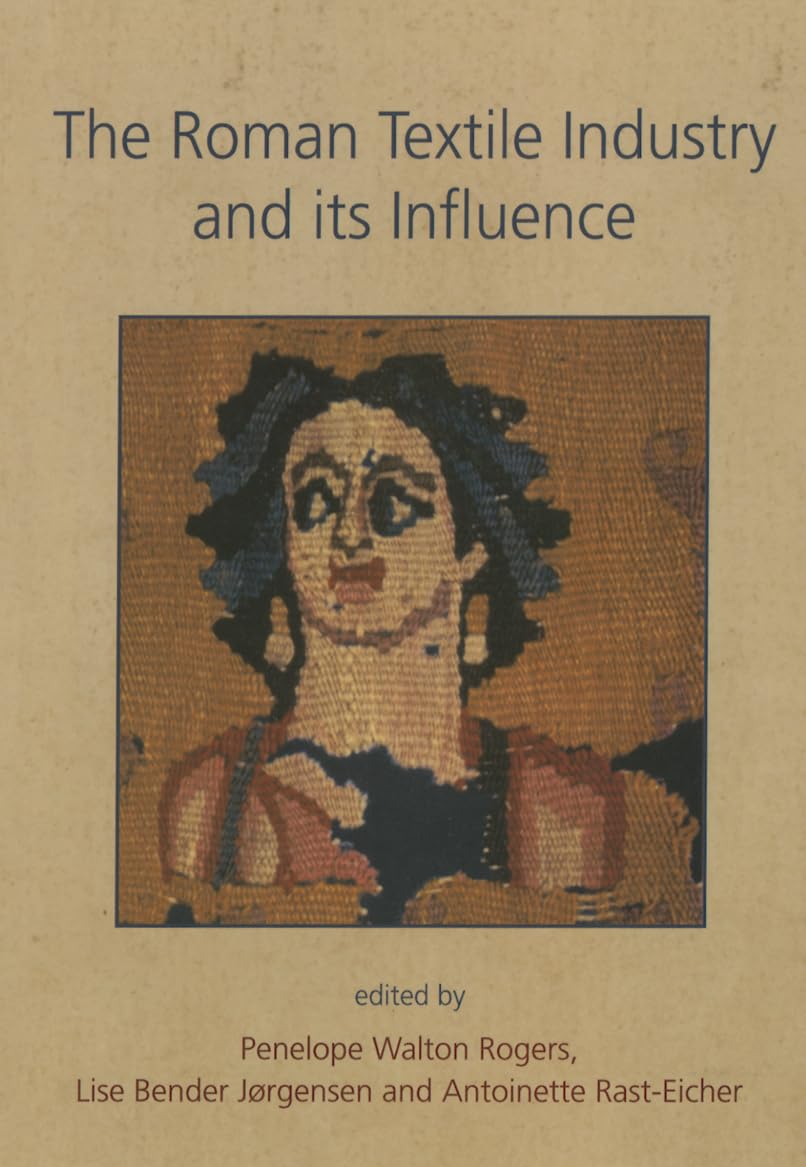



Textiles were a hugely important Roman industry yet, because of their perishable nature, only fragments remain. These twenty-two essays provide a detailed study of surviving fragments from across the Roman world, from the dry sands of Egypt to the Atlantic coast and the northern frontiers and beyond. The result is a comprehensive reconstruction of both everyday and exotic Roman clothing with information about the influences of fashion and of Roman weaving techniques. Written by friends and colleagues, the contributions are offered as a tribute to John Peter Wild whose own studies of Roman textiles have been the inspiration of so much recent work. Table of Contents Roamn Egypt and Nubia 1. Mons Claudianus: investigating Roman textiles in the desert Lise Bender Jogensen and Ulla Mannering 2. On the road to Berenike: a piece of tunic in damask weave from Didymoi Dominique Cardon 3. Two wide-sleeved linen tunics from Roman Egypt Frances Pritchard and Christ Verhecken-Lammens 4. Varia romana: textiles from a Roman army dump Nettie K. Adams and Elisabeth Crowfoot 5. Goat-hair textiles from Karanis, Egypt Jane Batcheller Contact with Asia 6. Two resist-dyed cottons recently found at Karadong, Xinjiang, (3rd centuary AD) Sophie Desrosiers, Corinne Debaine-Francfort and Abdurassul Idriss 7. A re-consideration of the human-figure emblems excavated in the at-Tar Caves in Iraq Kazuko Sakamoto 8. Was there Greek or Roman influence on Sasanian women's clothing? Gillian Vogelsang-Eastwood Europe, inside and outside the Frontier 9. Recent discoveries of gold textiles from Augustan Age Gadir (Cadiz) Carmen Alfaro Giner 10. Roman textiles in Switzerland Antoinette Rast-Eicher 11. Beyond the Empire: an Irish mantle and cloak Elizabeth Wincott Heckett 12. The Orkney hood, re-dated and recnsidered Thea Gabra-Sanders 13. Recent textile finds of the Roman period in Poland Jerzy Maik 14. The early Alamanni: the start of a new textile project Johanna Banck-Burgess 15. Recent analysis of the textiles from Bokener Moor and Vaaler Moor, Germany Klaus Tidow 16. A typical costume of te North German Iron Age? Some observations during conservation of the Bernuthsfeld 'plaid' Later Strands 17. From the Roman horizontal loom to the 3/1 twill damask loom of the early medieval period Daniel De Jonghe 18. A previously unrecognised Lion Silk at Canterbury Anne Muthesius 19. The re-appearance of an old Roman loom in medieval England Penelope Walton Rogers 20. Where are the Romans? Classical influences on women's fashionable dress from the late eighteenth to the twentieth century Naomi Tarrant 21. The contribution of experimental archaeology to the research of ancient textiles Elizabeth Peacock John Peter Wild: a bibliography a very welcome addition to a fast-growing twenty-first-century bibliography on textiles and dress in antiquity.' Mary Harlow, Britannia 34, 2003 Despite the fact that the volume is composed of such seemingly disparate papers, several strong themes recur throughout: the importance of provenienced material; the utility of single textile pieces in providing information about chronology, origin, function, and technology; and the significance of comparative studies for the understanding of broader cultural issues.' ' … although most of the papers contain technical descriptions of individual textile fragments, these can be easily 'avoided' by those unfamiliar with the jargon. The wide spectrum of topics and approaches to the study of Roman textiles makes this an accessible and useful volume not only for the specialists. The lay reader will find this collection of essays helpful in appreciating the incredible advances of textile studies in the last few decades. It also reflects how vast, geographically speaking, our corpus of Roman textiles is, covering almost the entire empire with the lamentable exception of Italy itself.' (For the full review go to the Bryn Mawr Classical Review website.) Margarita Gleba, Bryn Mawr Classical Review 2002 The editors of this book not only provide a fitting tribute to a leading scholar in the field of Roman textiles but also provide a balanced and easily readable set of case studies about the use and construction of ancient textiles. This book is a very useful text for both scholars and lay readers interested in the Roman textile industry.' 'Although the focus of the book is on textiles, two recurring themes are interwoven throughout the book. The first theme relates to the range and extensive influence of the Roman textile industry. As all of the chapters in the book illustrate, the Roman textile industry was not only centered in southern Europe but extended its influence into the Near East, southern Asia, and northern Europe. Within a temporal framework, the manufacturing techniques and stylistic designs utilized by Roman weavers continued to be used to varying degrees into the late 18th and ear