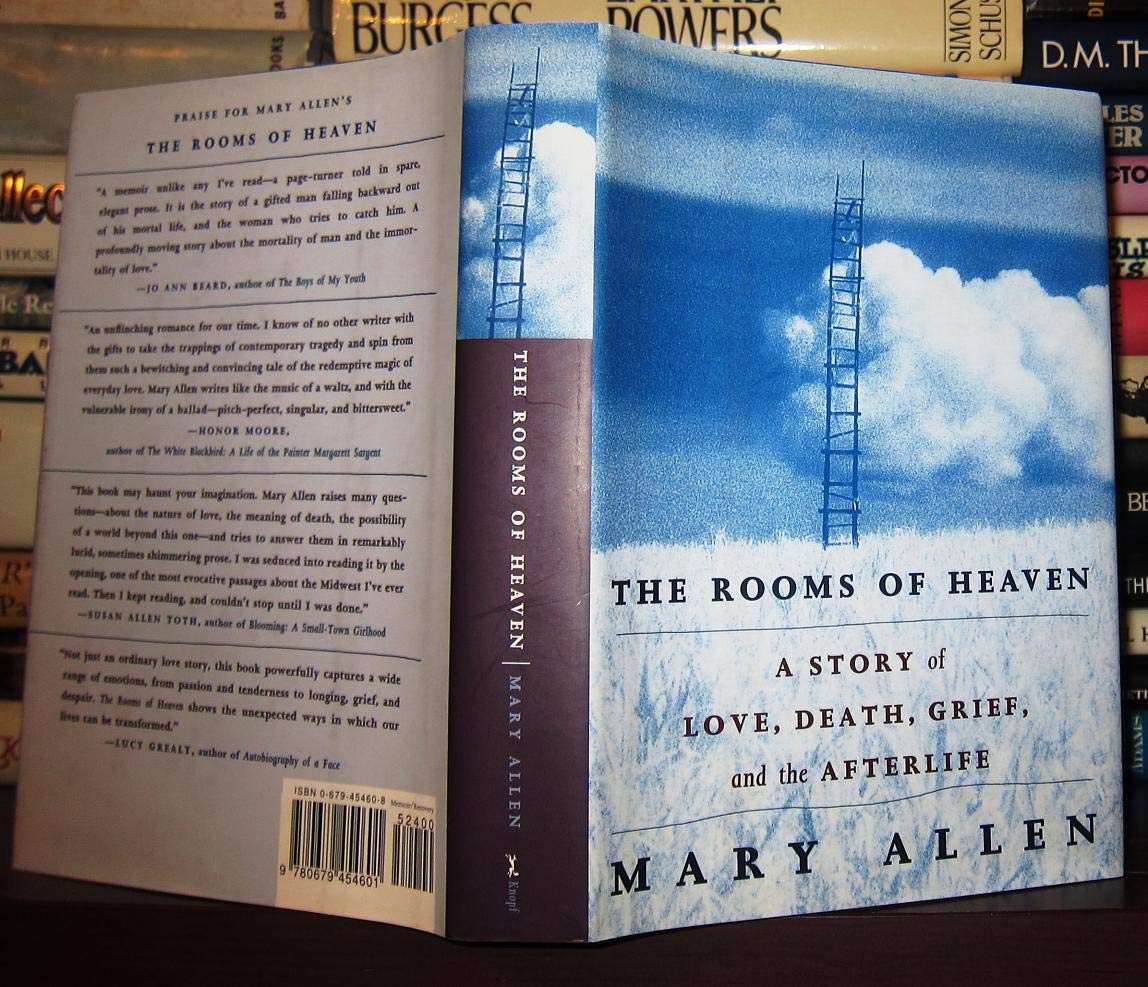



A memoir that is intimate and gripping, literary and suspenseful, The Rooms of Heaven is a love story, an anatomy of a suicide, an account of grief and healing, and a wholly original exploration of life after death. At its center is Mary Allen, seeking a new beginning in Iowa City. There she meets Jim Beaman--smart, handsome, charming--a workingman who defies the stereotypes: he has a lightning wit, he draws and sculpts, he makes chess sets out of clay. "It's hard to explain," Allen writes, "what it's like when you're attracted to someone as suddenly and fiercely as I was to Beaman, what it is about him that makes you fall in love with him." But she does explain, and we see the beginnings of an intense love affair: "We talked about everything and nothing, his childhood and my childhood, people we'd slept with and people we hated, death and college and dreams." There's more to this relationship, however, than a simple love story. Jim Beaman, it turns out, has a drug problem, and Allen gets drawn into the world of addiction, with its promises and denials, good intentions and inevitable disappointments. Then Jim kills himself. "Stories about somebody dying usually end with the death," notes Allen, but this time "death is not the end of the story." Convinced that Jim must be somewhere, "that a person, that Jim Beaman, was more than a complex piece of machinery, reduced now to a pile of ashes in a cardboard box," she embarks on a riveting, sometimes funny, often terrifying investigation of the landscape of the afterlife--a journey that leads her to (perhaps) contact with Jim, to the brink of madness, and, ultimately, back to herself. In prose of astonishing originality, The Rooms of Heaven captures the beauty of the American heartland, the transformative power of love, and the "terrible magic" of death. Although this is billed as a memoir, a more accurate label might be spiritual autobiography . After Mary Allen's drug-addicted boyfriend, Jim, commits suicide, she enters the classic dark night of the soul, confronting the denials as well as the truths that existed prior to her beloved's suicide. A less courageous author might have stopped there, but Allen has the guts also to reveal her mental anguish and psychiatric institutionalization. She delved into the underworld of the afterlife, desperate for connection with her boyfriend's spirit. Although Allen does not dismiss the possibility of "Summerland," a spiritualist term for the afterlife, she stays grounded in her personal experience with contacting Jim's spirit, instead of making sweeping assertions about the hereafter. The effect is engrossing and at times laugh-aloud funny. Overall, Allen's narrative rings with dignity--clearly the voice of an accomplished, award-winning writer as well as a woman who has risen from the ashes of a lover's suicide and codependency (a cliché she skillfully avoids lingering over) to become a person who can finally love with ferocity and self-respect intact. --Gail Hudson Only after her fianc?'s suicide did Allen realize that, somehow, she knew he had been abusing drugs. Writing with great insight, she reconstructs her relationship with Jim, from their first powerful attraction through her strong remembrances of him after his death. Allen skillfully avoids melodrama as she honestly reflects on Jim's addiction and death and her own denial and grief, including her search for a way to communicate with him after death and her fall into deep depression. Throughout, she and Jim are true to formAnever more or less than human. It is refreshing to read a book whose author lives through a trauma without whining or casting blame, managing not merely to survive but to find some sort of redemption. A beautifully written tale, thoughtful and arresting; for public and academic libraries. [For an essay by Allen, see p. 86.]ANaomi E. Hafter, Broward Cty. P.L., Ft. Lauderdale, F. -ANaomi E. Hafter, Broward Cty. P.L., Ft. Lauderdale, FL Copyright 1999 Reed Business Information, Inc. Allen's hypnotic memoir is sad, mysterious, and beautiful. It begins when Allen moves from Massachusetts to Iowa. She likes Iowa's quiet aura; it feels magical to her, and she falls in love with an Iowa City neighbor named Jim Beaman. They are happy and plan to marry, and then Allen slowly and reluctantly realizes that her dream man is living a nightmare: he's an alcoholic and a cocaine addict. Neither wants to admit to the severity of his problems, and Allen's careful parsing of the nature of denial is one of the more haunting aspects of this altogether disquieting meditation on love and loss. Allen recounts Beaman's transformations under the influence, his shame and despair, and, finally, shockingly, his suicide, with an almost eerie, undoubtedly cathartic meticulousness. And she maintains this eggshell-walking voice as she recounts her feverish attempts to contact Jim's spirit, inexplicable experiences that opened her up to a bewildering, frequently