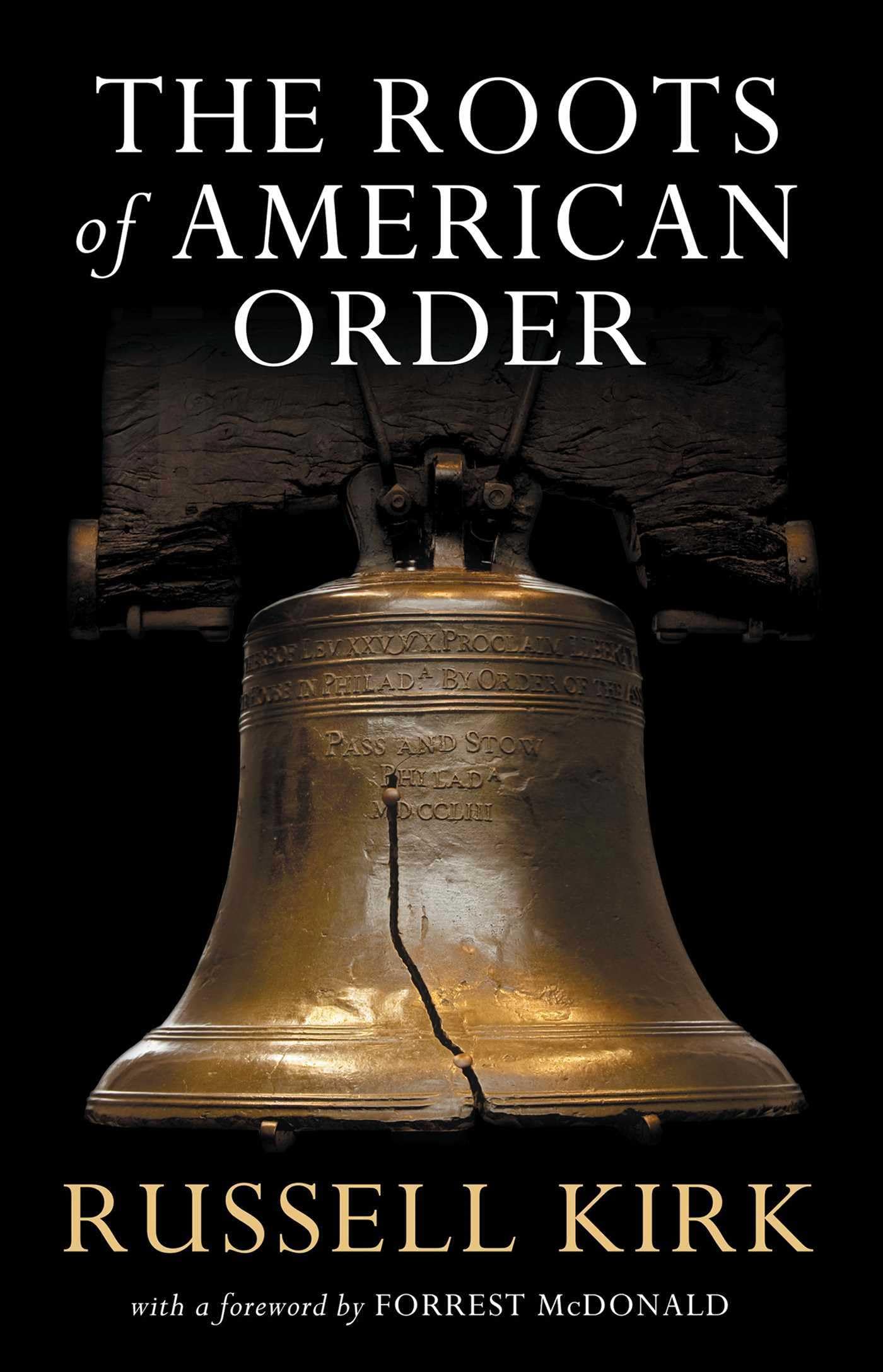



What holds America together? In this classic work, Russell Kirk identifies the beliefs and institutions that have nurtured the American soul and commonwealth. Beginning with the Hebrew prophets, Kirk examines in dramatic fashion the sources of American order. His analytical narrative might be called a "tale of five cities": Jerusalem, Athens, Rome, London, and Philadelphia. For an understanding of the significance of America in the twenty-first century, Russell Kirk's masterpiece on the history of American civilization is unsurpassed. "The Roots of American Order is destined to be accorded a distinctive status. . . . Kirk is one of the few intellectuals with the breadth and depth of knowledge necessary to place the American experience in the broader historical perspective of our Judaic-Christian tradition." —Wall Street Journal "This is a most impressive affirmation of faith in American ideals and institutions." —Publishers Weekly "Anyone who wishes to reflect and talk on the topic of 'America,' and especially any Christian who wishes to do so, will do himself a favor if he reads Kirk's book." —Christianity Today "Kirk's book is exactly what people need to read, and he has made it easy, even pleasurable, for them to do so." —Esquire Russell Kirk (1918-1994), the father of intellectual conservatism in America, was the author of more than thirty books, including The Conservative Mind , Eliot and His Age , and The Roots of American Order . His legacy lives on in the work of the Russell Kirk Center for Cultural Renewal, based at his ancestral home in Mecosta, Michigan. The Roots of American Order By Russell Kirk ISI Books Copyright © 2007 Russell Kirk All right reserved. ISBN: 978-1-882926-99-2 Foreword Russell Kirk wrote often and eloquently about what he referred to as "the permanent things"-perduring conditions and needs that must be met if human society is to function well. Among these are a transcendent moral order based necessarily on religious faith, social continuity, the principle of prescription or things established by immemorial usage, prudential and natural change as opposed to change based on abstract theories, variety and therefore inequality except in the Last Judgment and before a court of law, and the acceptance of the imperfectability of man. He was, for all his intellectual self-confidence, too modest a gentleman to claim that his own work was a permanent thing, though one suspects that in his heart of hearts he must have cherished the hope. Nevertheless, I make the claim on his behalf. Moreover, his work has a peculiar quality of being simultaneously timeless and ever timely, at once transcendent and relevant. I make these observations apropos of a brief review of the publishing history of The Roots of American Order . The book first appeared in 1974, a year of national crisis in which Richard Nixon resigned as president in disgrace, the war in Vietnam was coming toward a disastrous end, and colleges and universities were degenerating from seats of learning into madhouses. Kirk's work was obviously the result of long and deep study, but it was also written as an effort, in his words, "to assist in renewing an appreciation of America's moral and social order among the general public and among university and college students." The first paperback edition came out in 1978, in the midst of Jimmy Carter's often directionless presidency and on the eve of the calamity that was the Iranian hostage crisis. Carter himself, in a much-publicized speech at the University of Notre Dame, scolded Americans for having lost their sense of values and appreciation of the American order. I doubt whether Carter had read this book; if he had, instead of just scolding he might have urged every citizen to read the book as well. Yet another printing came in the early 1980s, before it had become evident what kind of president Ronald Reagan would turn out to be. Those in the know were aware that Reagan had carefully read this and much of Kirk's other work, and that it would affect his conduct during his years in the White House. Now, in the wake of the terrorist attacks of September 11, 2001-I am writing this on September 11, 2002-ISI Books has brought out this current edition, which is perhaps more relevant than ever. The response of most Americans to the attacks was a wave of patriotism that had long since seemed out of fashion, accompanied by a devout appreciation of and determination to defend the social and political order with which we have been blessed. Yet some aspects of the response are troublesome. Predictably, cynicism marked the reaction of the extreme Left, and was especially prevalent among academicians who had long espoused "multiculturalism"-the notion that no culture has a fair claim to being superior to any other. These academics insisted that the United States itself has a history of being a terrorist country, citing slavery, relations with Indians, and the oppr