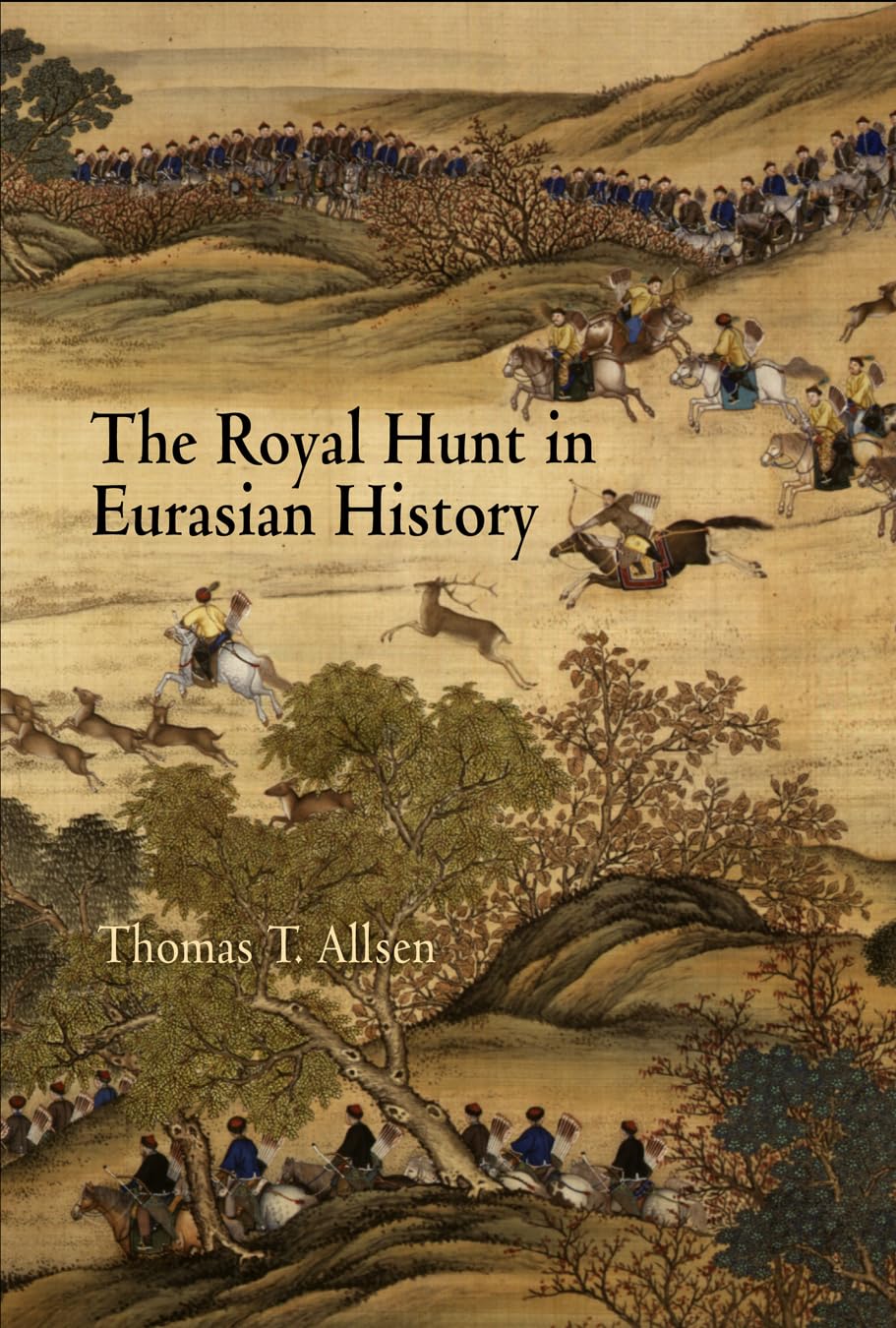



From antiquity to the nineteenth century, the royal hunt was a vital component of the political cultures of the Middle East, India, Central Asia, and China. Besides marking elite status, royal hunts functioned as inspection tours and imperial progresses, a means of asserting kingly authority over the countryside. The hunt was, in fact, the "court out-of-doors," an open-air theater for displays of majesty, the entertainment of guests, and the bestowal of favor on subjects. In the conduct of interstate relations, great hunts were used to train armies, show the flag, and send diplomatic signals. Wars sometimes began as hunts and ended as celebratory chases. Often understood as a kind of covert military training, the royal hunt was subject to the same strict discipline as that applied in war and was also a source of innovation in military organization and tactics. Just as human subjects were to recognize royal power, so was the natural kingdom brought within the power structure by means of the royal hunt. Hunting parks were centers of botanical exchange, military depots, early conservation reserves, and important links in local ecologies. The mastery of the king over nature served an important purpose in official renderings: as a manifestation of his possession of heavenly good fortune he could tame the natural world and keep his kingdom safe from marauding threats, human or animal. The exchanges of hunting partners—cheetahs, elephants, and even birds—became diplomatic tools as well as serving to create an elite hunting culture that transcended political allegiances and ecological frontiers. This sweeping comparative work ranges from ancient Egypt to India under the Raj. With a magisterial command of contemporary sources, literature, material culture, and archaeology, Thomas T. Allsen chronicles the vast range of traditions surrounding this fabled royal occupation. ...clear, precise writing and [an] ability to weave a solid analytical narrative on a topic that spans centuries and cultures. -- The Journal of Military History, January 2007 ...offers a powerful and persuasive vision of royal hunting as a Eurasian phenomenon. -- Journal of the Royal Asiatic Society, Series 3, 2007 ...very highly recommended, particulary for college libraries, but also as a valuable contribution to political history reference collections as well. -- Library Book Watch, August, 2006 Thomas T. Allsen is Professor Emeritus, Department of History, College of New Jersey. Thomas T. Allsen (1940-2019) was Professor Emeritus of The College of New Jersey and author of several books, including Commodity and Exchange in the Mongol Empire: A Cultural History of Islamic Textiles and Culture and Conquest in Mongol Eurasia. His The Steppe and the Sea is also available from the University of Pennsylvania Press. Chapter 1. Hunting Histories World Histories and the World of Animals Almost all peoples have explanations, usually articulated in mythology, for the creation of the world, of life and human culture. In these first grand narratives, beginnings or new departures in the cultural sphere are typically attributed to the intervention of the gods or to the inventions of cultural heros. As wisdom inherited from founders, these narratives, rarely challenged from within, commonly retained their relevancy and currency for long periods of time. There were, however, "evolutionary" alternatives to these mythologies of bestowal, particularly in the Western intellectual tradition, which has produced a long series of theories that divide human historical development into three successive stages. The most familiar of these, and the first to be based on systematic examination of physical remains, is the "three-age system," which posited sequential stone, bronze, and iron ages. This model, first outlined by Scandinavian naturalists in the late eighteenth century, gave rise to a new kind of grand narrative, one that linked cultural evolution to the human ability to manipulate inanimate materials. But this was not the only three-age system then circulating in Europe; another, far older notion going back at least to Varro in the first century B.C.E., maintained that humans passed through three distinct stages in their history: hunting, herding, and agriculture. These stages, what we would now term subsistence systems, were held to be universal and sequential. Long assumed to be self-evident, this theory survived until the end of the nineteenth century, when the German geographer Eduard Hahn convincingly demonstrated that animals were first domesticated by settled farmers, so that the "herding stage," that is, pastoralism in its varied forms, arose from and followed agriculture. What is striking about this particular conceptualization of cultural development, whatever its chronological failings, is that in an earlier agrarian age history was seen to turn on the relationship of humans to other animate objects; this, of course, in sharp contrast to the