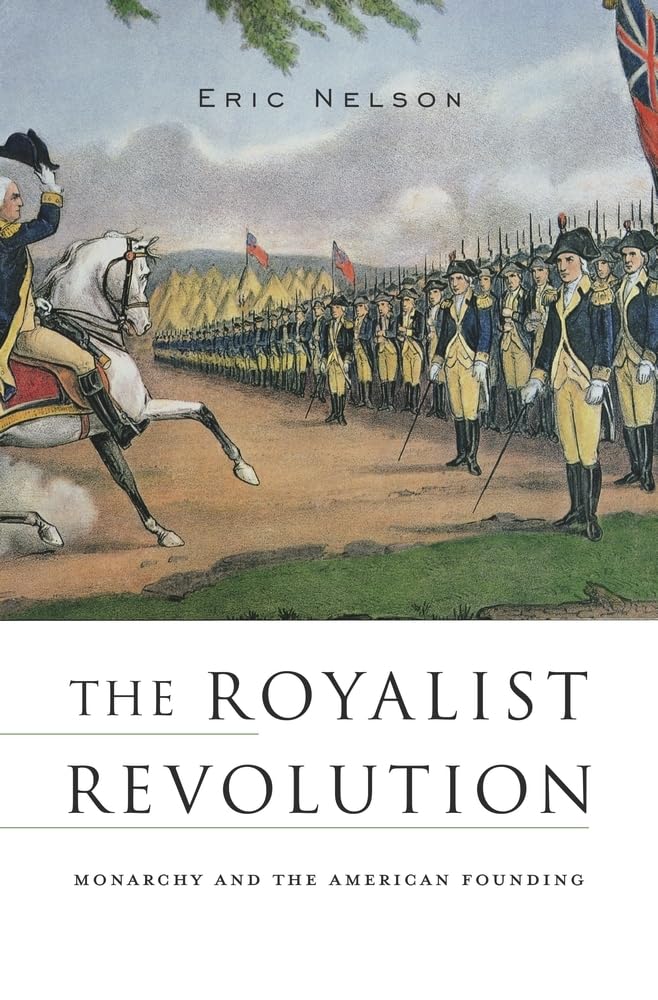



Generations of students have been taught that the American Revolution was a revolt against royal tyranny. In this revisionist account, Eric Nelson argues that a great many of our “founding fathers” saw themselves as rebels against the British Parliament, not the Crown. The Royalist Revolution interprets the patriot campaign of the 1770s as an insurrection in favor of royal power―driven by the conviction that the Lords and Commons had usurped the just prerogatives of the monarch. Leading patriots believed that the colonies were the king’s own to govern, and they urged George III to defy Parliament and rule directly. These theorists were proposing to turn back the clock on the English constitution, rejecting the Whig settlement that had secured the supremacy of Parliament after the Glorious Revolution. Instead, they embraced the political theory of those who had waged the last great campaign against Parliament’s “usurpations”: the reviled Stuart monarchs of the seventeenth century. When it came time to design the state and federal constitutions, the very same figures who had defended this expansive conception of royal authority―John Adams, Alexander Hamilton, James Wilson, and their allies―returned to the fray as champions of a single executive vested with sweeping prerogatives. As a result of their labors, the Constitution of 1787 would assign its new president far more power than any British monarch had wielded for almost a hundred years. On one side of the Atlantic, Nelson concludes, there would be kings without monarchy; on the other, monarchy without kings. [A] brilliant and provocative analysis of the American Revolution… [Nelson] departs radically from his predecessors, arguing that it was admiration for royal prerogative power and belief in the virtues of a strong executive, both derived from seventeenth-century precedents, that fostered the rebellion against Britain and shaped the Constitution of the new American republic. His Revolution comes out of a royalist, not a parliamentarian, tradition. The Royalist Revolution is a book of great intellectual power: it is not just challenging but erudite (many of its abundant footnotes are brilliant short essays in their own right), and, though densely argued, is written with admirable clarity and fairness. (John Brewer New York Review of Books ) The Royalist Revolution is a thought-provoking book, and Nelson is to be commended for reviving discussion of the complex ideology of the American Revolution. He reminds us that there was a spectrum of opinion even among the most ardent patriots and a deep British influence on the political institutions of the new country. (Andrew O’Shaughnessy Wall Street Journal ) By the 1760s, parliament was imposing taxes on the colonists without their consent. Patriot leaders like John Adams expressed longing for George III to restrain the legislative tyranny of parliament. Generations of historians have largely regarded such statements as insincere rhetorical ploys―as arguments of convenience lodged and then quickly forgotten. Nelson makes a convincing case that in so doing, historians have overlooked an important part of the political philosophy that impelled the American Revolution. (Yoni Appelbaum The Atlantic ) A scrupulous archaeology of American revolutionary thought. (Thomas Meaney The Nation ) [Nelson’s] argument will alternately surprise, shock, distress, and outrage many scholars, but it will also help to reshape a debate about the origins of the presidency, a topic that gravely matters as we agonize over the role of the post-9/11 executive in our impassioned and impasse-ridden politics… Eric Nelson’s real genius is to force us to rethink both the origins and substance of critical political ideas… We will be wrestling with the implications of its argument for some time. (Jack N. Rakove Weekly Standard ) Eric Nelson’s new book advances the royalist reinterpretation of 18th-century America a crucial stage further… The Royalist Revolution …provide[s] a powerful double-barrelled challenge to historiographical orthodoxy. Nelson argues persuasively that the Revolution―at least in the beginning―was not a revolt against the supposed tyrant George III, but a rebellion against the claims of the British Parliament. (Colin Kidd London Review of Books ) For anyone interested in the founding of the American Republic it is indispensable reading. (Jeremy Jennings Standpoint ) Brilliantly argued… The Royalist Revolution is surely one of the most important works on Revolutionary era political thought to appear in many years. (John W. Compton American Political Thought ) Nelson has given us a text of monumental importance. It is clear that historians will not be able to ignore this significant contribution… The Royalist Revolution will make many of us think very hard about what we thought we knew. (Matthew Dziennik Canadian Journal of History ) Eric Nelson’s provocative new work, The Royalist Revolution: Mo