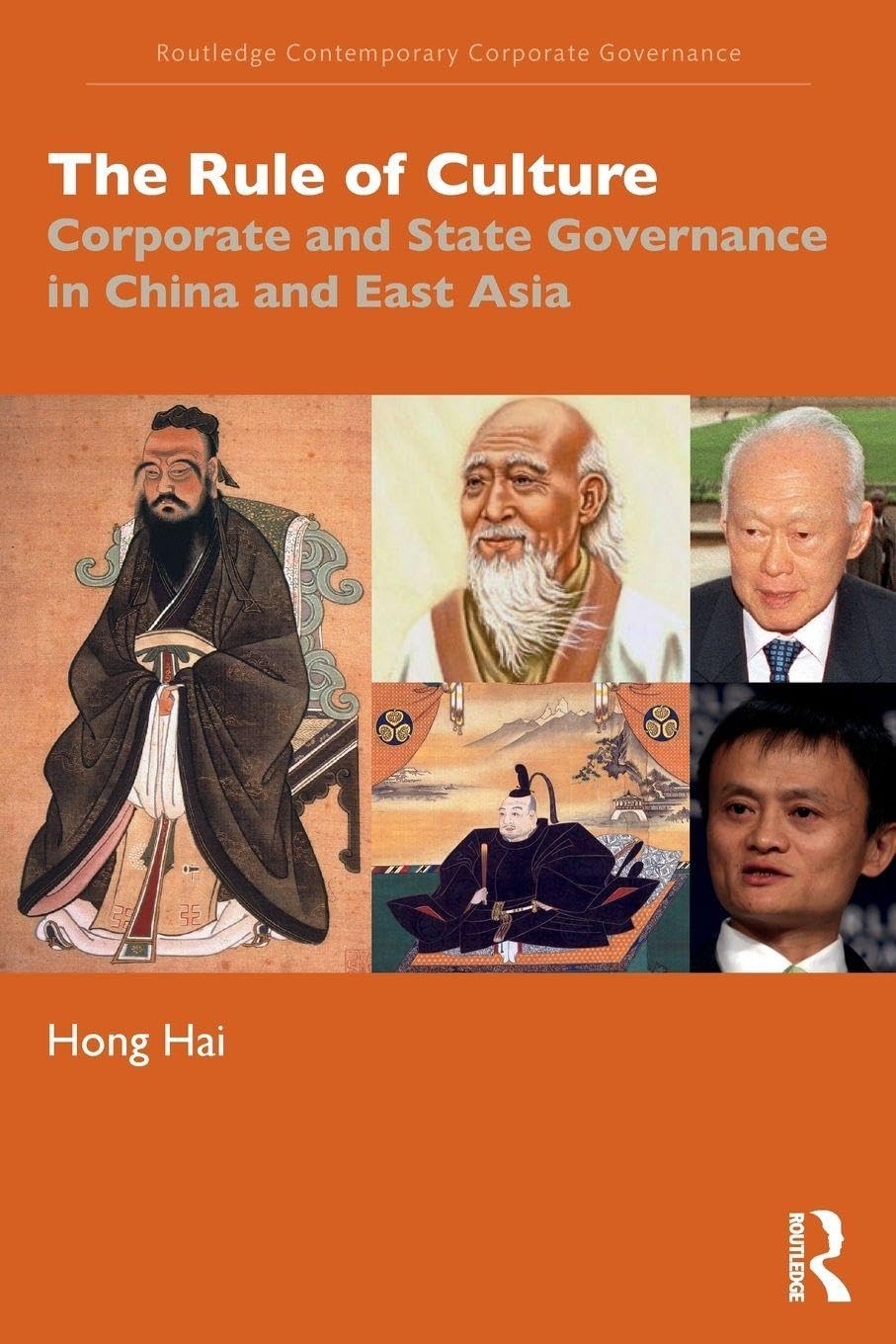



Culture has an abiding influence on the way countries and business corporations are governed. This book introduces the reader to the deep philosophies that drive corporations and governments in East Asia, from China through Japan and South Korea to Singapore. With sparkling clarity and spiced with anecdotes and case studies, it depicts how respect for cultures can lead to spectacular success, or the lack of it to failure. Confucian practices such as guanxi in Chinese society, the benevolent culture of entity firms in Japan, and patriarchal chaebols in South Korea are analyzed with examples like Esquel, Nissan, and Samsung. A delightful chapter on Daoism shows how it drives Jack Ma’s Alibaba.com. In the governance of nations, the author reinforces Burke’s dictum that systems of government must be consonant with traditional cultures, and he calls out misguided attempts by the West to foist liberal democracies on civilizations in the East where respect for authority and communitarian values come before individual interest. The author advances the novel concept of the meritocratic democracy in which leaders are chosen not by electoral popularity but by proven ability. In a thought-provoking concluding chapter, he evaluates prospective constitutional changes in China that would enshrine meritocratic democracy as an alternative to liberal democracies that have turned dysfunctional in many Western nations. "In this compact volume on culture and governance in China and East Asia, Hong Hai covers a wide field simply and succinctly. It is eminently readable and provides the best single short introduction to the region that I have come across. He paints in broad strokes covering a wide landscape with surprising depth. For some parts, he sketches interesting details which enhance and strengthen the overall presentation. It is remarkable how Hong Hai is able to explain diverse subjects - from the philosophy of Confucianism, Taoism, Buddhism to the leadership styles of Mao Tse-Tung, Deng Xiaoping and Lee Kuan Yew, to the success of companies like China’s Alibaba, Japan’s Toyota, Korea’s Samsung and Hong Kong’s Esquel, to recent scandals involving foreigners brought into companies like Olympus and Nissan - in a way which make them all cohere and explicable against the history and culture of the chopsticks peoples. For those wishing to understand more deeply the backdrop of China’s and East Asia’s response to the actions of the Trump Administration, this quick read can be very helpful . " ― George Yeo, Chairman, Kerry Logistics Network and Visiting Scholar, Lee Kuan Yew School of Public Policy, National University of Singapore. Mr Yeo served with distinction in the Singapore government cabinet, holding among others the key posts of Minister for Foreign Affairs and Minister for Trade and Industry "Drawing on a wealth of research and years of experience in academia, business, and politics, Professor Hong Hai persuasively argues for the importance of culture in East Asia. He not only shows how culture affects the workings of economic and political organizations: he also shows how modernized interpretations of traditional values can make those organizations work better in the future." ― Daniel A. Bell, Dean of the School of Political Science and Public Administration at Shandong University and Professor at Tsinghua University ; author of The China Model "The 21st century will be the Asian century. Asia’s success has been driven by a dynamic fusion of the best from the East and the West. We know well how the West transformed the world. We know little about how Asia’s resurgence was driven by its own cultures and values. In this volume, Hong Hai, a deep student of Asian history and culture, has distilled well the key elements of Asian cultures and shown how they relate to successful corporate practices as well as state governance in dynamic Asian economies. Those who want to get a glimpse of the Asian century should dive into this book." ― Kishore Mahbubani, Distinguished Fellow, Asia Research Institute, National University of Singapore, and author of Has The West Lost It? Professor Mahbubani previously served as Dean of the Lee Kuan Yew School of Public Policy and has written and lectured extensively on Asian affairs and China-US relations. "In this book Professor Hong has presented us with a deft and gentle interrogation of authoritarian regimes across East Asia, from the largest (China) to the very smallest (Singapore). He has consciously adopted the perspective of a cultural and political insider and in doing so he has brought a different quality to that of an overt critic and cultural outsider like myself. Those looking for the rhetorical flourish that delivers a fatal wound to an opponent will be disappointed, but if you want to read an empathetic interrogation of the shortfalls in East Asian authoritarian governance – argued mostly in terms of its own goals and ideological rationales – then you should