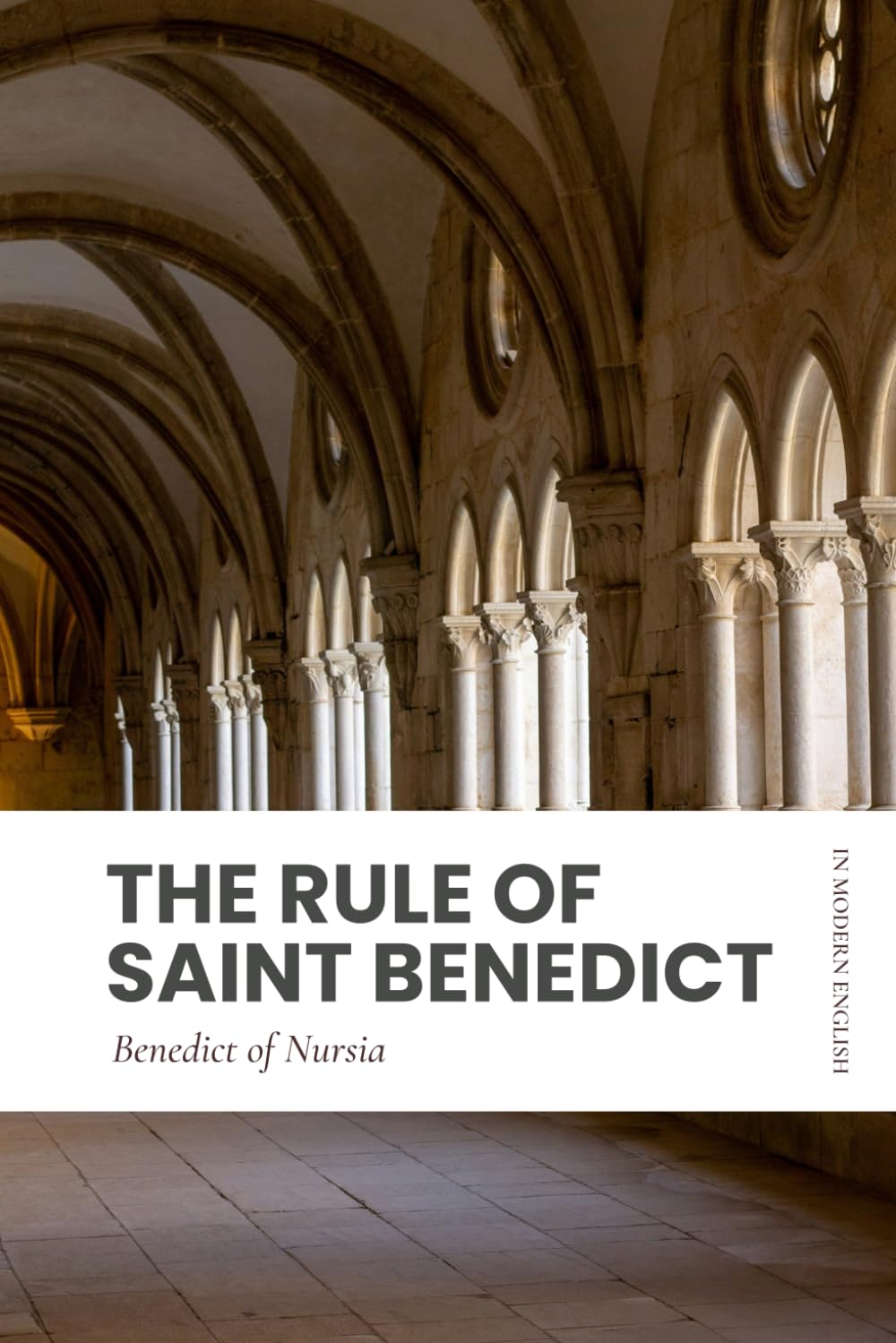



The Rule of St. Benedict (c. 540 AD) stands as one of the most influential documents in Western monasticism, providing a comprehensive guide for communal religious life that has shaped Christian spirituality for over 1500 years. Written by Benedict of Nursia for his monastery at Monte Cassino, this practical yet profound text establishes a "school for the Lord's service," balancing physical labor, spiritual reading, and communal prayer in a framework of obedience, stability, and spiritual growth. We have updated this timeless work into a modern, updated translation so you can understand exactly what Benedict wrote. At its heart, the Rule provides a detailed blueprint for monastic life centered on the principle of "ora et labora" (prayer and work). Benedict carefully structures the monastery's daily rhythm, from the Divine Office's eight prayer services to periods of manual labor, spiritual reading, and rest. The Rule is particularly notable for its moderation and flexibility, avoiding extreme asceticism while maintaining high spiritual standards. Its 73 chapters address every aspect of monastic life, from the selection of an abbot and admission of new members to practical matters of food, drink, clothing, and the distribution of goods. What distinguishes this work is Benedict's remarkable blend of spiritual wisdom with practical governance. While grounded in Scripture and earlier monastic traditions, the Rule demonstrates keen psychological insight and administrative skill. Benedict's understanding of human nature informs his approach to community life, discipline, and spiritual formation. The work is particularly valuable for its balanced approach to authority, emphasizing the abbot's responsibility to adapt rules to individual circumstances while maintaining community order. The influence of the Rule extended far beyond its original context, becoming the foundation for Western monasticism and significantly impacting European civilization. Its principles of ordered life, balanced discipline, and communal responsibility helped shape not only religious communities but also educational and administrative systems throughout medieval Europe. Modern readers continue to find in Benedict's Rule wisdom for building community, exercising leadership, and pursuing spiritual growth. About the Author Benedict of Nursia (c. 480-547 AD) was born into a noble Roman family but chose to abandon his studies and worldly pursuits for the religious life. After time as a hermit and early experiments in communal monasticism, he established a series of monasteries, culminating in the great abbey of Monte Cassino. His Rule, drawing on earlier monastic traditions but marked by distinctive wisdom and moderation, became the standard for Western monasticism. Though relatively little is known about his life outside the biography written by Pope Gregory the Great, Benedict's legacy as the father of Western monasticism and his Rule's continuing influence on Christian spirituality and community life have earned him recognition as one of the most significant figures in Christian history and the patron saint of Europe.